
Control Line: Scale
Bill Boss
Basic Tips (continued)
In last month's column I discussed problems related to building and flying a Ryan STA model built by Dave Mullens of Seattle, WA: proper installation of the wheels and wheel pants, and model tracking while taxiing. Another problem I didn't get to last month was an overheating engine on that model. I'll comment on the Ryan problem and also cover other types of planes, suggesting ways to cope with engine-cooling problems.
For the purposes of this item I will assume use of a good, steady-running, properly sized engine. A new, improperly broken-in engine can overheat under the best of circumstances. Equally important is engine sizing: using an engine that is too small for the model can create an instant overheating problem. The tendency with an undersized engine is to lean it excessively to try to gain extra revs and power to handle a too-large model. An over-lean engine runs extremely hot and can suffer serious damage. Remember, it's better to use a larger engine that can be throttled back than a smaller one that limits your power range.
Common cause of overheating
A frequent cause of overheating in scale models is the desire to hide the engine completely within the cowling, while not providing sufficient airflow over and through the cowling for proper cooling. Many builders fail to take advantage of the built-in cooling arrangements incorporated in the real plane. Study the real aircraft and use every possible opening and passage for cooling.
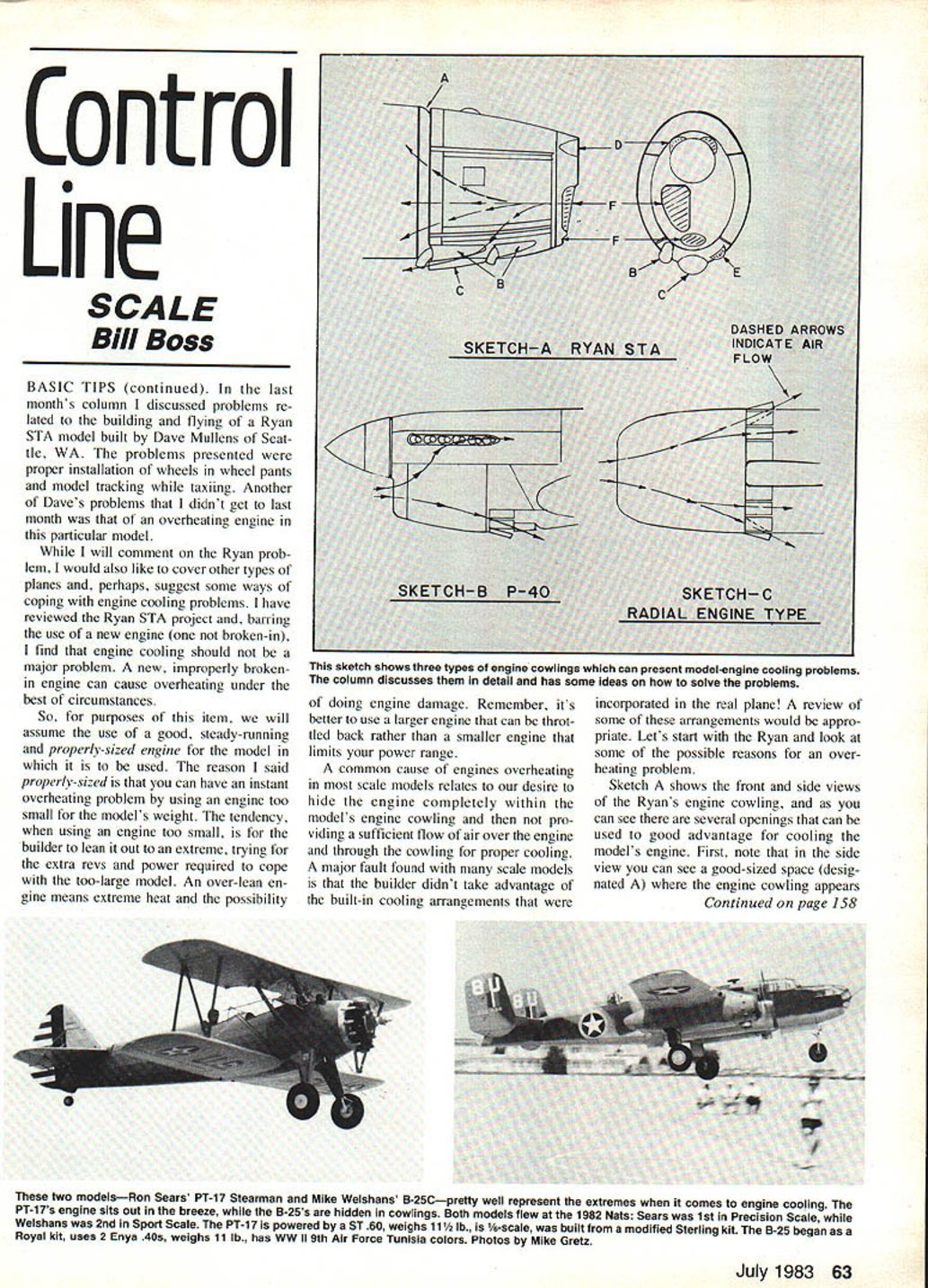
Sketch A — Ryan STA cowling (front and side views)
The Ryan's cowling shows several openings that can be used to good advantage:
- Space between the cowl and fuselage (side view, designated A) was a built-in air vent on the real airplane. Do not eliminate this gap in the model for the sake of appearance; it is a useful cooling vent and improves static fidelity.
- Cowl outlets for exhaust stacks (B).
- Main lower cooling vent (C).
- Air intakes (D, E, F).
Use all cowl inlets and outlets to their maximum for engine cooling. For example:
- Use the exhaust stack outlets for venting the model engine exhaust by installing an exhaust manifold (such as one made by Tatone) and running neoprene hose through the cowl's exhaust stack openings.
- Cut openings into the cowl for all other inlets and outlets shown on the sketch.
- Direct incoming air toward and over the engine cooling fins; if necessary, build baffles or guides to ensure airflow passes directly over the engine.
A general rule I use on my scale models: the total cowl air outlet area should be at least twice the size of the inlet area.
Note the dashed lines in the sketch represent airflow through the cowl and over the engine.
Sketches B and C — P-40 and radial-engine-type cowlings
These are further examples of cowling arrangements that can present cooling problems if not handled properly.
- For inline-engined types (Sketch B, e.g., P-40) and radial-type cowlings (Sketch C), take advantage of the cowl-flap area for engine-compartment cooling. Modify or construct the fuselage or nacelle so the area beneath the cowl-flap location is open and free of obstructions.
- Simulate open cowl flaps by cutting and bending an aluminum cowl at the proper locations, or make cowl flaps of a material appropriate for the model.
- For P-40-type models, provide additional openings in and around the dummy inline-engine exhaust stacks. Even small openings will permit a surprisingly good amount of airflow from the engine compartment.
Providing engine-cowling openings in these ways will generally permit sufficient airflow for proper engine cooling.
Final advice and features
- Study the real plane's engine-cooling details and use every possible opening when constructing your model.
- Consider installing working cowl flaps as an operational feature: they improve cooling and also score extra points for in-flight operational features.
- When in doubt about engine choice, favor a slightly larger engine you can throttle back rather than an undersized engine you will be tempted to over-lean.
Send ideas on CL Scale to Bill Boss, 77-06 269th St., New Hyde Park, NY 11040.
Transcribed from original scans by AI. Minor OCR errors may remain.

