
Control Line: Scale
Bill Boss
New FAI CL Scale rules
FAI CL Scale rules might interest builders and fliers. Entrants in the FAI CL Scale event should take particular notice — the rules changes become effective January 1, 1984. A complete listing and full explanation of the rules changes was published in the May 1983 issue of Model Aviation, Competition Newsletter section, starting page 113. In reviewing the rules changes, pay particular attention to the following:
- New static judging schedule — A key change is the elimination of the scale ruler. Distances of one and three meters will be used for static judging of the model's details such as scale accuracy, color, markings, craftsmanship and so on. This static judging procedure is similar to that used in Sport Scale.
- Proof requirements — Documentation requirements have been greatly reduced. Stringent requirements of years past have been relaxed to permit a wider variety of photos, Profile Publications, or authenticated written descriptions as acceptable proof of scale.
- Flap-operation option — An important optional change: if the flap option is chosen, the modeler must demonstrate flap operation as a completely independent function to obtain maximum points.
Flap-operation option details
The flap-option description states that flaps must be lowered on the model for takeoff if the full-scale airplane employed them for that purpose, and must remain down until at least one full lap has been completed (presumably one full airborne lap). For landing, the procedure calls for reducing model speed before flaps are lowered.
This is a significant departure from the common practice of coupling flaps to throttle control — where low throttle lowers the flaps and high throttle raises them. That coupled system does not permit the independent operation required by the new FAI rules, so those choosing the flap option will need a different method of operating the flaps.
Dale Campbell's independent flap system
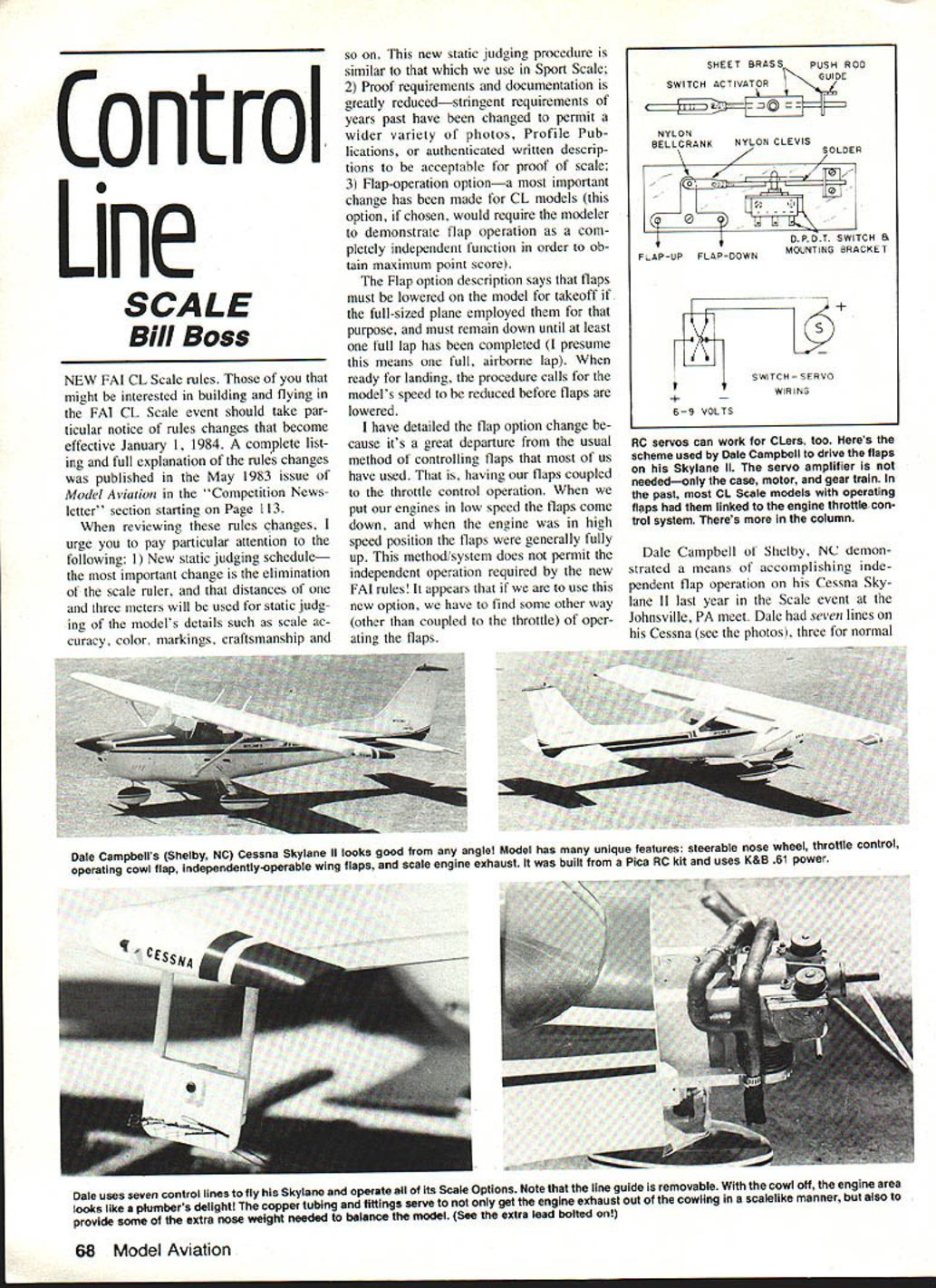
RC servos can be used by CL fliers. Dale Campbell (Shelby, NC) demonstrated an independent flap operation method on his Cessna Skylane II at the Scale event in Johnsville, PA. Dale's model used seven control lines:
- Three lines for normal throttle/elevator control.
- Two lines for controlling cowl flaps and a steerable nose wheel.
- Two lines to actuate the wing flaps.
The two lines used for the flaps were connected to a bellcrank-and-pushrod arrangement that operated a switch, which in turn operated a servo mechanism for actuating the flaps.
Construction and operation
The flap actuator unit consists of:
- A nylon bellcrank, pushrod and clevis arrangement.
- A motor and gear train taken from a standard RC servo with the electronics removed (using only the case, motor, and gear train).
- A miniature double-pole double-throw (DPDT) momentary-on switch to reverse motor direction.
- A bracket to mount the DPDT switch and motor.
- Batteries to supply six to nine volts.
Most materials to construct the unit (except the servo motor/gear train and the DPDT switch) can typically be found in hobby-stock. The DPDT momentary-on switch is available from electronics stores. Servos without the electronics are often sold as kits by RC suppliers and are usually considerably less costly than fully-equipped servos.
As wired, six to nine volts may be applied directly to the servo motor through the DPDT switch. Depending on switch position, the motor rotates in one direction or the other, bringing the flaps down with one line pull and raising them with the other. The voltage range provides varying speeds of operation and good torque. Battery options include AA or AAA cells in series to achieve the required voltage or a 9-volt transistor-radio type battery.
In Dale's Cessna the entire unit and batteries were installed in the plane. No dimensions are shown in the sketch because component sizes and layout will vary by builder.
Caution
Because the system relies on the servo's built-in mechanical stops rather than limit-switch circuitry, it is imperative that the linkage travel between the servo and the flap is properly set. When the servo is against one mechanical stop, the flap should be at its maximum position; when the servo is against the other stop, the flap should be at its opposite maximum. Improper linkage travel can overstress the motor or linkage.
Other uses
Although described for flaps, the unit might also be used to operate a sliding canopy, cooler doors, cowl flaps, or other scale functions you might devise.
Smithsonian Programs
The Smithsonian Institution will be offering two unique programs in October of this year. The first program, "World War I Aviation: Knights of the Air," will be offered October 16–21, 1983. This program will consist of a series of lectures and tours of the museum and restoration facility at Silver Hill (MD). Speakers, all experts in their fields, will focus on the excitement and adventure of the first air war, as well as the tragic problems of limitation and use of aviation during those years.
The second program will be entitled "Aircraft Restoration: How To" and will be
Contact
Send items to Bill Boss, 77-06 269th St., New Hyde Park, NY 11040.
Transcribed from original scans by AI. Minor OCR errors may remain.

