
Control Line: Scale
Bill Boss
JET SCALE is one form of scale modeling that has all but disappeared from the scene. I am, of course, referring to the use of jet-type engines such as the Dyna Jet, rather than the reciprocating-engine-driven fan units used in today's scale jet models. In the late 1950s and early 1960s, when all you had to do in competition was complete 10 airborne laps (no flight points were awarded and the CL Scale rules were only one page in the rule book), jet-type models were seen in many of our CL Scale competitions. Expansion of the rules, more use of operating features, and the need for throttle-control performance made jet scale models less desirable in competition.
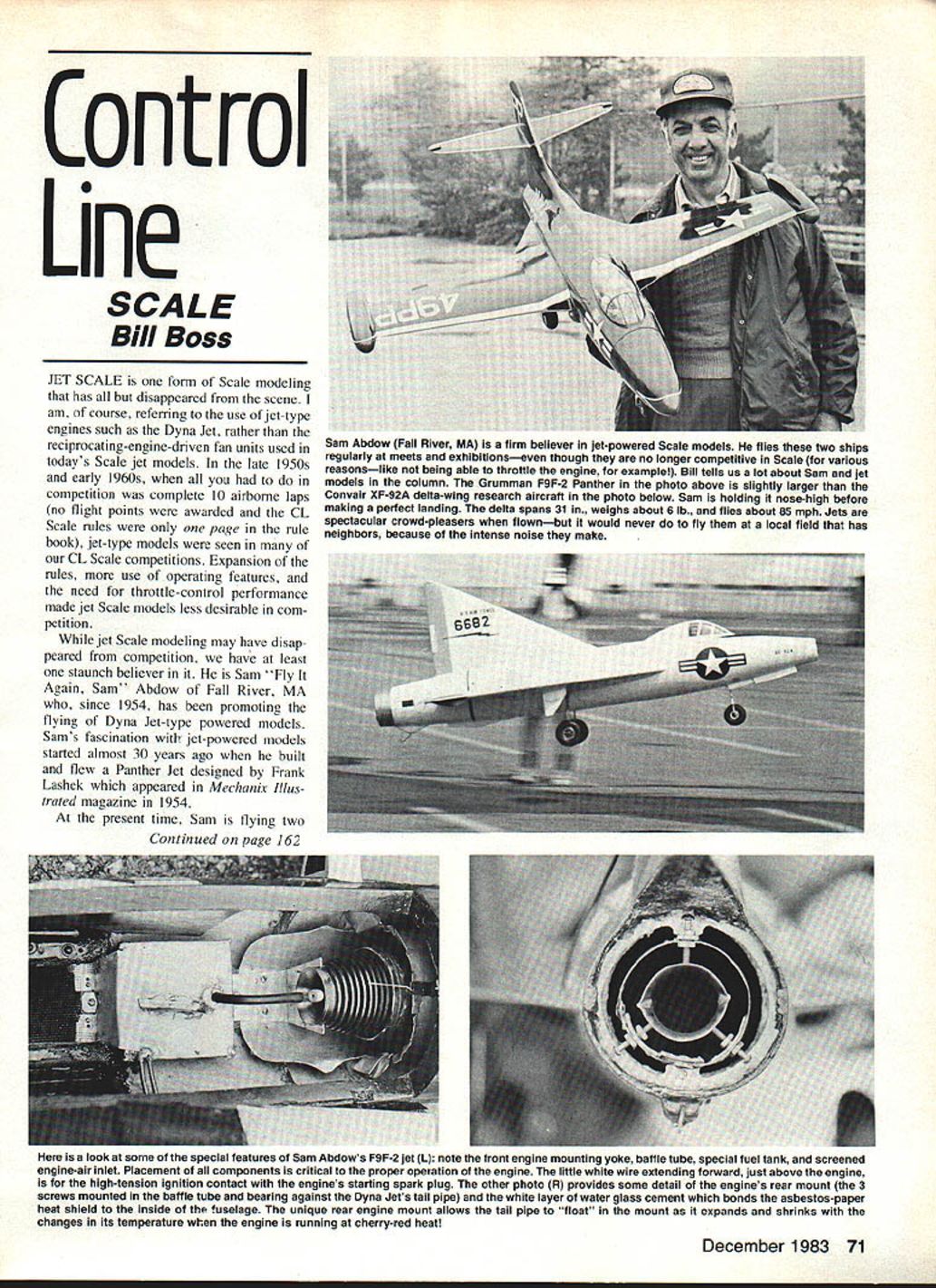
While jet scale modeling may have disappeared from competition, we have at least one staunch believer in it. He is Sam "Fly It Again, Sam" Abdow of Fall River, MA, who since 1954 has been promoting the flying of Dyna Jet–type powered models. Sam's fascination with jet-powered models started almost 30 years ago when he built and flew a Panther Jet designed by Frank Lashek which appeared in Mechanix Illustrated magazine in 1954.
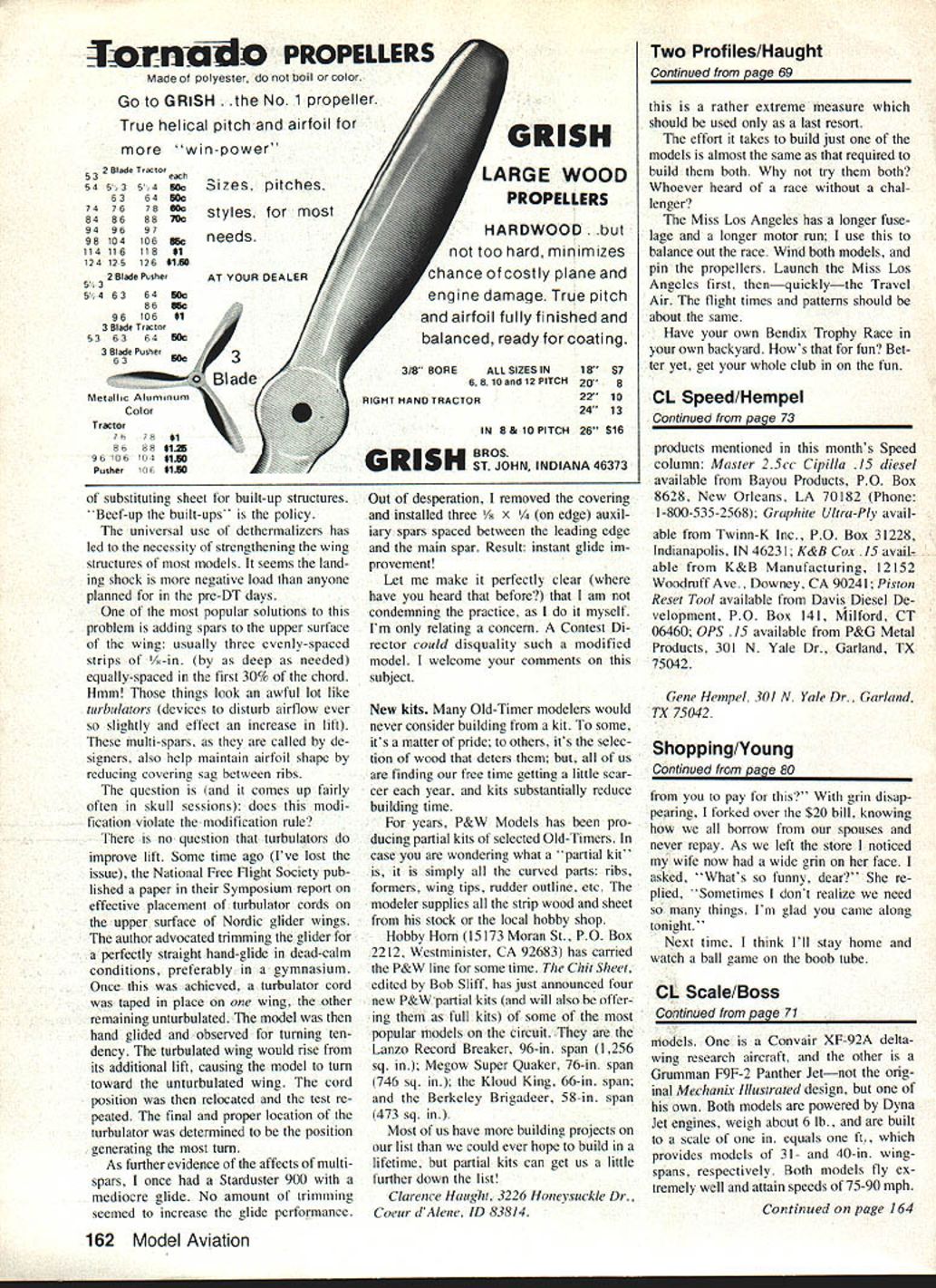
At the present time, Sam is flying two models. One is a Convair XF-92A delta-wing research aircraft, and the other is a Grumman F9F-2 Panther Jet — not the original Mechanix Illustrated design, but one of his own. Both models are powered by Dyna Jet engines, weigh about 6 lb., and are built to a scale of one inch equals one foot, which provides models of 31- and 40-inch wingspans, respectively. Both models fly extremely well and attain speeds of 75–90 mph.
While there is no scale competition category that Sam can effectively enter with his jets, he always seems to have one or both models on hand for demonstration purposes at the meets and modeling shows he attends. In addition to demonstrations at local meets, Sam has flown his jets at such events as the 1974 Aerolympics at Lakehurst, N.J., this year's Nats at Westover AFB, Chicopee, MA, and in AMA's "Grand Illusion" film. Seeing one of these models airborne with its flaming tail and bellowing jet sound is a sight that is always a tremendous crowd-pleaser.
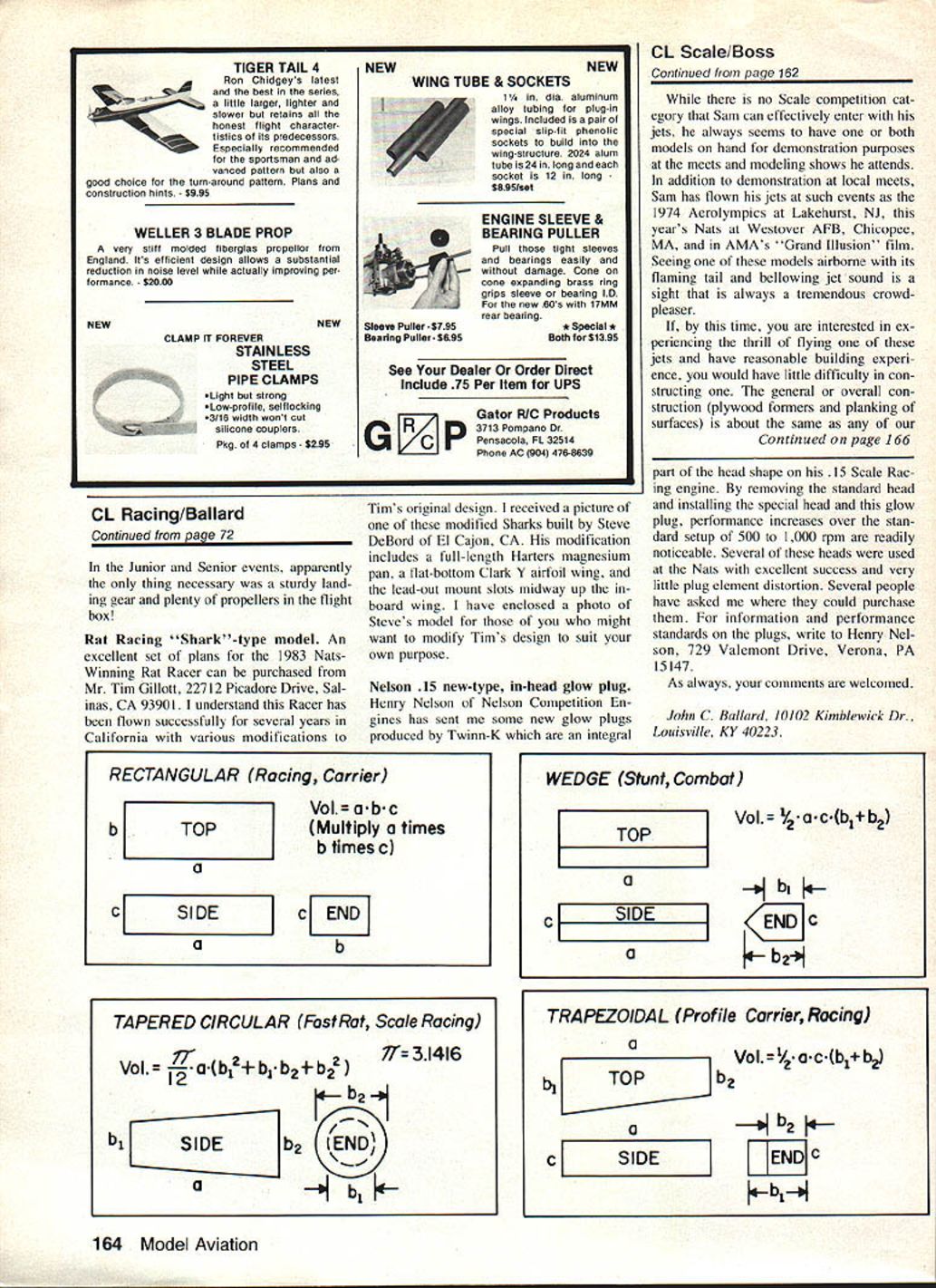
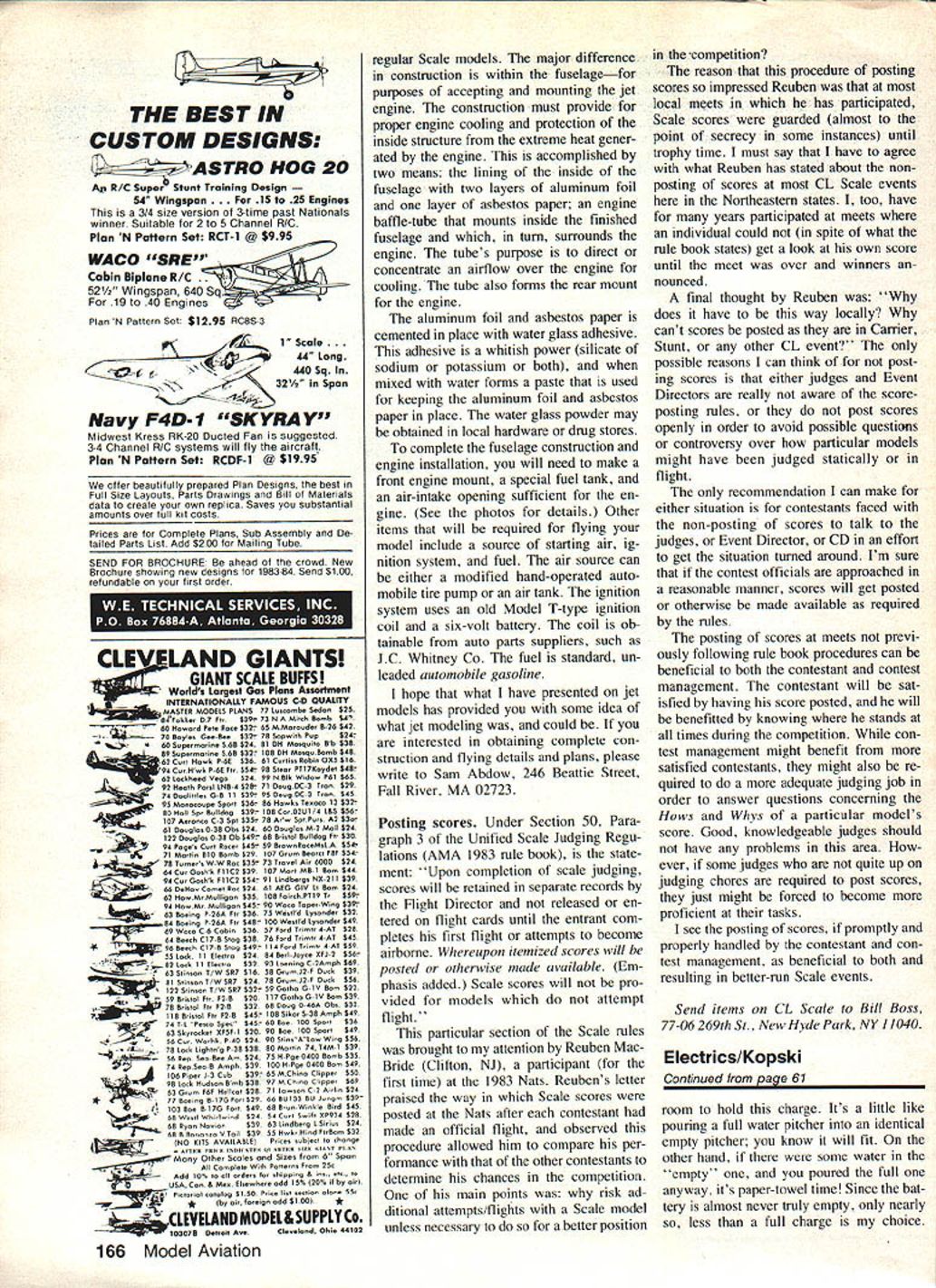
If, by this time, you are interested in experiencing the thrill of flying one of these jets and have reasonable building experience, you would have little difficulty constructing one. The general construction (plywood formers and planking of surfaces) is about the same as any of our regular scale models. The major difference in construction is within the fuselage—for purposes of accepting and mounting the jet engine. The construction must provide for proper engine cooling and protection of the inside structure from the extreme heat generated by the engine. This is accomplished by two means: lining the inside of the fuselage with two layers of aluminum foil and one layer of asbestos paper, and by an engine baffle-tube that mounts inside the finished fuselage and which, in turn, surrounds the engine. The tube's purpose is to direct or concentrate an airflow over the engine for cooling. The tube also forms the rear mount for the engine.
The aluminum foil and asbestos paper are cemented in place with water glass adhesive. This adhesive is a whitish powder (silicate of sodium, potassium, or both), and when mixed with water forms a paste that is used for keeping the aluminum foil and asbestos paper in place. The water glass powder may be obtained in local hardware or drug stores.
To complete the fuselage construction and engine installation, you will need to make a front engine mount, a special fuel tank, and an air-intake opening sufficient for the engine (see the photos for details). Other items that will be required for flying your model include:
- a source of starting air (either a modified hand-operated automobile tire pump or an air tank),
- an ignition system (an old Model T–type ignition coil and a six-volt battery; the coil is obtainable from auto parts suppliers such as J.C. Whitney Co.),
- fuel (standard unleaded automobile gasoline).
I hope that what I have presented on jet models has provided you with some idea as to what jet modeling was, and could be. If you are interested in obtaining complete construction and flying details and plans, please write to Sam Abdow, 246 Beattie Street, Fall River, MA 02723.
Posting scores
Under Section 50, Paragraph 3 of the United Scale Judging Regulations (AMA 1983 rule book) is the statement: "Upon completion of scale judging scores will be retained in separate records by the Flight Director and not released or entered on flight cards until the entrant completes his first flight or attempts to become airborne. Whereupon itemized scores will be posted or otherwise made available. (Emphasis added.) Scale scores will not be provided for models which do not attempt flight."
This particular section of the Scale rules was brought to my attention by Reuben MacBride (Clifton, NJ), a participant (for the first time) at the 1983 Nats. Reuben's letter praised the way in which scale scores were posted at the Nats after each contestant had made an official flight, and observed this procedure allowed him to compare his performance with that of the other contestants to determine his chances in the competition. One of his main points was: why risk additional attempts/flights with a scale model unless necessary to do so for a better position in the competition?
The reason this procedure of posting scores so impressed Reuben was that at most local meets in which he has participated, scale scores were guarded (almost to the point of secrecy in some instances) until trophy time. I must say that I have to agree with what Reuben has stated about the non-posting of scores at most CL scale events here in the Northeastern states. I, too, have for many years participated at meets where an individual could not (in spite of what the rule book states) get a look at his own score until the meet was over and winners announced.
A final thought by Reuben was: "Why does it have to be this way locally? Why can't scores be posted as they are in Carrier, Stunt, or any other CL event?" The only possible reasons I can think of for not posting scores are:
- Judges and Event Directors are really not aware of the score-posting rules, or
- Scores are not posted openly in order to avoid possible questions or controversy over how particular models might have been judged statically or in flight.
The only recommendation I can make for either situation is for contestants faced with the non-posting of scores to talk to the judges, Event Director, or CD in an effort to get the situation turned around. I'm sure that if the contest officials are approached in a reasonable manner, scores will get posted or otherwise be made available as required by the rules.
The posting of scores at meets not previously following rule book procedures can be beneficial to both the contestant and contest management. The contestant will be satisfied by having his score posted, and he will be benefited by knowing where he stands at all times during the competition. While contest management might benefit from more satisfied contestants, they might also be required to do a more adequate judging job in order to answer questions concerning the hows and whys of a particular model's score. Good, knowledgeable judges should not have any problems in this area. However, if some judges who are not quite up on judging chores are required to post scores, they just might be forced to become more proficient at their tasks.
I see the posting of scores, if promptly and properly handled by the contestant and contest management, as beneficial to both and resulting in better-run scale events.
Send items on CL Scale to Bill Boss, 77-06 269th St., New Hyde Park, NY 11040.
Transcribed from original scans by AI. Minor OCR errors may remain.

