
Control Line: Scale
By Bill Boss
One man's point of view — the following item was taken from the Dayton (Ohio) Buzzards MFC Newsletter, and is an editorial comment by Les Byrd on his observations of our recent FAI CL Scale Team Selection contest at Louisville, KY, August 12–14, 1983. While Les' commentary is not the kind that is likely to be accepted by all, I do feel that we should know how others sometimes see us in our event. Les also indicated in a note to me that the commentary is not just a potshot at our Scale efforts, but he hoped it would be taken by all as constructive criticism.
Les Byrd's commentary
"I've done a lot of spectating this year, and just had to go and watch the FAI Team selection contest. The event was well-attended, with most aircraft displaying superior craftsmanship. I thought, 'Oh boy, this is going to be great.'
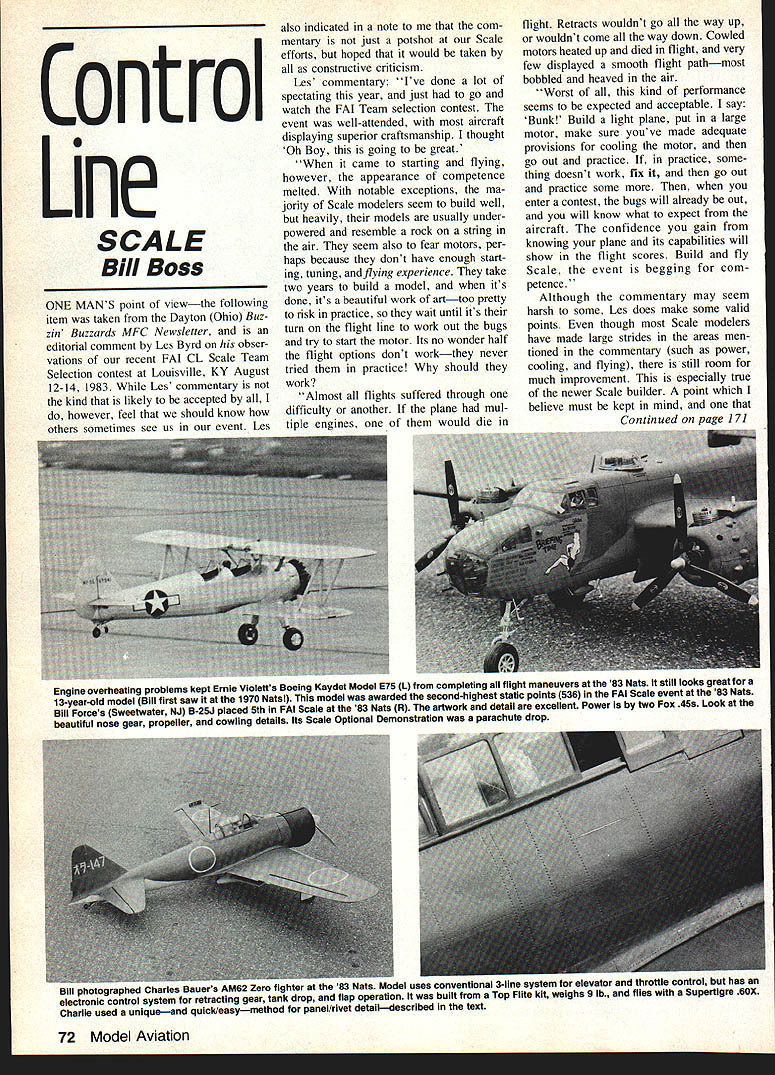
"When it came to starting and flying, however, the appearance of competence melted. With notable exceptions, the majority of Scale modelers seem to build well, but heavily; their models are usually underpowered and resemble a rock on a string in the air. They seem also to fear motors, perhaps because they don't have enough starting, tuning, and flying experience. They take two years to build a model, and when it's done, it's a beautiful work of art—too pretty to risk in practice, so they wait until it's their turn on the flight line to work out the bugs and try to start the motor. It's no wonder half the flight options don't work—they never tried them in practice! Why should they work?
"Almost all flights suffered through one difficulty or another. If the plane had multiple engines, one of them would die in flight. Retracts wouldn't go all the way up, or wouldn't come all the way down. Cowled motors heated up and died in flight, and very few displayed a smooth flight path—most bobbled and heaved in the air.
"Worst of all, this kind of performance seems to be expected and acceptable. I say: 'Bunk!' Build a light plane, put in a large motor, make sure you've made adequate provisions for cooling the motor, and then go out and practice. If, in practice, something doesn't work, fix it, and then go out and practice some more. Then, when you enter a contest, the bugs will already be out, and you will know what to expect from the aircraft. The confidence you gain from knowing your plane and its capabilities will show in the flight scores. Build and fly Scale; the event is begging for competence."
Editor's response
Although the commentary may seem harsh to some, Les does make valid points. Even though most Scale modelers have made large strides in the areas mentioned (such as power, cooling, and flying), there is still room for much improvement—especially among newer Scale builders. A point that probably contributed to Les' observations is that the team selection contest was open to all for entry. It did not matter if one was a beginner or an expert; under these circumstances, you would no doubt see some unskilled modelers and the problems discussed in the commentary.
All of this brings to mind some basic questions:
- Is it right to have a completely open competition for our World Championship team selection?
- Should entry be by invitation, based on past performance at local and national contests?
- Should a team selection program result in a showcase event where only the very best compete?
If you have any thoughts on the matter, drop me a line or write to the National Association of Scale Aeromodelers (NASA), c/o John Guenther, President, Box 714, RR #1, Borden, IN 47106. I'm sure your comments would be well received and could help NASA in planning future Scale team selection programs.
Before closing, it should be noted that NASA sponsored and ran this year's Scale team selection program (for the first time) as a completely independent function from AMA. While I was not at the event, reports indicate that NASA and the local Louisville clubs did an excellent job. Congratulations to all.
Finishing made easy
Charles Bauer, Northridge, IL, tells us that by following a few simple steps you can greatly reduce the effort required to finish a Sport Scale model. Charles' method for painting an A6M2 Zero (seen at the 1983 Nats) had a considerable amount of rivet and skin-panel detail—a finish most modelers should be able to produce quite easily.
Rather than using extensive filler and paint to obtain a good finish, Charles did minor grain-filling and then applied chrome MonoKote covering per the covering material instructions. After the MonoKote covering was completed, skin-panel outlines and rivet patterns were very lightly applied.
Steps Charles used:
- Score the covering for skin-panel outlines with a fine ball-point pen or similar rounded object. Care should be taken not to cut through the covering. Use a flexible plastic ruler as a straightedge to follow curves and keep score lines straight.
- Make rivet markings by lightly pressing a dressmaker's pattern tracing wheel into the MonoKote surface. The right pressure (determined by experimenting on test pieces) produces indentations that look like flush rivets when viewed from a distance.
- Use a soft lead pencil with the wheel held against it to produce straight lines of rivets.
- Rub the covering lightly with fine steel wool. This provides a finely scratched surface for better adherence of an epoxy-paint finish.
- Paint with a suitable system (Charles used K&B's Superkote Matched Finish System paints).
The pattern tracing wheel is about one inch in diameter, has teeth similar to a gear, and is usually mounted in a small plastic handle. It is sold in sewing-supply stores; wheels with varying numbers of teeth are available for different rivet spacings.
Another advantage of chrome MonoKote is that, if you decide to weather the model, the aluminum color shows through in heavily worn areas. If you're deciding how to finish your next Sport Scale model, you might try Charles Bauer's time-saving approach.
Something new
A new version of the three-line bellcrank will be available from L-R Products, Ltd. This new bellcrank is a "short-span" type (approximately 2-1/2 in. between elevator line connection points) and is of the same heavy-duty construction as the original G-S units. The major difference between these and the original G-S units is the location of the elevator pushrod connection, which is the same as the old Roberts unit. This new design allows the unit to be used in a much smaller space than the larger G-S units, and is therefore suitable for use in smaller Scale models. The new L-R units come in right and inverted mounting versions and are now being supplied to the trade.
If you're looking for the larger G-S units for a large Scale model, they can also be obtained from L-R Products, Ltd. For a data and cost sheet on all bellcranks and control handles now available, write to L-R Products Ltd., 77-87 Archdale Ave., Detroit, MI 48228.
Bill Boss 77-06 269th St. New Hyde Park, NY 11040
Transcribed from original scans by AI. Minor OCR errors may remain.

