
Control Line: Scale
Mike Stott
SINCE MY LAST month's article, I've been hearing more and more about the Scale Speed proposals. As you may have already heard, the FAI passed a new rule that goes into effect immediately, that includes a definite emphasis on the scale speed of the model aircraft in flight.
I've heard pros and cons on the Scale Speed subject and some people have expressed a desire for AMA to adopt this in their rules for judging.
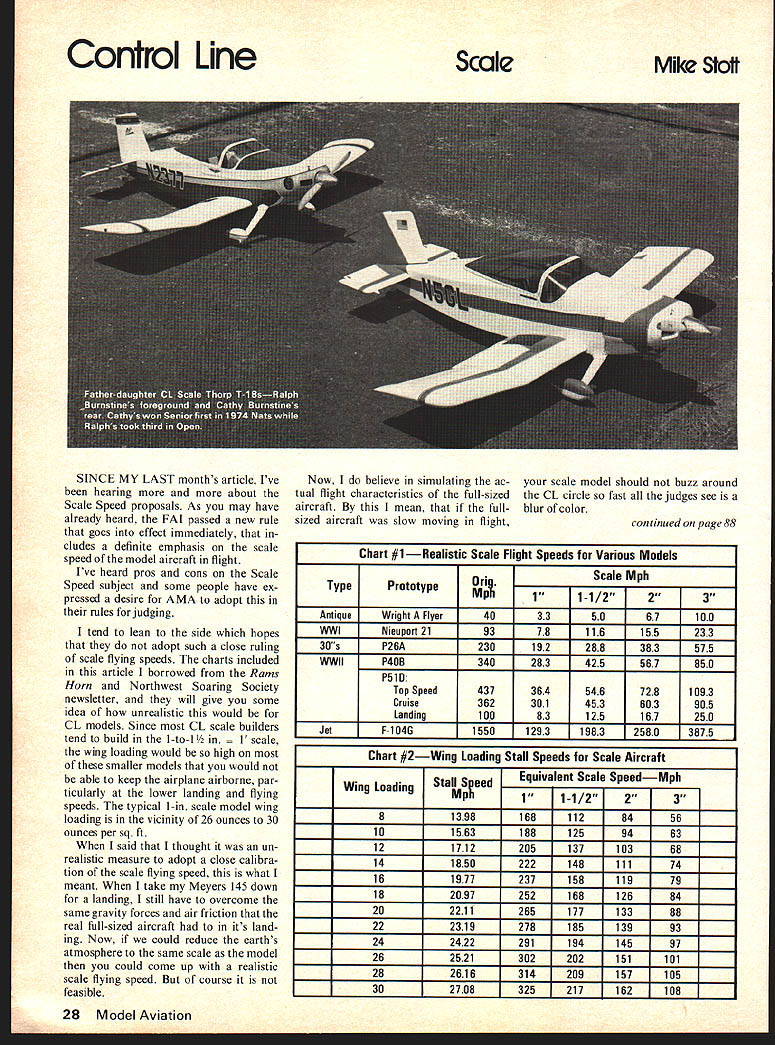
I tend to lean to the side which hopes that they do not adopt such a close ruling of scale flying speeds. The charts included in this article I borrowed from the Rams Horn and Northwest Soaring Society newsletter, and they will give you some idea of how unrealistic this would be for CL models. Since most CL scale builders tend to build in the 1- to 1-1/2 in. = 1' scale, the wing loading would be so high on most of these smaller models that you would not be able to keep the airplane airborne, particularly at the lower landing and flying speeds. The typical 1-in. scale model wing loading is in the vicinity of 26 ounces to 30 ounces per sq. ft.
When I said that I thought it was an unrealistic measure to adopt a close calibration of the scale flying speed, this is what I meant. When I take my Meyers 145 down for a landing I still have to overcome the same gravity forces and air friction that the real full-sized aircraft had to in its landing. Now, if we could reduce the earth's atmosphere to the same scale as the model then you could come up with a realistic scale flying speed. But of course it is not feasible.
Now, I do believe in simulating the actual flight characteristics of the full-sized aircraft. By this I mean, that if the full-sized aircraft was slow moving in flight, your scale model should not buzz around the CL circle so fast all the judges see is a blur of color.
Chart #1 — Realistic Scale Flight Speeds for Various Models
Type / Prototype / Orig. Mph / Scale Mph (1" / 1-1/2" / 2" / 3") Antique — Wright A Flyer / 40 / 3.3 / 5.0 / 6.7 / 10.0 WWI — Nieuport 21 / 93 / 7.8 / 11.6 / 15.5 / 23.3 30's — P26A / 230 / 19.2 / 28.8 / 38.3 / 57.5 WWII — P40B / 340 / 28.3 / 42.5 / 56.7 / 85.0 P51D — Top Speed / 437 / 36.4 / 54.6 / 72.8 / 109.3 P51D — Cruise / 362 / 30.1 / 45.3 / 60.3 / 90.5 P51D — Landing / 100 / 8.3 / 12.5 / 16.7 / 25.0 Jet — F-104G / 1550 / 129.3 / 198.3 / 258.0 / 387.5
Chart #2 — Wing Loading Stall Speeds for Scale Aircraft
Wing Loading / Stall Speed Mph / Equivalent Scale Speed — Mph (1" / 1-1/2" / 2" / 3") 8 / 13.98 / 168 / 112 / 84 / 56 10 / 15.63 / 188 / 125 / 94 / 63 12 / 17.12 / 205 / 137 / 103 / 68 14 / 18.50 / 222 / 148 / 111 / 74 16 / 19.77 / 237 / 158 / 119 / 79 18 / 20.97 / 252 / 168 / 126 / 84 20 / 22.11 / 265 / 177 / 133 / 88 22 / 23.19 / 278 / 185 / 139 / 93 24 / 24.22 / 291 / 194 / 145 / 97 26 / 25.21 / 302 / 202 / 151 / 101 28 / 26.16 / 314 / 209 / 157 / 105 30 / 27.08 / 325 / 217 / 162 / 108
CL Scale/Stott continued from page 28
If a strict calibration of scale speeds was ever adopted by the AMA, we would find we would have to build larger models of full-sized aircraft that flew at a higher rate of speed. And we would have to build them lighter to achieve a lighter wing loading. Lighter wing loadings will allow you to fly at a slower speed without stalling. (See Chart #2.)
With the fact in mind that we would be limited to larger, lighter planes that flew at a comparatively good speed, I feel we would be then taking a step backwards again restricting selection of your model down to one certain type of aircraft.
In January of this year some new rules that I proposed went into effect concerning the judging of scale models. (Check my column in your January-1976 issue of Model Aviation for a complete list of the rule changes.) These rules leveled out the points given for flying and static judging. The purpose of this was to give every type of aircraft an equal chance in competition. Quality, not quantity of options should be the basic fundamental in choosing the best scale model. This could also mean that the J-3 Cub has just as good an opportunity in competing as the larger 4-engine bomber. If AMA would decide to accept a proposal with a slight emphasis on the actual scale flying speeds we would be backing up again by limiting the field of selection for our scale models. In some cases we would be eliminating altogether the planes of earlier eras and many of the classics.
(My address is: 118 East Wheeler St., North Mankato, MN 56001.)
Transcribed from original scans by AI. Minor OCR errors may remain.

