
Control Line: Scale
Bill Boss
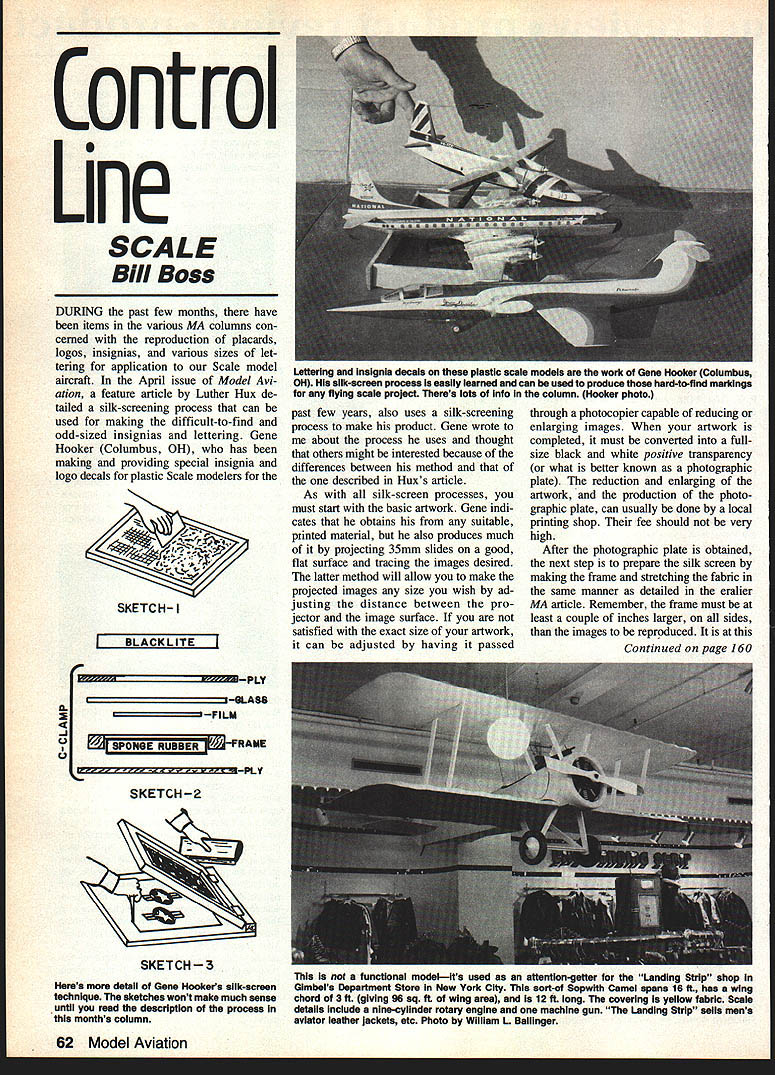
During the past few months, there have been items in the various Model Aviation columns concerned with the reproduction of placards, logos, insignias, and various sizes of lettering for application to our scale model aircraft. In the April issue of Model Aviation, a feature article by Luther Hux detailed a silk-screening process that can be used for making the difficult-to-find and odd-sized insignias and lettering. Gene Hooker (Columbus, OH), who has been making and providing special insignia and logo decals for plastic scale modelers for the past few years, also uses a silk-screening process to make his product. Gene wrote to me about the process he uses and thought that others might be interested because of the differences between his method and that described in Hux's article.
Artwork preparation
As with all silk-screen processes, start with the basic artwork. Gene indicates that he obtains his from any suitable printed material, but he also produces much of it by projecting 35 mm slides on a good, flat surface and tracing the images desired. This method allows you to make the projected images any size you wish by adjusting the distance between the projector and the image surface.
If you are not satisfied with the exact size of your artwork, it can be adjusted by having it passed through a photocopier capable of reducing or enlarging images. When your artwork is completed, it must be converted into a full-size black-and-white positive transparency (a photographic plate). The reduction/enlarging of the artwork and the production of the photographic plate can usually be done by a local printing shop for a modest fee.
Screen preparation (difference from Ulano system)
After the photographic plate is obtained, prepare the silk screen by making the frame and stretching the fabric in the same manner as detailed in the earlier Model Aviation article. Remember: the frame must be at least a couple of inches larger on all sides than the images to be reproduced.
Gene Hooker's method differs from Luther Hux’s in the way the photo emulsion is applied. Instead of using the Ulano system, where the light-sensitive emulsion is on a separate film sheet, Gene uses a liquid light-sensitive emulsion applied directly to the silk-screen fabric.
- Fabric: 305-mesh, monofilament material.
- Apply the emulsion as a good, even coat to the screen.
- Set the coated screen aside in darkness to air- or fan-dry thoroughly.
Exposure assembly and exposure
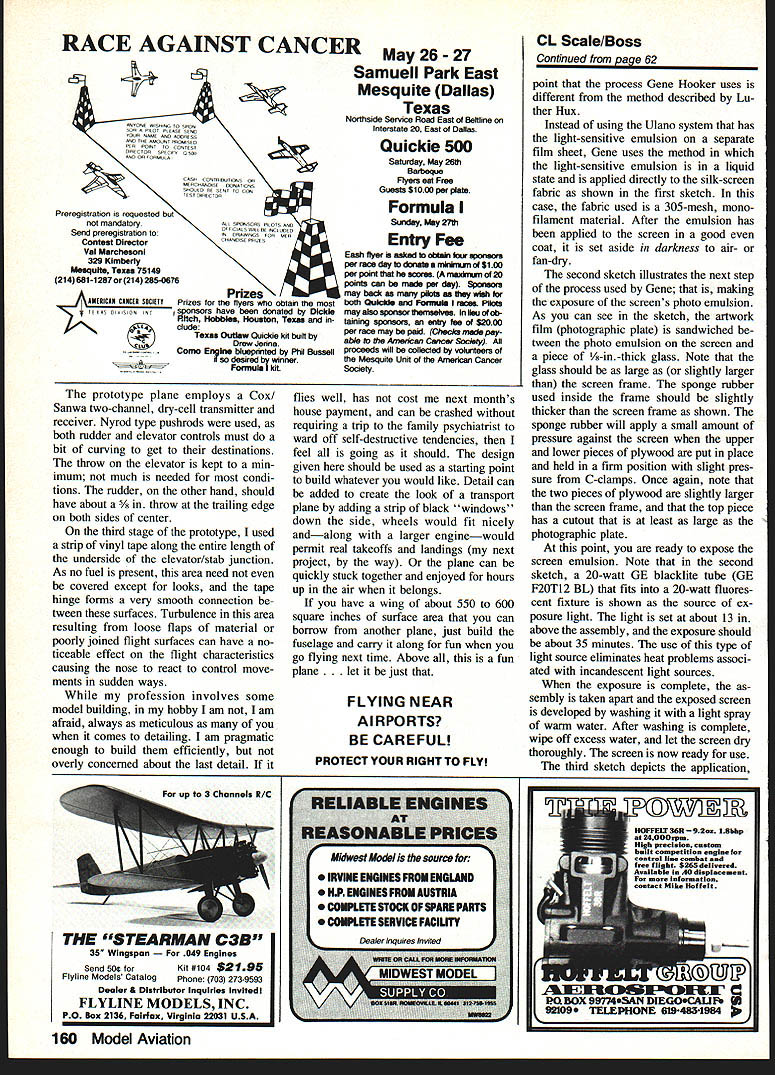
The next step is to make the exposure of the screen's photo emulsion. Gene's assembly uses the following components and arrangement:
- Place the artwork film (photographic plate) on the dried emulsion side of the screen.
- Lay a piece of 1/8 in.-thick glass over the photographic plate. The glass should be as large as (or slightly larger than) the screen frame.
- Use sponge rubber inside the frame; it should be slightly thicker than the screen frame. The sponge rubber will apply a small amount of pressure against the screen when the top and bottom plywood assemblies are clamped.
- Two pieces of plywood are used to sandwich the assembly; they should be slightly larger than the screen frame. The top piece of plywood should have a cutout at least as large as the photographic plate so the light can pass through.
For the ultraviolet light source, Gene uses a 20-watt GE blacklight tube (GE F20T12 BL) that fits into a 20-watt fluorescent fixture.
- Position the light about 13 in. above the assembly.
- Exposure time: about 35 minutes.
- Using this type of light source eliminates heat problems associated with incandescent light sources.
Developing the screen
When the exposure is complete:
- Take the assembly apart.
- Develop the exposed screen by washing it with a light spray of warm water.
- After washing, wipe off excess water and let the screen dry thoroughly.
The screen is now ready for use.
Printing decals (application of ink)
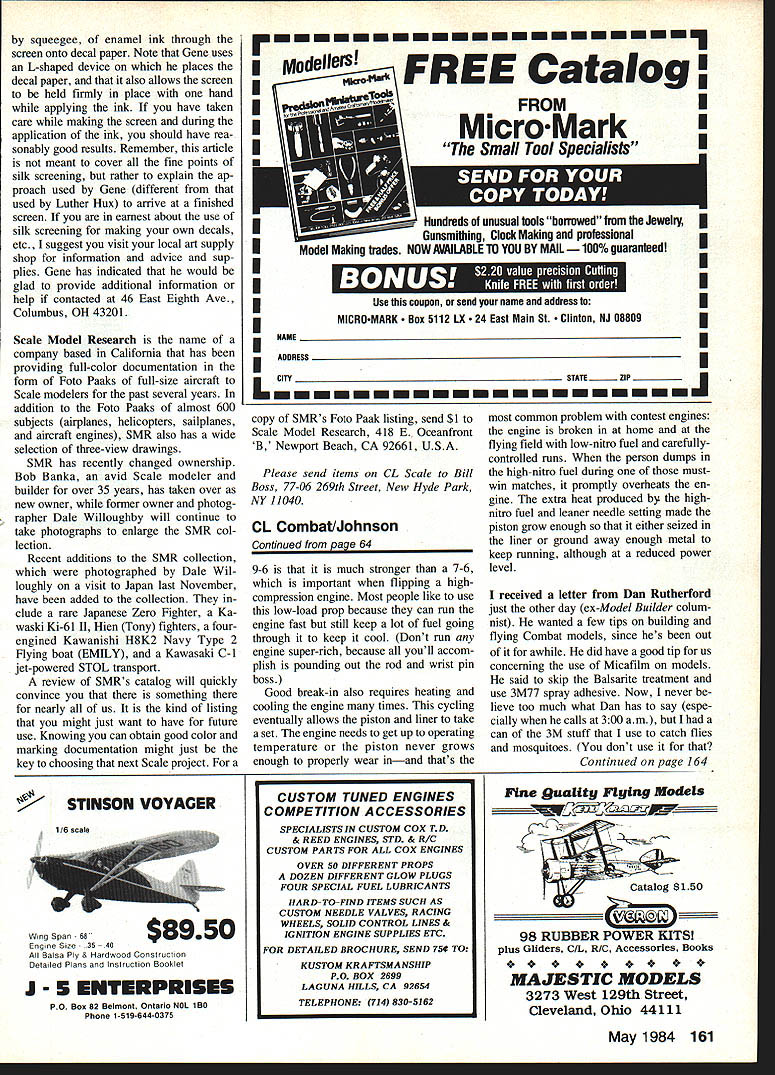
The actual application of enamel ink through the screen onto decal paper is done by squeegee. Gene uses an L-shaped device on which he places the decal paper; this device also allows the screen to be held firmly in place with one hand while applying the ink.
- If you have taken care while making the screen and during ink application, you should achieve reasonably good results.
- This article is not intended to cover all the fine points of silk screening, but rather to explain Gene's approach (which differs from Luther Hux's) to arrive at a finished screen.
If you are serious about silk screening for making your own decals, visit your local art supply shop for information, advice, and supplies. Gene has indicated he would be glad to provide additional information or help; he can be contacted at:
46 East Eighth Ave. Columbus, OH 43201
Scale Model Research (SMR) update
Scale Model Research is a company based in California that has been providing full-color documentation in the form of Foto Paaks of full-size aircraft to scale modelers for several years. In addition to Foto Paaks of almost 600 subjects (airplanes, helicopters, sailplanes, and aircraft engines), SMR also has a wide selection of three-view drawings.
SMR has recently changed ownership. Bob Kanka, an avid scale modeler and builder for over 35 years, is the new owner. Former owner and photographer Dale Willoughby will continue to take photographs to enlarge the SMR collection.
Recent additions to the SMR collection, photographed by Dale Willoughby on a visit to Japan last November, include:
- A rare Japanese Zero fighter
- Kawasaki Ki-61 II Hien (Tony) fighters
- A four-engined Kawanishi H8K2 Navy Type 2 Flying Boat (Emily)
- A Kawasaki C1 jet-powered STOL transport
A review of SMR’s catalog will quickly convince you there is something for nearly all modelers. Knowing you can obtain good color and marking documentation might help you choose your next scale project. For a copy of SMR’s Foto Paak listing, send $1 to:
Scale Model Research 418 E. Oceanfront Blvd. Newport Beach, CA 92661 U.S.A.
Please send items for CL Scale to:
Bill Boss 77-06 269th Street New Hyde Park, NY 11040
Transcribed from original scans by AI. Minor OCR errors may remain.

