
Control Line: Scale
Bill Boss
VENERABLE. In my last column, I presented information on a method of making and applying pinked rib-tapes to your fabric-covered model. I would like to continue with the vintage theme this month and talk about the use of camouflage fabric covering (known as Lozenge Pattern Fabric) as used by Germany during World War I. As in last month's column, I again have taken the information on the pattern fabric from an old Chicago Scalemasters Newsletter. Keith Ward (who was the editor of the newsletter) presented the basic material.
Lozenge Pattern Fabric (World War I Germany)
When the war started in 1914, aircraft of the fighting powers were usually finished in varnished, bleached linen. Very soon, it became apparent that some form of camouflage was desirable to prevent attack while on the ground and in the air. Early in 1916, German aircraft appeared sporting hand-painted camouflage schemes consisting of blotches of dark green and mauve or streaky dark green dope over light blue fabric. In an effort to reduce the weight of the painted camouflage in the days when powered flight, alone, was a remarkable achievement (not to mention combat in overweight, underpowered aircraft), the German Air Ministry issued directives in April 1917 to correct this problem by introducing pre-painted camouflage fabric in two different patterns and color combinations.
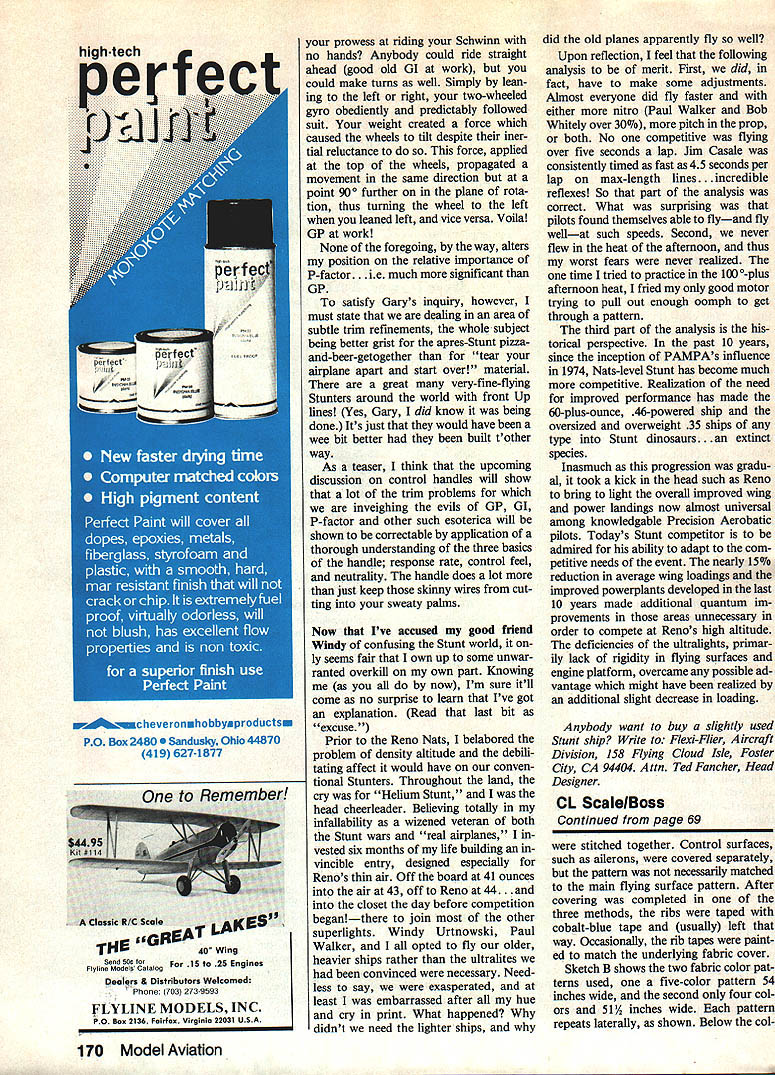
The darker of each pattern was designated as the upper-surface color, and the lighter pattern as the undersurface; however, as might be expected, examples turned up covered entirely in either light or dark fabric. The fabric was printed in continuous rolls, in much the same manner as wallpaper, the same pattern repeating as shown in the accompanying sketches.
Pattern Application
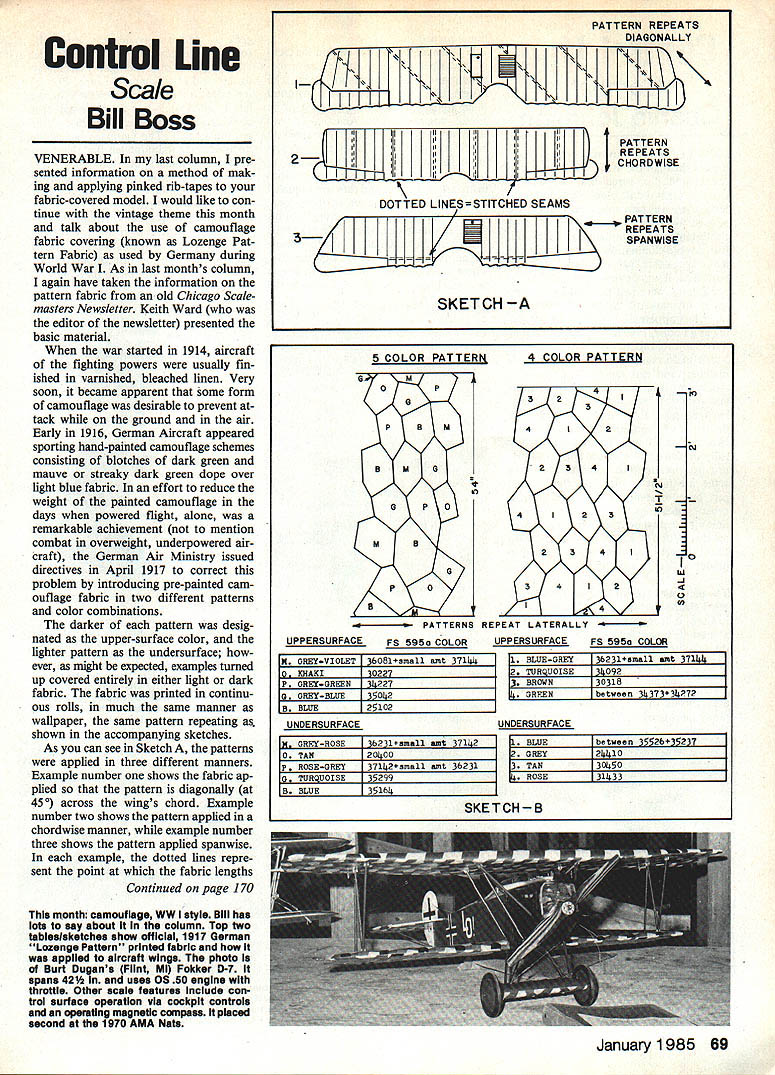
As shown in Sketch A, the patterns were applied in three different manners:
- Example 1: The fabric applied so that the pattern is diagonal (at 45°) across the wing chord.
- Example 2: The fabric applied in a chordwise manner.
- Example 3: The fabric applied spanwise.
In each example, the dotted lines represent the point at which the fabric lengths were stitched together. Control surfaces, such as ailerons, were covered separately, but the pattern was not necessarily matched to the main flying surface pattern. After covering was completed in one of the three methods, the ribs were taped with cobalt-blue tape and (usually) left that way. Occasionally, the rib tapes were painted to match the underlying fabric color.
Sketch B shows the two fabric color patterns in use: one a five-color pattern 54 inches wide, and the second a four-color pattern 51½ inches wide. Each pattern repeats laterally, as shown.
References
References used for the information presented include:
- Munsell Book of Color, Standard Edition, 1929
- PMS-UK Magazine, October 1966 and April 1968
- Peter Gray, Scale Models, December 1969
- IPMS Quarterly, January 1971
- H. Kligman
- Federal Standard color FS-595a
Federal Standard (FS 595a) Overview
During the preceding presentation, reference was made several times to FS 595a color numbers. For those who are not familiar with Federal Standard color numbering, FS 595a numbers are assigned to paint colors by the Standardization Division, Federal Supply Service, General Services Administration, Washington, D.C. The basic purpose of the standard is to provide all governmental departments with a convenient reference for procurement, inspection, and other color-matching purposes.
The reference is about 35 pages long, is provided in three-ring, loose-leaf binder format, and contains approximately 440 color chips which are 1/4 x 1 inch in size. The color chips are presented in nine broad color categories:
- Brown
- Red
- Orange
- Yellow
- Green
- Blue
- Gray
- Fluorescent
- Miscellaneous (includes Black, White, and metallics)
Each category is further broken down by presenting the colors in three lustres: Gloss, Semigloss, and Lusterless, and in several gradations of each color. According to the notes in my copy of the standard, copies can be obtained from the Specifications Activity, Printed Materials Supply Division, Building 197, Naval Weapons Plant, Washington, D.C. 20407. It is identified as Fed. Std. No. 595a Volume I—Text and 1/2 x 1 inch chips (for desk use). Large 3 x 5-inch chips are also available in sets or singly. I can’t give today’s cost, as the volume I have was obtained in the mid-seventies when the cost was only $2.75, and individual chips were only seven cents each. If you attempt to order a volume, you will first have to obtain present costs.
Applying FS 595a to Scale Models
You might be asking how all of this information can be used and applied to your particular model. This is probably the hardest part and will require some research to determine which FS chip must be matched so that the proper color is applied to your plane. In the case of the lozenge fabric, Keith Ward did the research to determine the appropriate color and FS 595a chips that matched.
The only thing remaining is to mix paints (most likely by trial and error) to obtain colors that match the 595a chip, and apply them to the model. In doing a little research of my own, I found that FS 595a color numbers and their equivalent names (see Sear) can quite often be found in publications we are used to seeing and reading. One example of such a publication that has data on published color names used during the Second World War is Squadron/Signal’s publication Air Force Colors. Volume 2 of this publication contains a listing and explanation of the colors used on aircraft between 1942 and 1945.
Being able to prove that the colors used on your model are correct is important to any scale model builder and is extremely helpful to judges. The end result could mean higher static scores, if you’re competition-oriented.
Send items on CL Scale to Bill Boss, 17-06 26th St., New Hyde Park, NY 11040.
Transcribed from original scans by AI. Minor OCR errors may remain.

