
Control Line: Speed
Phil Bussell
I HAVE BEEN ASKED BY AMA to write a column on U-Control Speed. I was so excited I could hardly wait to get off the phone and get started. After I started over the 3rd or 4th time, some of the excitement was replaced with apprehension. It has been a long time since U-Control Speed has been heard from in a National Publication on a regular basis and because of this I wanted to write about everything and all at the same time.
Since this is my first column, and since this column will be used strictly to promote and report on U-Control Speed, I will use the majority of this column to discuss Speed in general—where we are, where we have been, and where we are going. I feel that U-Control Speed at this point in time has a lot to offer the aspiring competitor. Participation in Speed has reached a low ebb on the local level, and as far as numbers go, on the national level. One can observe this state of participation in Speed from an optimistic or a pessimistic viewpoint. Personally, I always view Speed from an optimistic point of view; therefore, I feel that, due to the fact that participation is low at this time, that the aspiring Speed flyer has an opportunity to start competing in Speed right now with a good chance to taste success quickly, especially on the local level.
First, it is no harder to build and fly a Speed ship than a Rat or Goodyear racer and second, Speed would certainly cost no more. In my opinion, one of the biggest myths that needs to be dispelled is that of the need to spend a lot of money to compete in Speed. It will cost no more to fly Speed than to fly Rat or Goodyear and it shouldn't take any more time unless you choose to start off competing in four or five Speed events at the same time. Because of the present low level of competition in Speed, I am convinced that a beginner could enjoy success in Speed much quicker than in the racing events and contrary to popular belief, help to the beginner is available. I don't know of an experienced Speed flyer who is not willing to give time and effort towards helping the beginner and/or novice.
Equipment and supplies to fly Speed are available and just as easy to come by as equipment to fly the racing events, that is if you know where to get it. I will not take my space to list available sources at this time, but will be happy to answer all inquiries in regards to obtaining equipment and supplies. I will also be happy to pass along names, addresses and phone numbers of Speed flyers in your area to beginners so that you can ask for help in getting started. (My address: Phil Bussell, 4803 Fallon Pl., Dallas, Tex. 75227.) From time to time, I will answer questions that have been sent to me in my column, if I think the information in the answer would be of benefit to the majority of readers. I solicit your questions in regards to Speed and will try my best to answer all that are sent to me either in my column or by personal letter. I also solicit your comments in regards to what you would like to see discussed in this column. I solicit these comments from the beginners, as well as the experienced Speed flyers.
Speaking from an experienced Speed flyer's point of view, I seldom have the opportunity to read anything of interest on the subject of Speed in a national publication. Once in a while, a local club newsletter will have an editorial from someone, like Harry Roe or Bill Pardue, that will be extremely informative, but seldom get national attention. Hopefully through this column, we can give national exposure to some of the thoughts of our more advanced competitors, which will be of benefit and interest to all.
Some of the large and more prestigious U-Control (Speed) Meets will be discussed in this column so that those interested can plan to attend as a competitor or spectator. If you are interested in getting started in speed, the people to ask questions and request help from will be there. Don't be bashful; I don't know a Speed flyer who would not welcome the opportunity to discuss Speed with anyone willing to listen.
Speed flying in the past has enjoyed a prestigious position among model enthusiasts and the desire to race, or make an engine perform better than the next competitor, has been and remains very alluring. Speed is one of the events where the element of luck is cut to the bare minimum. Normally, the competitor that is the best prevails. For many reasons, interest in Speed in the recent past has suffered. One of the big reasons is lack of organized control of Speed by the competitors themselves. There has been virtually no control of new innovations or techniques used in Speed regardless of the impact these innovations or techniques have on our sport. For example, unlimited use of Monoline in the 1950's made all 2-wire systems obsolete overnight. It also made building more tedious and difficult, and consequently made it more difficult for some to fly, and downright impossible for others. The point I am making is that the unrestricted use of Monoline in speed with no element of control had a dramatic effect on participation in our sport. Again, unrestricted use of tuned pipes in the early 1960's had the same dramatic effect on the speed events. Tied lines, if allowed with no restrictions imposed, will also have the same kind of impact. Before anyone gets the idea that I am against progress in general and Monoline, tuned pipes and tied lines specifically, let me hasten to dispel that thought. What I am against is unrestricted use of dramatic innovations or changes that overnight make present methods of equipment obsolete—this cannot have a positive effect on the level of competition in our sport.
In my opinion, Monoline is much easier to fly than 2-line and tuned pipes are a challenge and consequently fun to work with; but the uncontrolled use of these major innovations has unquestionably had a dramatic effect on the popularity of Speed and only recently, have Speed flyers banded together through the Speed Advisory Committee in an effort to thus turn things around. It obviously took a long time for Speed to deteriorate to where we are now and it will take a long time for Speed to come back. But I have no doubt that if we are patient, and make some good decisions in regards to making Speed more appealing and inviting, that the very strong desire to race and go fast will have its effect on the competition modeler. And we will once again see Speed claim its spot as the glamor event in model competition.
I could do two or three entire columns on what is good and what is bad in Speed at this time, but as I am trying to hit the high spots in my first effort, I will stop here. However, before stopping on the subject of what needs to be done, I would like to point out the dramatic need for a National Speed Organization. I am sure much could be done for Speed through such an organization. It is time for action on this and all active speed flyers should give some thought to a National Organization, and possibly a meeting can be held at the 1975 Nationals for further discussion on the subject. I would be willing to act as a coordinator on this project and request all interested parties to correspond and propose the format for such an organization.
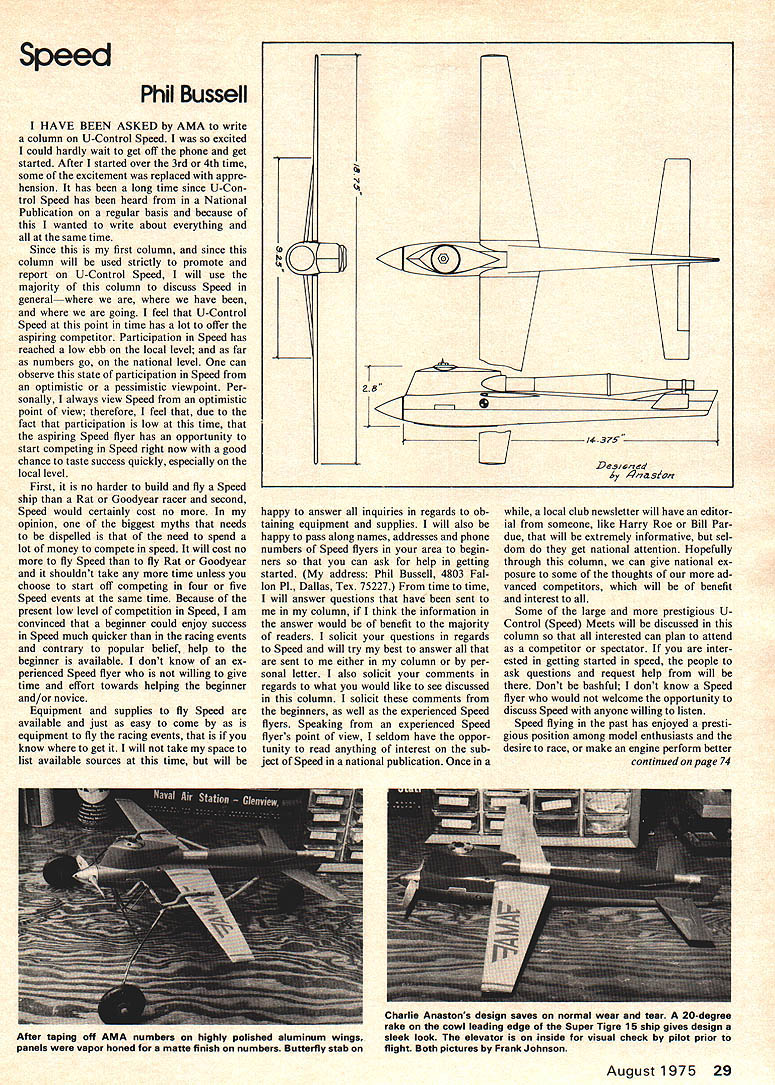
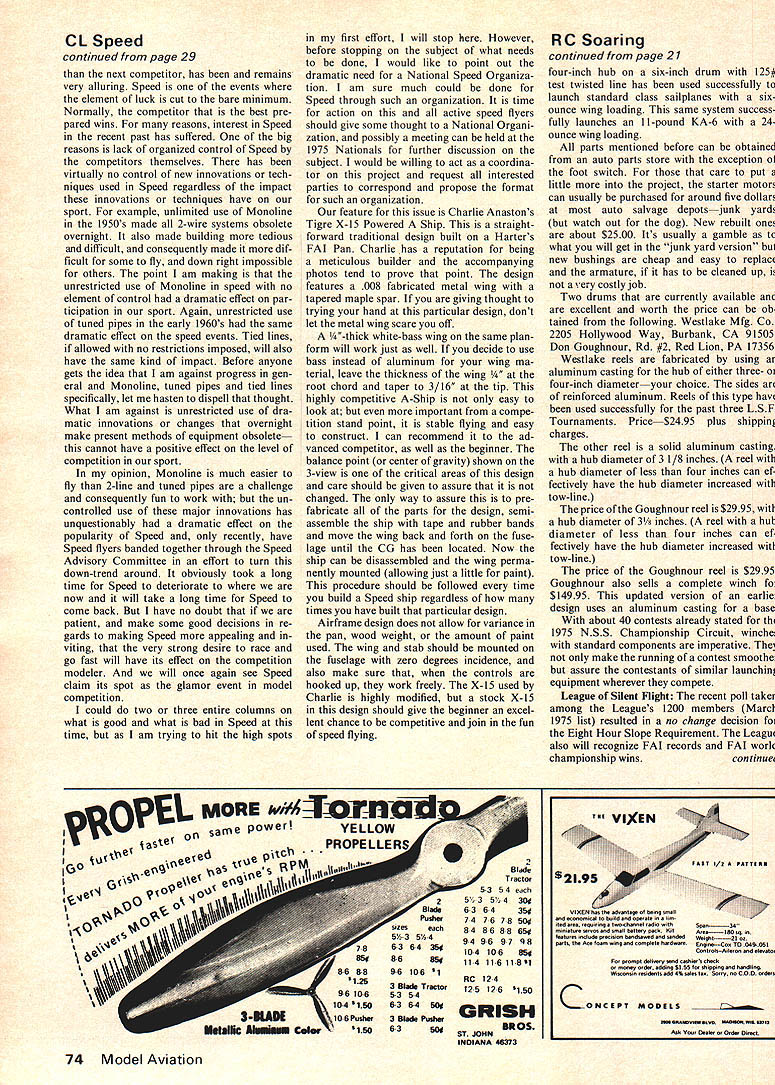
Our feature for this issue is Charlie Anastasi's Tigre X-15 Powered A Ship. This is a straightforward traditional design built on a Harter's FAI Pan. Charlie has a reputation for being a meticulous builder and the accompanying photos tend to prove that point. The design features a .008 fabricated metal wing with a tapered maple spar. If you are giving thought to trying your hand at this particular design, don't let the metal wing scare you off.
A 1/4"-thick white-bass wing on the same planform will work just as well. If you decide to use bass instead of aluminum for your wing material, leave the thickness of the wing 1/8" at the root chord and taper to 3/16" at the tip. This highly competitive A-Ship is not only easy to look at, but even more important from a competition standpoint, it is stable flying and easy to construct. I can recommend it to the advanced competitor, as well as the beginner. The balance point (or center of gravity) shown on the 3-view is one of the critical areas of this design and care should be given to assure that it is not changed. The only way to assure this is to prefabricate all of the parts for the design, assemble the ship with tape and rubber bands and move the wing back and forth on the fuse until the CG has been located. Now the ship can be disassembled and the wing permanently mounted (allowing just a little for paint). This procedure should be followed every time you build a Speed ship regardless of how many times you have built that particular design.
Airframe design does not allow for variance in the pan, wood weight, or the amount of paint used. The wing and stab should be mounted on the fuselage with zero degrees incidence, and also make sure that, when the controls are hooked up, they work freely. The X-15 used by Charlie is highly modified, but a stock X-15 in this design should give the beginner an excellent chance to be competitive and join in the fun of speed flying.
Transcribed from original scans by AI. Minor OCR errors may remain.

