
Control Line: Speed
Phill Bussell
BY THE TIME you read this, the largest part of the 1975 Speed season will be history. It is frustrating to try to be current with your reporting when you realize what you are writing in June will be read in late August or early September (regardless of what the date on the cover says).
I am tired and contest weary and I hope this is not reflected in my column. We have been to three meets in a row; Louisiana State Championships in Shreveport; the Southeastern Controline Championships in Winston‑Salem, North Carolina; and the Texas State Championships in Dallas. We will be off one week and then to Houston, and then home to get ready for Lake Charles and the 1975 Nationals. I can honestly say Speed is on the upswing. Everywhere we go we see more Junior interest than I can ever remember and Senior and Open interest seem to be holding their own. It appears that interest in Formula 40 Speed is growing and I look for this event to be a big one in the 1976 Speed Season. The event should be a natural because for the first time it will allow racing and speed people to compete head‑to‑head — which should make for a hotly contested event. I know of several speed flyers currently flying or making plans to fly the event; I can only hope the racing group takes the challenge.
Fun! Fun! Fun!: We attended the 3rd Annual Southeastern Controline Championships in Winston‑Salem, N.C., June 14 and 15. This meet was hosted by the Golden Triad Model Masters and CD'd by Bill Pardue. I have never been to a larger non‑National Speed meet in all my days of competition flying. Speed flyers were coming out of the woodwork! If you are interested in Speed and live close enough to Winston‑Salem to make the scene and missed this contest either as a spectator or contestant, you really missed a good one. Brent Bussell, age 13 from Dallas, while beginning his second year of competition Speed flying, really got it all together. Brent broke three National Speed Records: 91.94 in 1/2A Profile Proto, 158.67 in A Speed and 109.45 in 1/4A Speed. You could see the smile on Brent's face all the way back to Dallas. Seems as though Brent, up to this point in time, was playing second fiddle to big brother, Mike, who is a Senior in competition. Mike did manage to break the Senior B Record when he turned 179.21, but this was not enough over the existing record to edge Brent out in the Cash Bash.
Al Stegens and son, Eric, really had their 1/2A's and 1/4A Protos hauling. You don't have to listen to Al's engine run but once to know Al thinks rpm is the way to go in 1/2A and who can argue. Al's Proto has turned 114.90 in 1/2A Speed and 104.37 in 1/4A Proto Speed while running a gray Cox .049 with a cut down prop. This is even more impressive when you consider that Al is running his engines open face (no tuned exhaust system). Frank Garzon and his group from New York were impressive in C Speed and Formula 40 Speed. Bob Ytuarte turned 148.33 in Formula 40 and edged out Frank who turned 144.40. Frank, however, must have just been warming up since he turned 192.85 in C Speed on a mini‑pipe. I can remember six national speed records broken at one contest. I told you big meets — new Speed, old Speed — keys to success: remember consistency. Consistency is the biggest hurdle beginners and some advanced flyers must overcome. It doesn't matter how fast a good engine is if you have inconsistencies; your efforts at success will be limited. Remember saying a chain is no stronger than its weakest link?
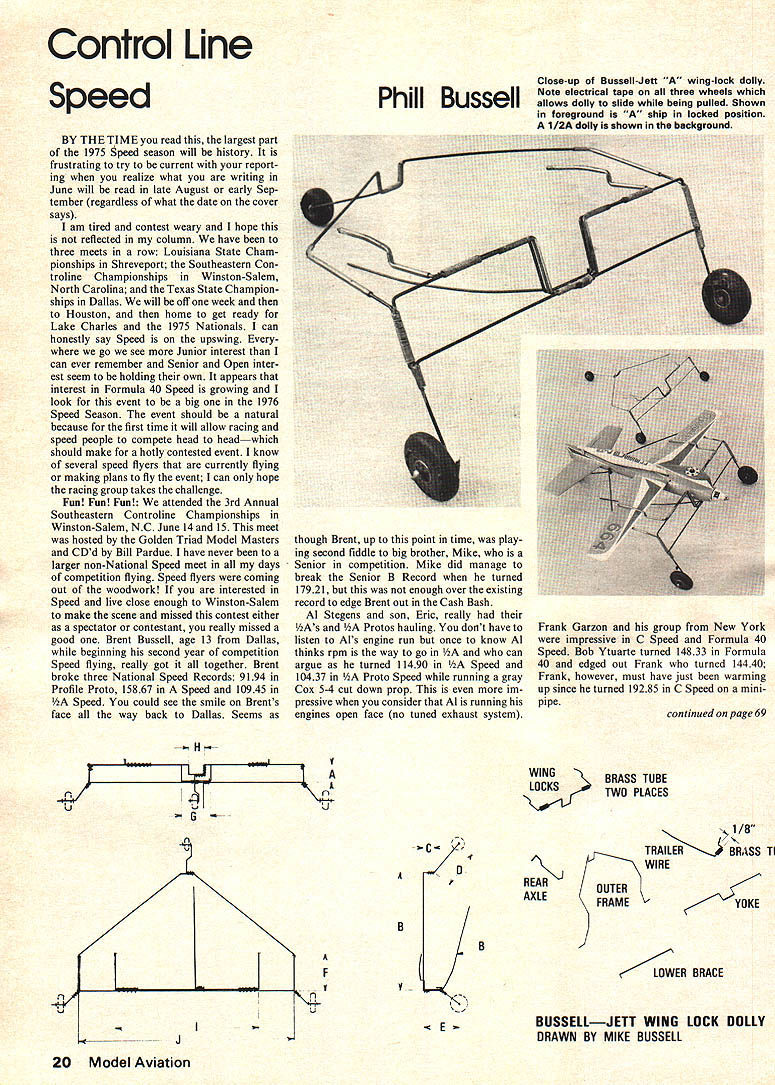
In the last column I featured a good‑looking, good‑flying, highly competitive A‑Ship design. This column will present a well‑tested, long‑used wing‑lock dolly that has served us well for years. With slight modifications the dolly can be fitted to conventionally designed ships, and it is a good working dolly design I currently use and can guarantee reliability. The wing‑lock dolly, in its original form, was designed by Jim Clem and Sam Beasley way back in the early
Frank Garzon and his group from New York were impressive in C Speed and Formula 40 Speed. Bob Ytuarte turned 148.33 in Formula 40 and edged out Frank who turned 144.40; Frank, however, must have just been warming up since he turned 192.85 in C Speed on a mini‑pipe.
continued on page 69 1950s to fly off grass. It has been modified only slightly over the years, mainly to accommodate the larger airframes we now fly. I might caution you against making additional bracing on the dolly or going up on the wire sizes. Don't — flexibility is the secret of the dolly. Built on the given specs and adjusted to fit your individual ship, it will give you trouble‑free operation. Make sure the dolly is not nose heavy and bend the wing locks to allow your ship to set far enough back in the dolly so the needle setter can adjust the valve. The wing locks should be adjusted so that the ship is held firmly in the dolly and the pilot should be able to tow the dolly around the circle. If you have ever watched Dub or myself fly, you know how hard we pull the dolly. This gives the pilot positive control of the dolly and ship at all times. On the other hand, Brent takes off in the pit with his 1/2A and A ship and the dolly works perfectly.
Dolly Assembly: Dimensions — A) Distance from bottom pan to bottom of wing; B) Distance from front wing to front of stab plus 1/4"; C) 1/2 or 1/4 thickness of fuselage at this point; D) 'B' Bent to clear prop by amount in chart (no more); E) 3/8 of B; F) 3/8 of B; G) Maximum width of fuselage plus 1/4"; H) Width of fuselage in front of stab plus 1/4"; I) One‑half length of spar; J) Three‑quarters length of spar.
Assembly Instructions:
- Bend frame (on B and C a splice may be necessary) and yoke.
- Using heavy wire (.010), wrap yoke to frame and solder.
- Bend lower brace to fit, wrap and solder. Wrap 1/4" at center and solder.
- Bend center of wing lock to fit yoke, slide on brass tubing and bend ends straight back (do not bend to fit wing).
- Slide tubing to outer ends of wing lock, wrap to yoke and solder.
- Bend rear axle to fit rear of frame, wrap and solder. Bend rear axle to shape (note length shown on drawing).
- Bend 90° 2" from end of trailer wire. Slide on tubing and bend short end same direction as long end.
- Wrap to center of yoke and brace (do not solder), bend short end straight up. Cut off excess wire past 1/4" up.
- Move trailer wire so that it does not interfere with airplane, solder.
- Slide airplane under wing locks and position so that needle valve (rear valve) clears yoke by at least 1/4" with bend of needle valve pointed forward.
- Bend wing locks straight up in front of wings, then bend them over wings and cut off excess wire. Slide rubber tubing over wing locks.
- Install wheels and bend frame and axle so that the dolly rolls straight and the airplane sits level.
- The airplane should release about 2"‑4" off the ground depending on the class (see chart).
- Adjust release height by bending or shortening the trailer wire by shortening the catch, or bending the catch back. The trailer wire should remain long enough to be held easily by the needle setter.
- When sitting in the dolly, the airplane should balance level or tail heavy at the thick section of the wing. Add weight to the rear axle, if necessary.
Specification Chart Classes: 1/2A A B C Frame: 1/16 3/32 1/8 3/16 Lower Brace: 1/16 3/32 3/32 3/32 Wing Locks: 1/16 3/32 3/32 3/32 Axle: 1/16 3/32 3/32 3/32 Trailer Wire: 1/16 3/32 3/32 3/32 Brass Tubing: 3/32 3/32 3/32 3/32 Front Wheels: 1/16 3/32 1/8 1/8 Rear Wheel: 1/8 1/8 1/8 1/8 Dolly Release Height: 2" 2‑3/4" 3" 3‑3/4" Prop Clearance: 1/8" 1/8" 3/16" 1/4"
New Products: By the time you read this, you will know what a Glo Bee is — I didn't until arriving at Winston‑Salem. John Ballard advised that he was testing an experimental glow plug that would have a revolutionary impact on racing and speed. I was taking all of this with a grain of salt since I had never tried this kind of fuel before — that's it until I saw the plug. It is revolutionary in design and, while the test program at this writing is not complete, it does indeed show great potential.
The Glo Bee is being developed by the Fusite Division of Emerson Electric Co. of Cincinnati, Ohio under the direction of Ben Boswick and Harry Roe who is working with Fusite as a Consultant Engineer. The Fusite Co. is involved in experimental electrical circuits and supplies to the industry. It was explained to me that Fusite is testing model glow plugs under laboratory conditions and hopes to have product available in the near future.
While on the subject of new items, I had a chance to see the new H.K.G. imported from Japan while in North Carolina. It is impressive looking and if it can live up to its claims, it should have an impact on Speed, as well as Racing in the USA. The H.K.G. features an aluminum piston on a chrome plated sleeve and rpm claims are in the 38,000 area on a tuned pipe. I got to see it to believe it.
My address is: Phill Bussell, 4803 Fallon Pl., Dallas, Tex. 75227.
Transcribed from original scans by AI. Minor OCR errors may remain.

