
Control Line: Speed
Gene Hempel and Tom Upton
HEMPEL AND UPTON, who are they? Besides being the new authors of this column we are two fathers (Gene Hempel, Tom Upton) and two sons (Patrick Hempel age 16, and Ashley Upton age 6) who enjoy control-line speed competition. Gene and Tom do some of the building, most of the engine work, and very little flying. Patrick does the majority of the building, all the painting, and pulls double duty flying his Senior and our Open class airplanes. Ashley is the valuable team helper who acts as a go-for at the end of each flight, but all you 1/2A nuts beware, for he will be joining your ranks shortly. If you have any comments, questions, or valuable photos ($5 if it gets published) we can be reached at the address at the end of this column.
For several years, the general complaint of many potential speed fliers has been the complete lack of high quality production engines that could compete with the "homebuilt demons" that have dominated the speed circles. We were some of the bums guilty of running the "homebuilts," but no more, since the manufacturers have come through with high quality equipment available to anyone interested in flying speed. We have compiled
a list by AMA classes of all competitive production engines currently available, and a few slated for production by next contest season.
All engines are rear exhaust unless otherwise noted, and steel, ABC, or steel ringed, refer to the type of piston and cylinders available. 1/2A (.0000-.0504 cu. in.) — Cox TD .049 (front rotor, side exhaust). A (.0505-.1525 cu. in.) — Rossi .15 (front rotor, rear rotor, steel or ABC); Supertigre X15 (rear rotor, steel or ABC); Cox .15 (front rotor, steel, some parts interchangeable with Rossi). B (.1526-.3004 cu. in.) — K&B 29 (front rotor, ABC can be converted to rear rotor with production K&B parts); Supertigre X29 (rear rotor, ABC); OPS 29 (front or rear rotor, ABC, new stronger case and steel rotor). C.
Control Line: Speed
(.3005-.4000 cu. in.) and Formula 40 (.2800-.4000 cu. in.) — K&B 40 (front or rear rotor, ABC), Supertigre X40 (rear rotor, ABC), OPS 40 (front or rear rotor, ABC), OS Max 40 (front or rear rotor, steel ringed, side exhaust); HP 40 (front or rear rotor, steel ringed, side exhaust); D (.3005-.6500 cu. in.) — OPS 60 (rear rotor, ABC, has new stronger front housing, rod, and backplate assembly), OS Max 65 (rear rotor, side exhaust, steel ringed), Rossi 65 (rear rotor, ABC, available sometime in the spring).
If you cannot find these engines at your local hobby shop, try the following sources: Cox — Kustom Kraftsmanship, P.O. Box 2699, Laguna Hills, CA 92653; Rossi — Bill's Miniature Engines, 1325 Carol Dr., Memphis, TN 38116; Supertigre & OS Max — World Engines, 8960 Rossash Ave., Cincinnati, OH 45236; HP — Midwest Models, 6926 West 59th St., Chicago, IL 60638; OPS and K&B — Shamrock Competition Imports, P.O. Box 26247, New Orleans, LA 70186, or for K&B only — K&B Manufacturing, 12152 S. Woodruff Ave., Downey, CA 90241.
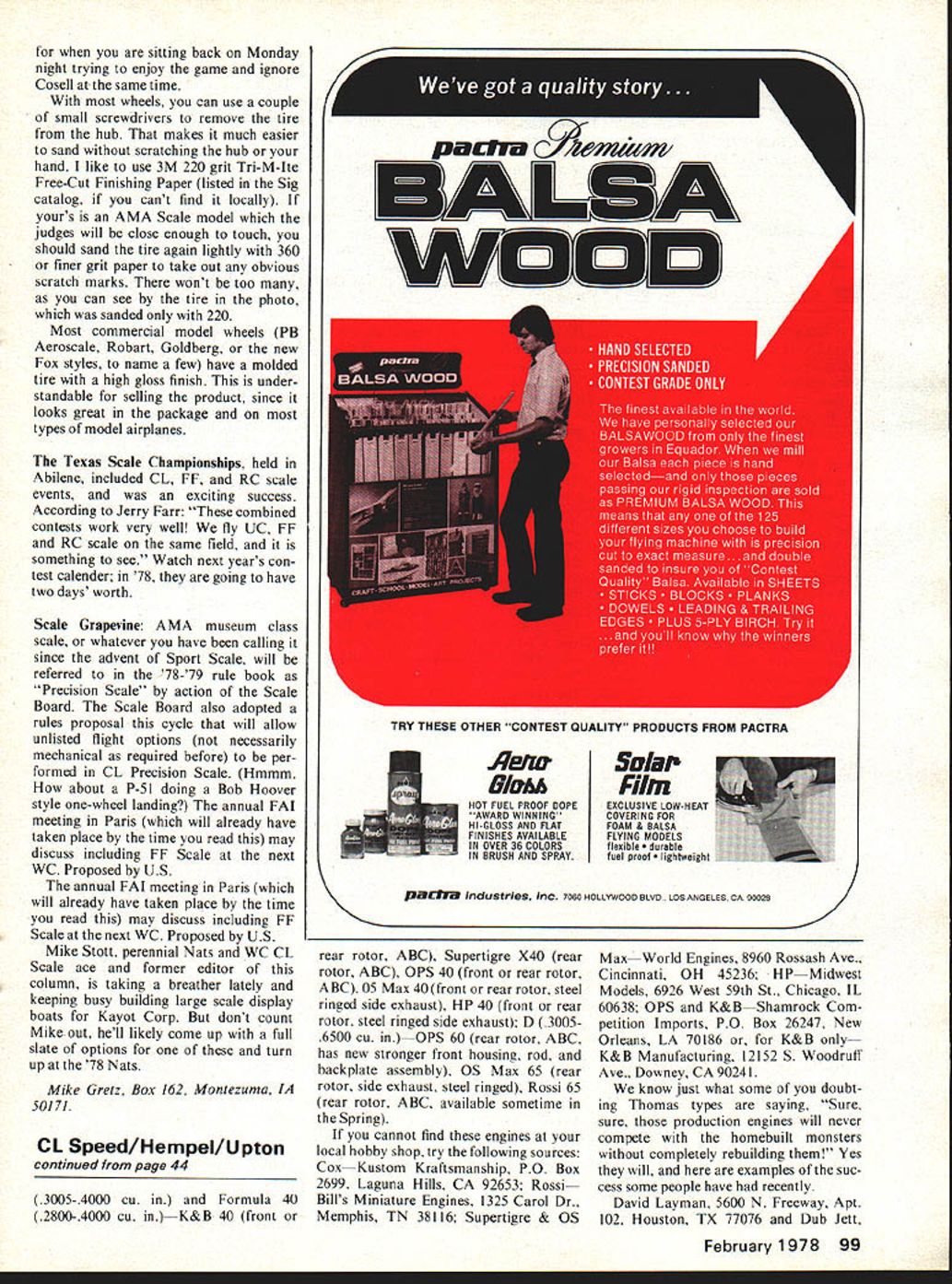
We know just what some of you doubting Thomas types are saying, "Sure, those production engines will never compete with the homebuilt monsters without completely rebuilding them!" Yes they will, and here are examples of the success some people have had recently. 4720 Ashbrook Rd., Dallas, TX, have turned 180.11 and 180.86 mph respectively with stock ST X-15's, except for chromed liners and new heads. Dub will chrome and fit your liners for about $18, and David will do the other work. Brent Bussell, Dallas, TX has turned 186 with a stock X-29, and we understand Nick Shear, 815 Beech Rd., Langhorne, PA 19047, has done 188 with one. Patrick Hempel holds the Senior B record 192.64 mph with a practically stock K&B 40 and mini-pipe. Charley Anaston, Dallas, TX, has turned 161-mph Formula 40 time with a very stock X40, but could not back it up for a record, and we hold the Formula 40 record with a K&B 40 RR at 161.81 mph.
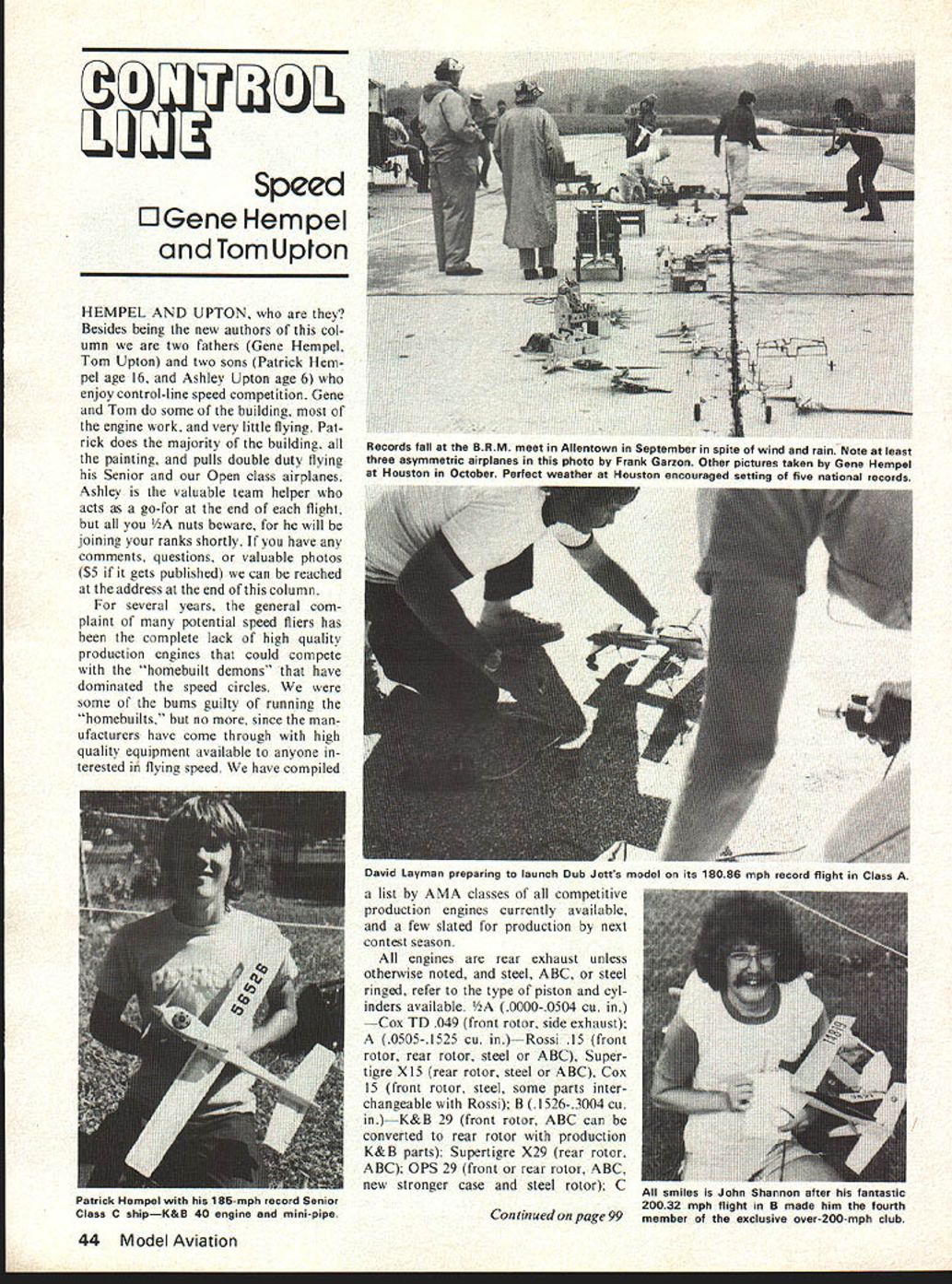
We received some photos and contest results from Nick Shear about the B.R.M. speed meet held September 24 and 25 near Allentown, PA. Nick says the weekend was rainy and windy with 67° on Saturday and 54° on Sunday, but record speeds were achieved by Quay Barber of Cleveland and Glen Vansant. Quay turned 93.71 mph for a new Jr. 1/2A Proto record and backed it up with 91.1 mph. He was using a TD .049 equipped with the new Glo Bee 1/2A plug and his own molded high aspect ratio prop. Glen blasted his Senior Formula 40 to 152.68 mph, but was unable to back it up. Next year, right? There were winners in each class through third place except for B proto which had no entries.
Nick Shear also attended a Dayton, OH meet October 9 where he set a new 1/2A speed record of 121.57 mph using a piped Cox .049, and Al Stegans (Cleveland, OH) turned 118.37 mph with his open-faced (no pipe) 1/2A to prove that it can be done without a pipe. Frank Garzon put in a respectable 195 mph in D speed using an OPS 65 and mini-pipe. Beware, because this combination meets the '78-'79 rules.
October 15 and 16 saw the Texas bunch get together in Houston for their yearly end of the season contest, and five new national records were established. The weather was perfect with 70 - 80° temperatures and 30% or less humidity.
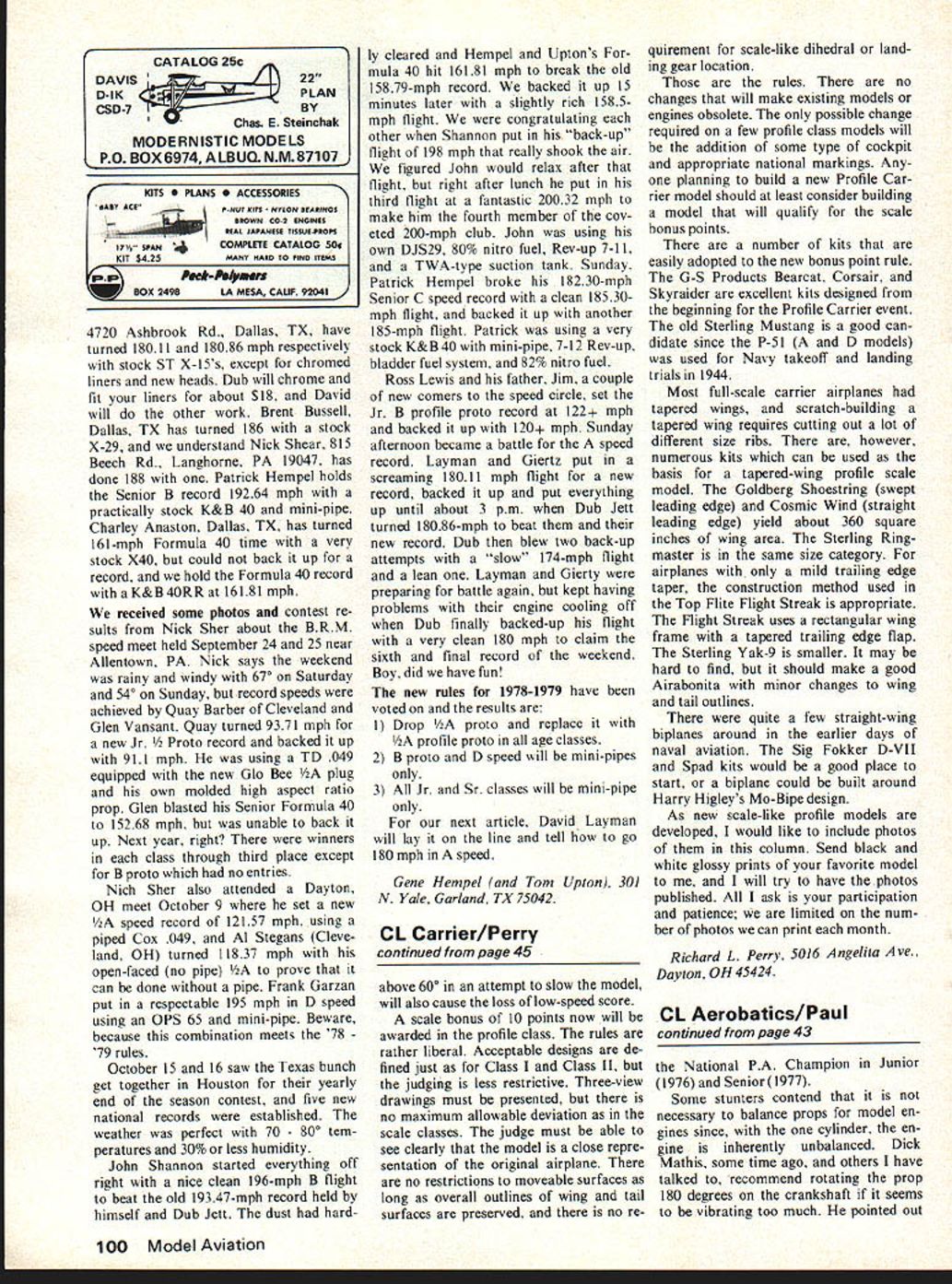
John Shannon started everything off right with a nice clean 196-mph B flight to beat the old 193.47-mph record held by himself and Dub Jett. The dust had hardly cleared and Hempel and Upton's Formula 40 hit 161.81 mph to break the old 158.79-mph record. We backed it up 15 minutes later with a slightly rich 158.5-mph flight. We were congratulating each other when Shannon put in his "back-up" flight of 198 mph that really shook the air. We figured John would relax after the flight, but right after lunch he put in his third flight at a fantastic 200.32 mph to make him the fourth member of the coveted 200-mph club. John was using his own DJS29, 80% nitro fuel, Rev-up 7-11, and a TWA-type suction tank. Sunday, Patrick Hempel broke his 182.30-mph Senior C speed record with a clean 185.30-mph flight, and backed it up with another 185-mph flight. Patrick was using a very stock K&B 40 with mini-pipe, 7-12 Rev-up, bladder fuel system, and 82% nitro fuel.
Ross Lewis and his father, Jim, a couple of newcomers to the speed circle, set the Jr. B profile proto record at 122+ mph and backed it up with 120+ mph. Sunday afternoon became a battle for the A speed record. Layman and Giertz put in a screaming 180.11 mph flight for a new record, backed it up and put everything up until about 3 p.m. when Dub Jett turned 180.86 mph to beat them and their new record. Dub then blew two back-up attempts with a "slow" 174-mph flight and a lean one. Layman and Giertz were preparing for battle again, but kept having problems with their engine cooling off when Dub finally backed-up his flight with a very clean 180 mph to claim the sixth and final record of the weekend. Boy, did we have fun!
The new rules for 1978-1979 have been voted on and the results are: 1) Drop 1/2A proto and replace it with 1/2A profile proto in all age classes. 2) B proto and D speed will be mini-pipes only. 3) All Jr. and Sr. classes will be mini-pipe only.
For our next article, David Layman will lay it on the line and tell how to go 180 mph in A speed.
Gene Hempel (and Tom Upton), 301 N. Yale, Garland, TX 75042.
Transcribed from original scans by AI. Minor OCR errors may remain.

