
Control Line: Speed
Glenn Lee, 819 Mandrake Drive, Batavia, IL 60510
Jets and pulse jets
JETS! Just the word is exciting, and it conveys a sense of speed, daring, and wonder. Many spectators come to the Nats simply to watch the noisiest event: Jet Speed. They seem to enjoy the magnificent roar produced by these firesticks—as if in response to a primeval urge (a latent remembrance of fire-breathing dragons?).
I write about pulse jets—miniature versions of the engine that powered the German V1 flying bomb used in World War II. Unlike turbojets with their rapidly spinning rotors, pumps, and other complicated machinery, pulse jets have only one moving part: the reed valve that opens and closes every time the engine fires. Many different pulse-jet designs have been built, some with no valves at all. The ones used in Jet Speed, however, are the reed-valve type.
A pulse jet has the following major parts:
- a multiport head
- a reed valve
- a valve retainer
- a combustion chamber with extended tailpipe
- a fuel metering jet
- a spark plug for initial ignition
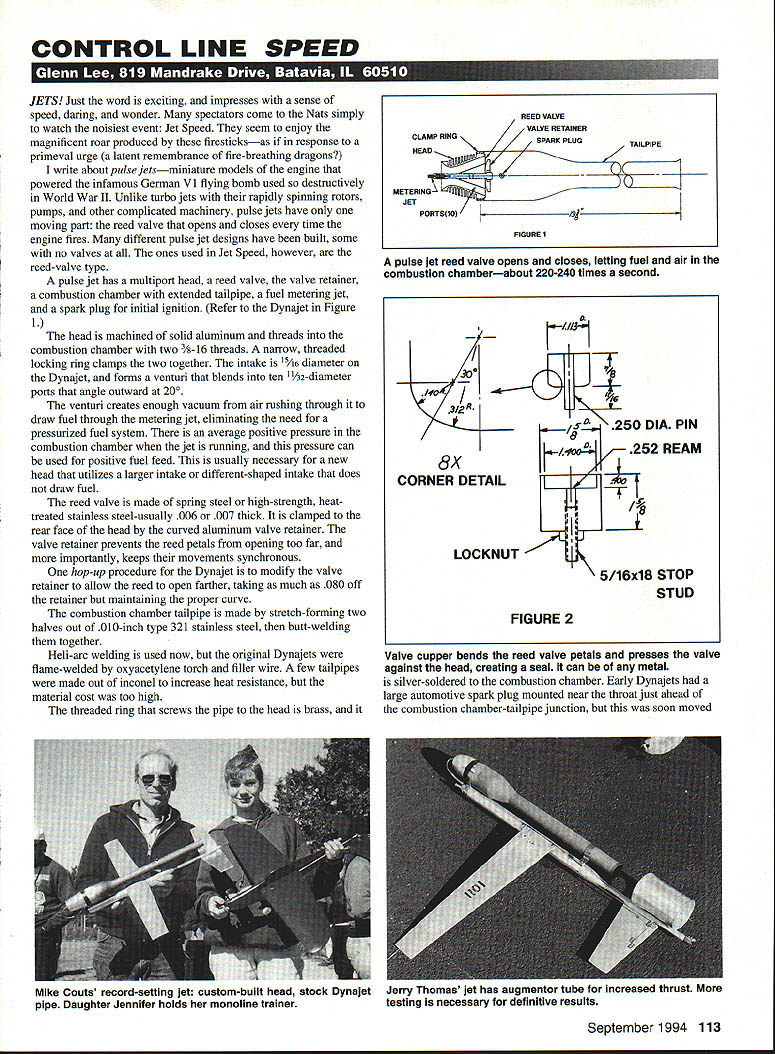
(Refer to the Dynajet in Figure 1.)
Construction details
The head is machined from solid aluminum and threads into the combustion chamber with two 3/8-16 threads. A narrow, threaded locking ring clamps the two together. The intake is 15/16" diameter on the Dynajet, and forms a venturi that blends into ten 11/32" diameter ports that angle outward at 20°.
The venturi creates enough vacuum from air rushing through it to draw fuel through the metering jet, eliminating the need for a pressurized fuel system. There is an average positive pressure in the combustion chamber when the jet is running, and this pressure can be used for positive fuel feed. This is usually necessary for a new head that utilizes a larger intake or a differently shaped intake that does not draw fuel well.
The reed valve is made of spring steel or high-strength, heat-treated stainless steel—usually 0.006" or 0.007" thick. It is clamped to the rear face of the head by the curved aluminum valve retainer. The valve retainer prevents the reed petals from opening too far, and, more importantly, keeps their movements synchronous.
One hop-up procedure for the Dynajet is to modify the valve retainer to allow the reed to open farther, taking as much as 0.080" off the retainer while maintaining the proper curve.
The combustion-chamber tailpipe is made by stretch-forming two halves out of 0.010"-thick type 321 stainless steel, then butt-welding them together. Heli-arc welding is used now, but the original Dynajets were flame-welded by oxyacetylene torch and filler wire. A few tailpipes were made out of Inconel to increase heat resistance, but the material cost was too high.
The threaded ring that screws the pipe to the head is brass, and it is silver-soldered to the combustion chamber.
The valve cupper bends the reed valve petals and presses the valve against the head, creating a seal. It can be made of any metal.
Early Dynajets had a large automotive spark plug mounted near the throat just ahead of the combustion-chamber/tailpipe junction, but this was soon moved forward and replaced by the smaller, model-airplane-type spark plug.
Operation
Operation is simple: turn on a continuous spark and inject a charge of fuel and air into the combustion chamber, where it explodes. The explosion forces the flapper (reed) valve shut and ejects the exhaust gases out of the tailpipe. These gases have appreciable mass and are forced out at high velocity, resulting in a net forward thrust.
After the explosion, the pressure pulse collapses and fresh air rushes back into the combustion chamber from both ends—from the intake and the tailpipe. Since the tailpipe is long, most of the incoming charge is fresh air from the intake that has opened the reed valves and rushed into the combustion chamber, along with the fuel that it picked up in the venturi. When this fresh charge of fuel and air meets the remaining hot exhaust gases, another explosion occurs, repeating the sequence.
The combustion sequence happens about 220 to 240 times every second. The explosions produce about 4.5 pounds of static thrust from the stock Dynajet burning white gas.
Many volumes of theoretical calculations have been written about how pulse jets must be built and why they work, but the system is complex and not every detail is fully settled. The system must be synchronous to work, so you must have the correct chamber diameter, chamber length, tailpipe diameter, and tailpipe length for proper operation. The dimensions change with the size of the engine, so the V1 engine was short and fat, while some small model jets are long and skinny.
Starting
The Dynajet had a hose fitting on the fuel metering jet to attach a tire pump for starting. Pumping is too much work, so many modelers now use a pressurized air tank or scuba tank with regulators for the starting air. Just squirt a shot of prime fuel in the intake, turn on the spark, and give short blasts of air into the intake until it starts. The spark is supplied by a Model T Ford spark coil, still available from some auto-supply houses, or by other vibrator-type spark supplies.
I used to have trouble getting my jet started. I think most of the trouble was that my reed did not seat tightly against the head.
Earl Bailey gave me dimensions for the "valve cupper" (see Figure 2). The device bends each petal of the reed so that it presses against the head after the valve retainer is tightened. Adjust the stop screw until there is at least 0.030" cupping of the valve.
The face of the head must be smooth and flat, of course. If it is not, lap the head on a glass plate using various grits of fine sandpaper with oil. I usually start with 280 grit and end up with 400 or 600 grit, always finishing with a figure-eight motion. Be sure the reed is aligned to cover the ports correctly. Seal the head threads with Teflon plumbing tape.
Fuel and safety
Several modelers have written to me questioning the toxicity of our alcohol‑propylene oxide fuel. Controlled tests indicated that massive doses of propylene oxide seemed to be carcinogenic to animals, but results were not conclusive and the effect on humans has not been determined. It is dangerous, but so is methanol and most other hydrocarbons—even gasoline.
Propylene oxide can penetrate skin and enter the bloodstream, so take every precaution to prevent contact when filling the fuel tank or mixing fuel. I store mine cool in an ice-filled picnic cooler at contests. It is highly flammable and explosive, so keep it away from any possible source of fire or sparks.
I'll continue the jet discussion in the next column.
Transcribed from original scans by AI. Minor OCR errors may remain.

