
CONTROL LINE: SPEED
Glenn Lee 819 Mandrake Drive, Batavia, IL 60510
The Nats atmosphere
The Nats is much more than just a contest — especially to us diehards who keep attending year after year. Sure, we come to fly and try to win, but it's no big disaster if we haven't worked hard enough or if trouble hits and we don't place first. The best part is meeting old friends again from places like Massachusetts, Florida, California, Minnesota, Canada, and Texas, sitting in the shade swapping stories and tall tales of long-ago Nats, good flights, and new tricks we’re working on to reach that magic “record flight.”
Old-timers and history
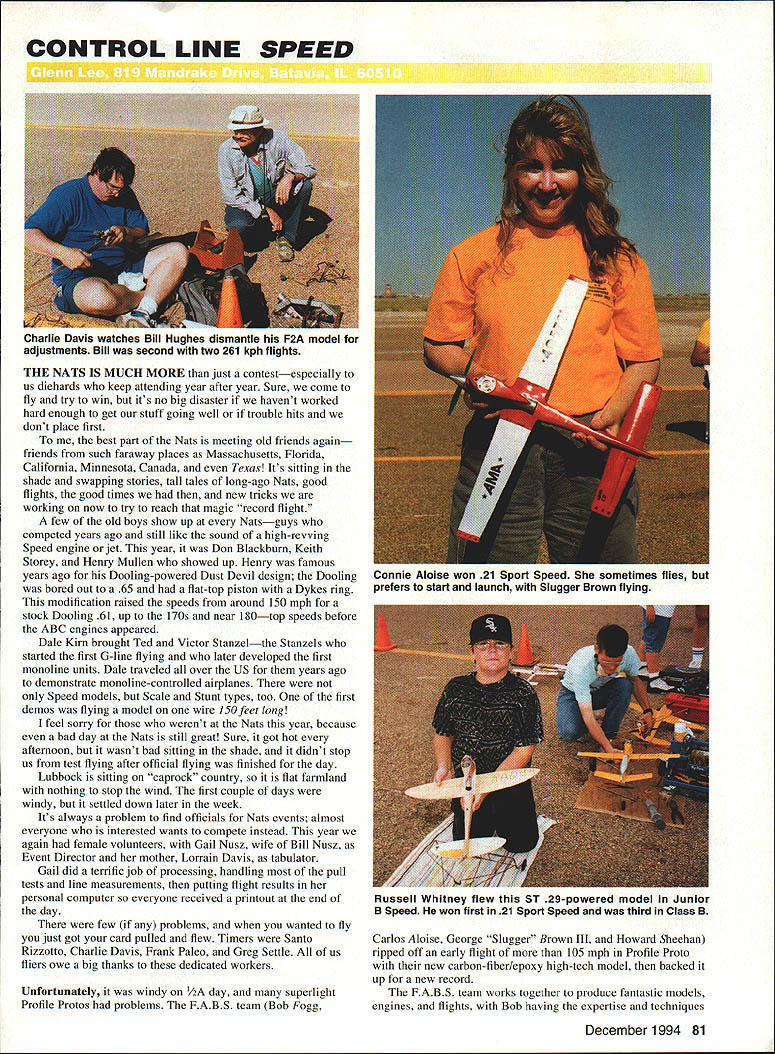
A few of the old boys show up at every Nats — guys who competed years ago and still like the sound of a high-revving Speed engine or jet. This year included Don Blackburn, Keith Storey, and Henry Mullen. Henry was famous for his Dooling-powered Dust Devil design; the Dooling was bored out to a .65 and fitted with a flat-top piston and Dykes ring. That modification raised speeds from around 150 mph for a stock Dooling .61 into the 170s and near 180 — top speeds before ABC engines appeared.
Monoline and G-line pioneers
Dale Kim brought Ted and Victor Stanzel — the Stanzels who started the first G-line flying and later developed the first monoline units. Dale traveled around the U.S. years ago demonstrating monoline-controlled airplanes. Their demos included Speed, Scale, and Stunt types — one of the first showed a model flying on one wire 150 feet long.
Location and weather
Lubbock sits on “caprock” country: flat farmland with nothing to stop the wind. The first couple of days were windy, but conditions settled down later in the week. It got hot every afternoon, but sitting in the shade wasn’t bad and we still did test flying after official flying ended each day.
Officials and volunteers
It’s always a problem to find officials for Nats events — almost everyone who’s interested wants to compete. This year we again had female volunteers helping out:
- Gail Nusz — Event Director (wife of Bill Nusz)
- Lorraine Davis — tabulator
Gail handled processing, pull tests, and line measurements, then entered flight results into the personal computer so everyone received a printout at the end of the day. Timers were Santo Rizzotto, Charlie Davis, Frank Palco, and Greg Settle. All fliers owe a big thanks to these dedicated workers.
F.A.B.S. team and Profile Proto
The F.A.B.S. team (Bob Fogg, Carlos Aloise, George “Slugger” Brown III, and Howard Sheehan) ripped off an early flight of more than 105 mph in Profile Proto with a new carbon-fiber/epoxy high-tech model, then backed it up for a new record. Their teamwork combines Bob’s modeling expertise, Carlos’s machining (A.C.E. engines), Slugger’s flying, and Howard’s pit and advisory work.
Notable Profile Proto results:
- Charlie Legg — about 100 mph (second in Open)
- Tom Hartvigsen — 98 mph
- Justin McWilliams — crashed three times in the wind, then returned for a good flight on his last attempt (second in Junior Profile Proto)
1/2A and small-class results
- Bobby Fogg Jr. — ~135 mph in Junior 1/2A Speed
- Peter Brown — 114 mph in Senior 1/2A Speed
Open 1/2A was dominated by the F.A.B.S. crew, followed by Charlie Legg and Warren Kurth, both long-time Nats winners. The wind was very tough on the Peanuts (tiny models) flown by Warren and Tom Hartvigsen; the longer lines added to the difficulty.
Entries and contest statistics
Although total Nats registration was quite low this year, Speed had one of the highest entry counts:
- 87 entrants
- 158 official flights
- 73 attempts
The wind continued for A Speed and F2A on Tuesday, but larger, heavier models handled it better.
Class A and F2A
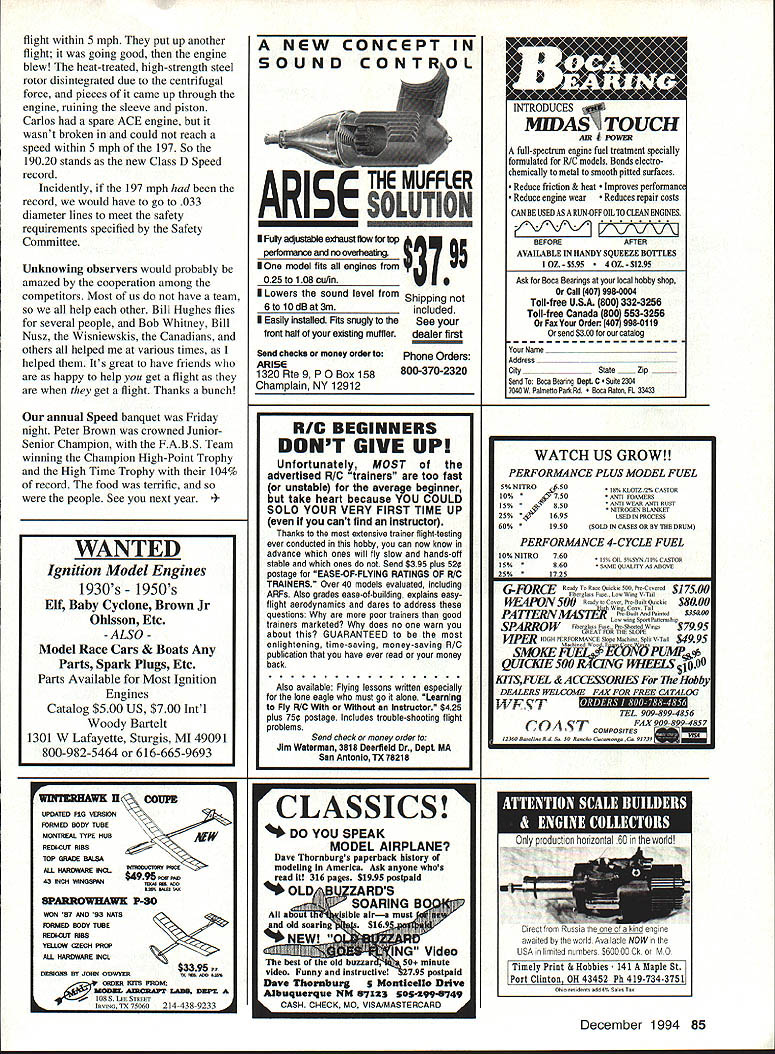
Canada’s Sam Burke — who builds some of the prettiest models — had a dandy Class A flight early in the morning, then the engine quit when the cap that plugs the fuel tank fill line fell off due to bad tubing. The loss of uniflow action in the tank drastically changed the needle setting. He managed a winning flight later, though it wasn’t as fast as the first would have been.
F2A entries were low (about five F2A entries, including two Juniors and one Senior), but it’s good to see young pilots tackling this difficult international class. Highlights:
- Junior: wind defeated Bobby Fogg and Russell Whitney
- Senior: David Van Allen — 225 kph
- F2A Open: F.A.B.S. team won at 272 kph using an Irvine engine and a model finished five days before the Nats (Carlos is working on an ACE .15 for next year)
.21 Sport Speed
.21 Sport Speed remains the most popular event — fun, relatively easy, and with great models.
- Mike Wisniewski (Junior) — learning from his Grandpa Bill; three good Junior flights with a K&B .21-powered pink model (Grandpa as chief pit man)
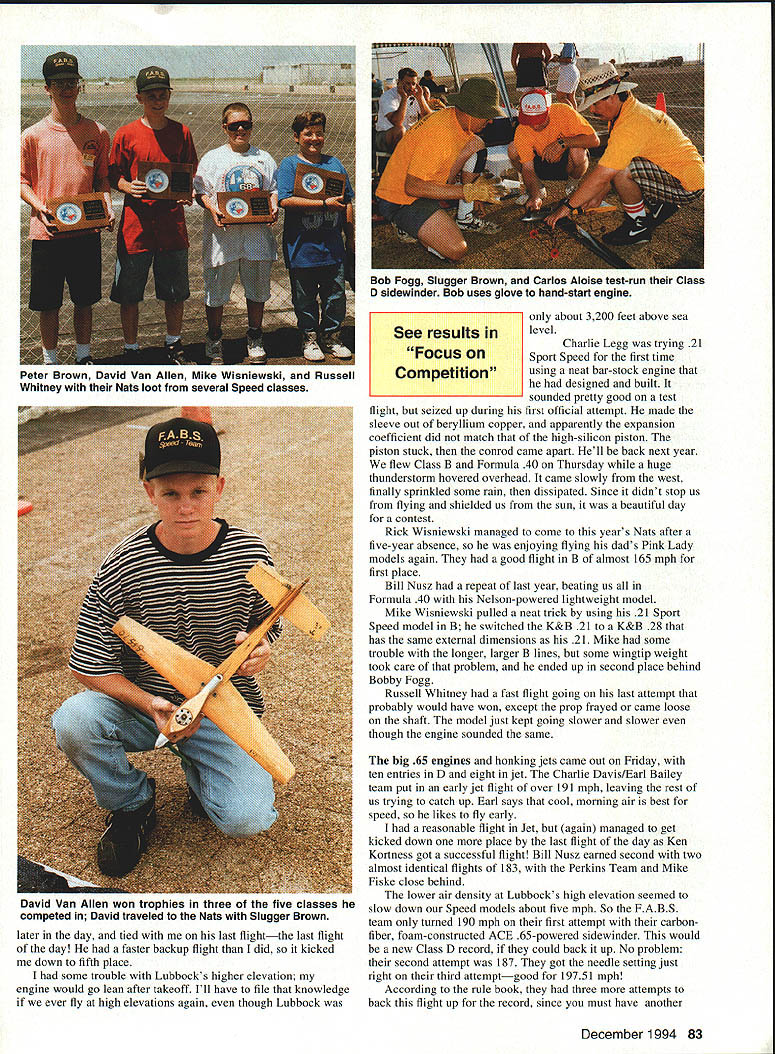
- Russell Whitney — third place in Open; will be Senior next year
- Peter Brown — beat David Van Allen in Senior
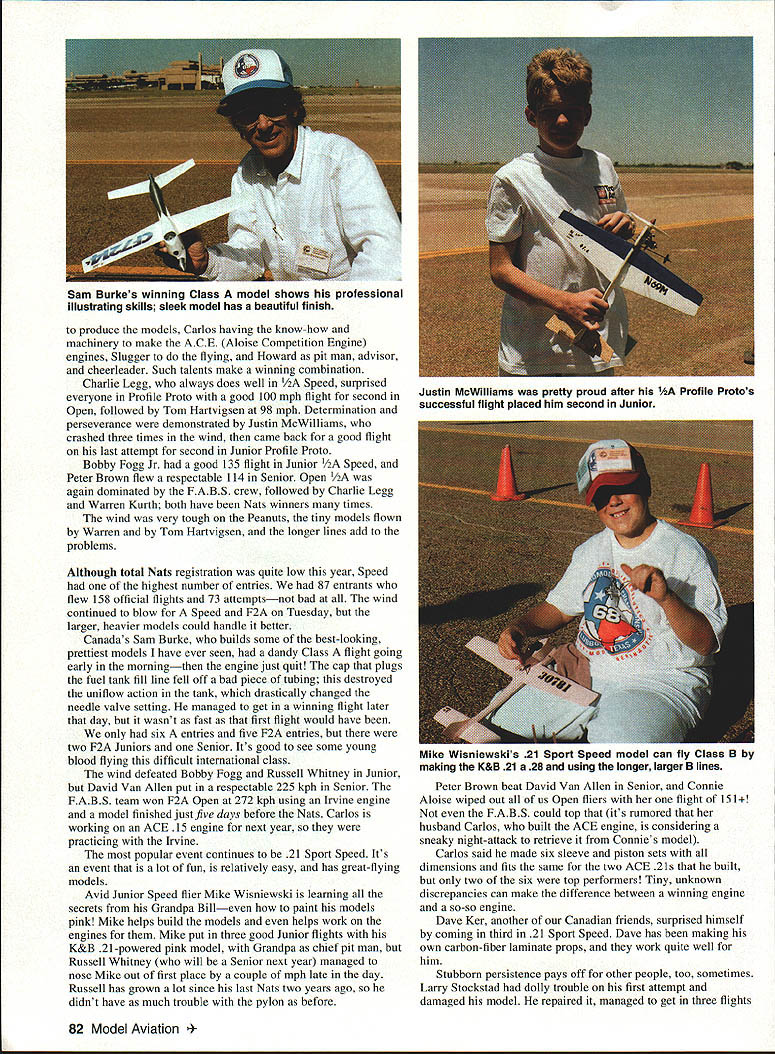
- Connie Aloise — an outstanding Open flight of 151+ mph (rumor: husband Carlos might try a “sneaky retrieval” of the ACE engine from Connie’s model)
Carlos noted he made six sleeve-and-piston sets with identical dimensions for two ACE .21s but only two of the six were top performers — tiny discrepancies can make a big difference. Dave Kerr (Canada) surprised himself with third in .21 Sport Speed using his own carbon-fiber laminate props.
Persistence paid off for Larry Stockstad, who damaged his model on his first attempt, repaired it, and managed three flights later in the day. On his last (and the day’s last) flight he tied me but had a faster backup, which bumped me to fifth.
I had trouble with Lubbock’s higher elevation (about 3,200 feet); my engine tended to go lean after takeoff. I’ll file that away for future high-elevation flying.
Technical note: Charlie Legg tried .21 Sport Speed with a neat bar-stock engine he built. It sounded good in testing but seized on his first official attempt. He made the sleeve from beryllium copper and the expansion coefficient didn’t match the high-silicon piston; the piston stuck and the conrod failed. He’ll be back next year.
Class B and Formula .40
We flew Class B and Formula .40 on Thursday while a large thunderstorm hovered to the west. It eventually only sprinkled and helped shield us from the sun, making for a nice contest day.
- Rick Wisniewski — first in B with almost 165 mph (flying his dad’s Pink Lady models)
- Bill Nusz — repeat winner in Formula .40 with a Nelson-powered lightweight model
Mike Wisniewski ran a neat trick by using his .21 Sport Speed model in B: he swapped the K&B .21 for a K&B .28 that has the same external dimensions. After adding some wingtip weight to cope with the longer B lines, he finished second behind Bobby Fogg. Russell Whitney had a fast last attempt that probably would have won, except the prop frayed or came loose on the shaft and the model slowed despite the engine sounding the same.
D and Jet classes
Friday brought the big .65 engines and jets: ten entries in D and eight in Jet. The Charlie Davis / Earl Bailey team put in an early jet flight over 191 mph. Earl likes cool morning air for speed.
Final results and notes:
- Early jet: Charlie Davis / Earl Bailey — over 191 mph
- Bill Nusz — second in Jet with two nearly identical flights of 183 mph
- Perkins Team and Mike Fiske — close behind
I had a reasonable Jet flight but got bumped down one more place by Ken Kortness’s last successful flight.
F.A.B.S. Class D record attempt
Lower air density at Lubbock’s elevation seemed to slow models by about five mph. The F.A.B.S. team’s ACE .65 sidewinder first turned 190 mph, then 187 on a second attempt. On their third attempt they hit 197.51 mph — potentially a new Class D record.
Per the rules, they needed a backup flight within 5 mph to certify the record. They launched another attempt that was going well until the engine blew: a heat-treated, high-strength steel rotor disintegrated from centrifugal force, with fragments destroying the sleeve and piston. A spare ACE engine was available but not broken in and couldn’t reach a speed within 5 mph of 197. So the 190.20 mph flight stands as the new Class D Speed record.
Incidentally, if the 197 mph had been certified as the record, the Safety Committee would have required .033 diameter liners to meet safety requirements.
Cooperation and banquet
Observers might be surprised by the cooperation among competitors. Most of us don’t have a team, so we all help one another. Helpers included:
- Bill Hughes
- Bob Whitney
- Bill Nusz
- The Wisniewskis
- Several Canadians
- Many others who helped in pits and on the line
Thanks to everyone who was as happy to help me get a flight as they were when they got one.
Our annual Speed banquet was Friday night. Awards:
- Junior-Senior Champion: Peter Brown
- Champion High-Point Trophy and High Time Trophy: F.A.B.S. Team (104% of record)
The food was terrific, the people were great — see you next year.
Transcribed from original scans by AI. Minor OCR errors may remain.

