
CONTROL LINE SPEED
Glenn Lee, 819 Mandrake Drive, Batavia IL 60510
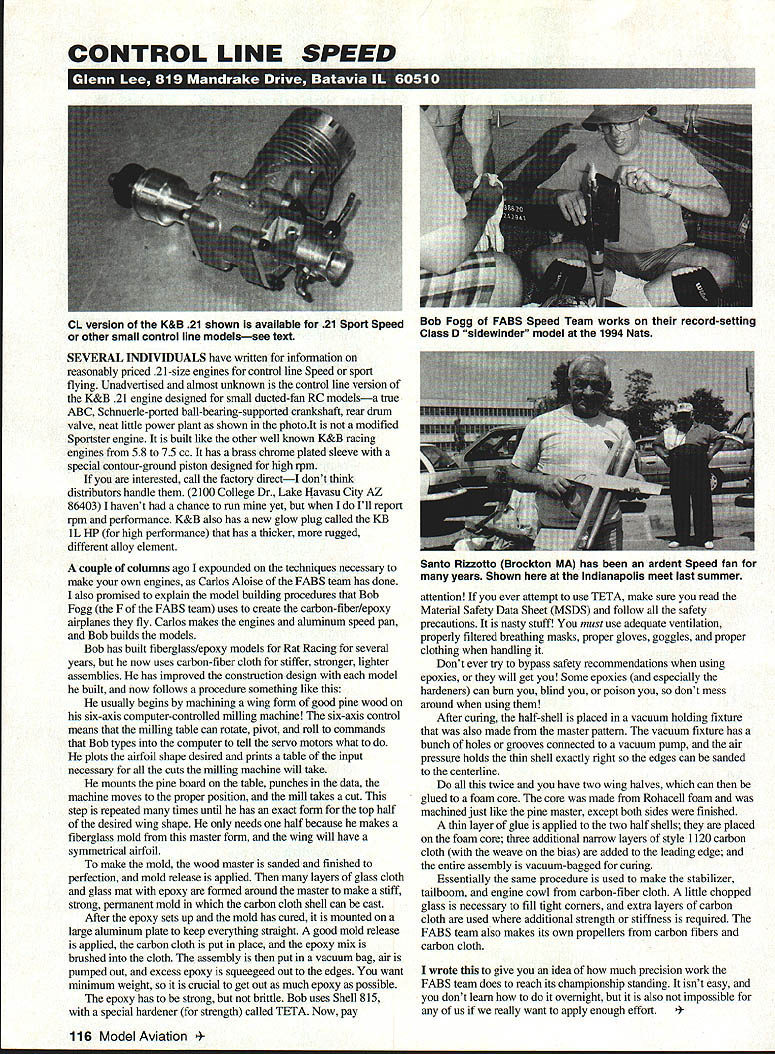
Several individuals have written asking about reasonably priced .21-size engines for control-line Speed or sport flying. Unadvertised and almost unknown is the control-line version of the K&B .21 engine designed for small ducted-fan RC models — a true ABC, Schnürle-ported, ball-bearing-supported crankshaft, rear drum-valve, neat little power plant. It is not a modified Sportster engine. It is built like the other well-known K&B racing engines from 5.8 to 7.5 cc and has a brass chrome-plated sleeve with a special contour-ground piston designed for high RPM.
If you are interested, call the factory direct — I don't think distributors handle them:
- Factory: K&B, 2100 College Dr., Lake Havasu City, AZ 86403
I haven't had a chance to run mine yet, but when I do I'll report RPM and performance. K&B also has a new glow plug called the K&B IL HP (for high performance) that has a thicker, more rugged element made of a different alloy.
A couple of columns ago I expounded on the techniques necessary to make your own engines, as Carlos Aloise of the FABS team has done. I also promised to explain the model-building procedures that Bob Fogg (the F of the FABS team) uses to create the carbon-fiber/epoxy airplanes they fly. Carlos makes the engines and aluminum speed pan, and Bob builds the models.
How Bob Fogg builds carbon-fiber/epoxy models
Bob has built fiberglass/epoxy models for Rat Racing for several years, but he now uses carbon-fiber cloth for stiffer, stronger, lighter assemblies. He has improved the construction design with each model he built and now follows a procedure like this:
- Machining the master wing form
- He begins by machining a wing form from good pine on his six-axis computer-controlled milling machine. The six-axis control lets the milling table rotate, pivot, and roll according to commands Bob types into the computer to drive the servo motors.
- He plots the desired airfoil shape and prints a table of the inputs needed for all the cuts the milling machine will take.
- He mounts the pine board, punches in the data, and the mill makes repeated cuts until he has an exact form for the top half of the wing. One half is sufficient because he makes a fiberglass mold from this master form, producing a symmetrical airfoil.
- Making the fiberglass mold
- The wood master is sanded and finished to perfection, then mold release is applied.
- Many layers of glass cloth and glass mat with epoxy are formed around the master to make a stiff, strong, permanent mold in which the carbon cloth shell can be cast.
- After the epoxy cures, the mold is mounted on a large aluminum plate to keep everything straight. Mold release is applied again.
- Casting the carbon shell
- Carbon cloth is placed in the mold and epoxy is brushed into the cloth.
- The assembly is vacuum-bagged and air is pumped out so excess epoxy is squeezed to the edges. Minimizing epoxy content is crucial to keep weight down.
- The epoxy used must be strong but not brittle. Bob uses Shell 815 with a special hardener called TETA.
- Finishing the half-shells
- After curing, each half-shell is placed in a vacuum holding fixture made from the master pattern. The fixture has holes or grooves connected to a vacuum pump; air pressure holds the thin shell so edges can be sanded to the centerline.
- Repeat the process to make two wing halves.
- Bonding to the foam core
- The two half-shells are glued to a foam core made from Rohacell foam, which was machined like the pine master and both sides finished.
- Three additional narrow layers of style 1120 carbon cloth (weave on the bias) are added to the leading edge.
- The entire assembly is vacuum-bagged for curing.
Safety with epoxy and hardeners
- The hardener TETA (and some other hardeners) is hazardous. Read the Material Safety Data Sheet (MSDS) and follow all safety precautions.
- Use adequate ventilation, properly filtered breathing masks, chemical-resistant gloves, goggles, and appropriate clothing.
- Do not bypass safety recommendations — some epoxies and hardeners can burn, blind, or poison you.
Other parts and final notes
- Essentially the same procedure is used to make the stabilizer, tailboom, and engine cowl from carbon-fiber cloth.
- Chopped glass is used to fill tight corners, and extra layers of carbon cloth are added where additional strength or stiffness is required.
- The FABS team also makes its own propellers from carbon fibers and carbon cloth.
I wrote this to give you an idea of how much precision work the FABS team does to reach its championship standing. It isn't easy, and you don't learn how to do it overnight, but it is not impossible if you are willing to apply the necessary effort.
Transcribed from original scans by AI. Minor OCR errors may remain.

