
Control Line: Speed
Glenn Lee 819 Mandrake Drive, Batavia IL 60510
Introduction and Venue
Boy, did we have a good time taking in the Nats this year! We turned it into a vacation tour and visited many friends and relatives throughout the West as we drove to and from Richland, Washington.
Richland, Pasco, and Kennewick form the Tri‑Cities, where the Yakima and Snake rivers join the Columbia. The flying site was right next to the Yakima River in the yacht club parking lot. The lot has beautiful, smooth blacktop. It was one of the best Speed sites we've had in several years. The weather was unusually calm and cool for the whole week — some contestants even wore light jackets some mornings.
1/2A Speed
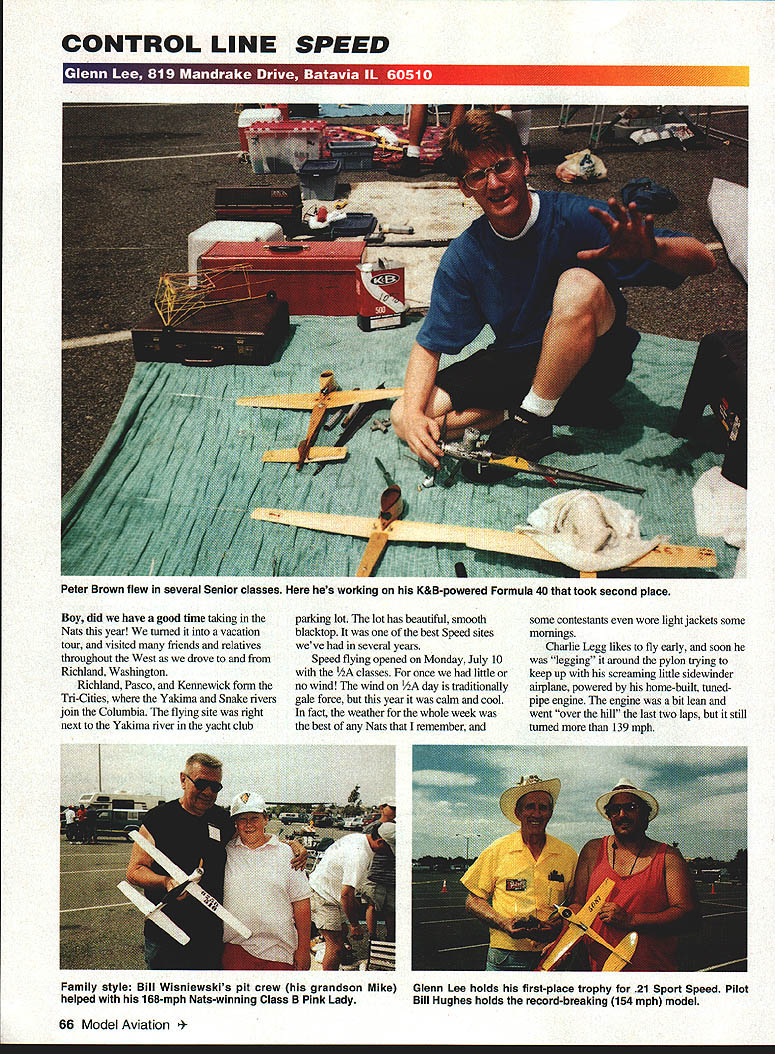
Speed flying opened on Monday, July 10 with the 1/2A classes. For once we had little or no wind. Charlie Legg likes to fly early, and soon he was "legging" it around the pylon trying to keep up with his screaming little sidewinder airplane, powered by his home‑built tuned‑pipe engine. The engine ran a bit lean and "went over the hill" on the last two laps, but it still turned more than 139 mph.
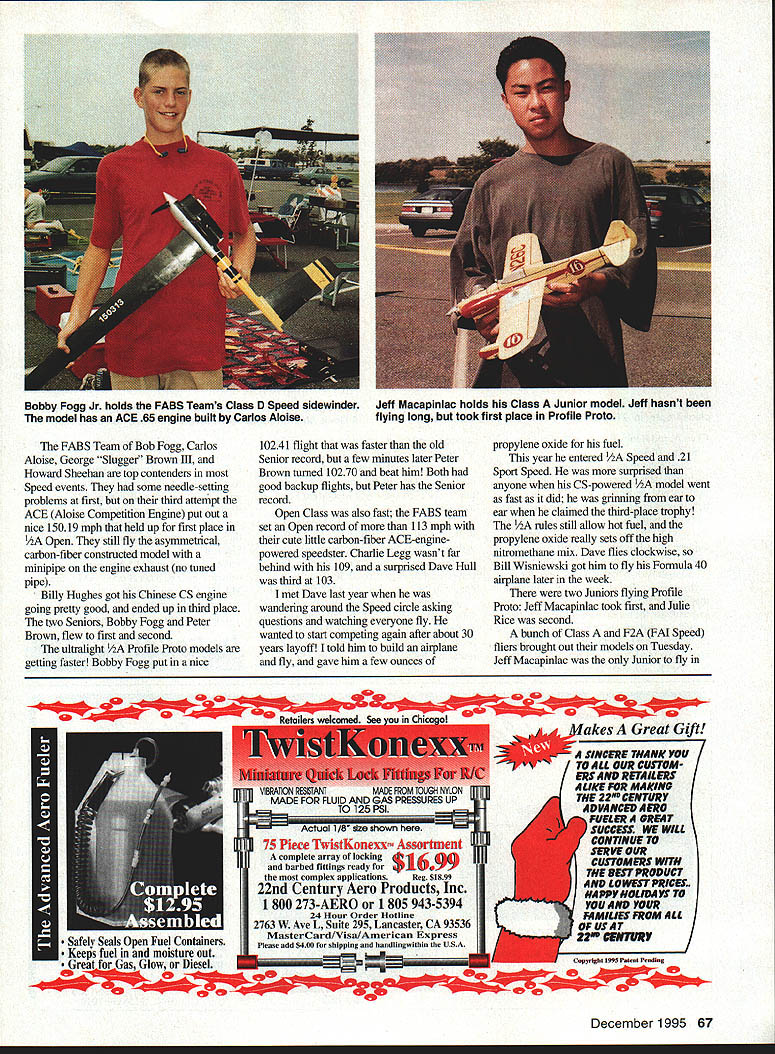
The FABS Team (Bob Fogg, Carlos Aloise, George "Slugger" Brown III, and Howard Sheehan) are top contenders in most Speed events. They had some needle‑setting problems at first, but on their third attempt the ACE (Aloise Competition Engine) put out a nice 150.19 mph that held up for first place in 1/2A Open. They still fly the asymmetrical carbon‑fiber model with a minipipe on the engine exhaust (no tuned pipe).
Billy Hughes got his Chinese CS engine going pretty well and ended up third. The two Seniors, Bobby Fogg and Peter Brown, flew first and second.
The ultralight 1/2A Profile Proto models are getting faster. Bobby Fogg put in a nice 102.41 mph flight that was faster than the old Senior record, but a few minutes later Peter Brown turned 102.70 mph and beat him. Both had good backup flights, but Peter holds the Senior record.
Open Class was also fast; the FABS Team set an Open record of more than 113 mph with their small carbon‑fiber, ACE‑engine‑powered speedster. Charlie Legg wasn't far behind with 109 mph, and a surprised Dave Hull was third at 103 mph.
I met Dave last year when he was wandering around the Speed circle asking questions and watching everyone fly. He wanted to start competing again after about 30 years' layoff. I told him to build an airplane and fly, and gave him a few ounces of propylene oxide for his fuel. This year he entered 1/2A Speed and .21 Sport Speed. He was more surprised than anyone when his CS‑powered 1/2A model went as fast as it did; he was grinning from ear to ear when he claimed the third‑place trophy.
The 1/2A rules still allow hot fuel, and the propylene oxide really sets off the high nitromethane mix. Dave flies clockwise, so Bill Wisniewski got him to fly his Formula 40 airplane later in the week.
There were two Juniors flying Profile Proto: Jeff Macapinlac took first, and Julie Rice was second.
Class A and F2A (FAI Speed)
A bunch of Class A and F2A fliers brought out their models on Tuesday. Jeff Macapinlac was the only Junior to fly in Class A, and Bobby Fogg was the only Senior who got a flight.
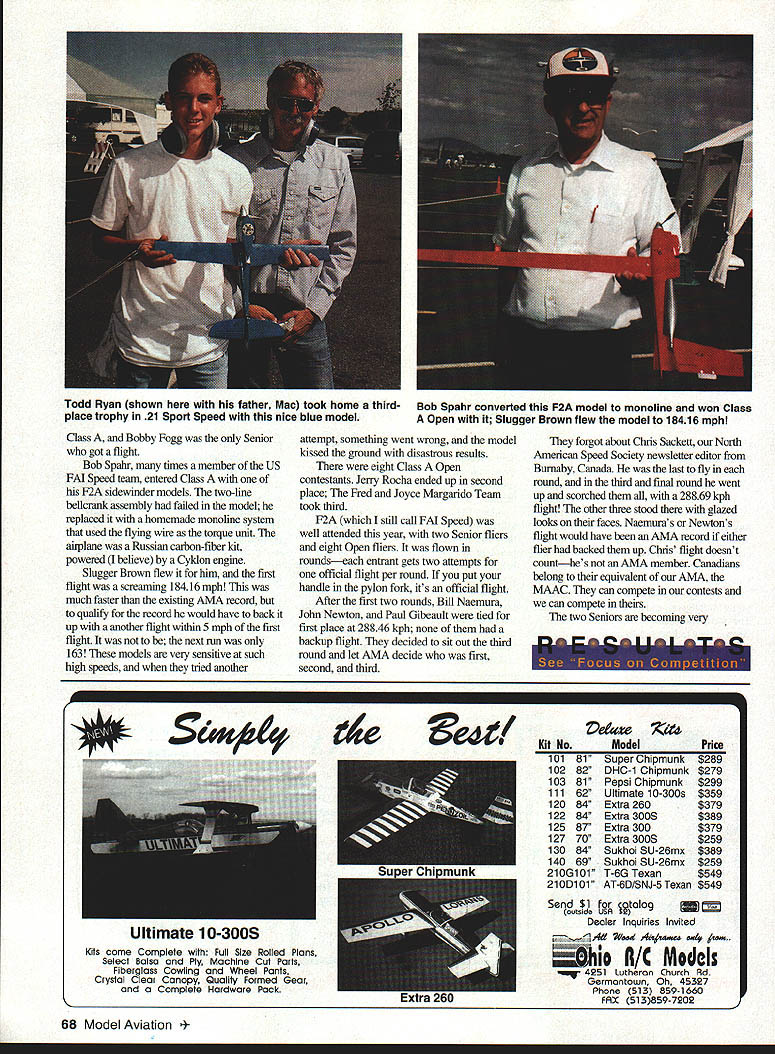
Bob Spahr, many times a member of the US FAI Speed team, entered Class A with one of his F2A sidewinder models. The two‑line bellcrank assembly had failed in the model; he replaced it with a homemade monoline system that used the flying wire as the torque unit. The airplane was a Russian carbon‑fiber kit, powered (I believe) by a Cykion engine. Slugger Brown flew it for him and the first flight was a screaming 184.16 mph — much faster than the existing AMA record. To qualify for the record he would have had to back it up with another flight within 5 mph of the first, but the next run was only 163 mph. On a subsequent attempt something went wrong and the model kissed the ground with disastrous results.
There were eight Class A Open contestants. Jerry Rocha ended up second; the Fred and Joyce Margarido Team took third.
F2A (FAI Speed) was well attended this year, with two Senior fliers and eight Open fliers. It was flown in rounds — each entrant gets two attempts for one official flight per round. After the first two rounds, Bill Naemura, John Newton, and Paul Gibeault were tied for first at 288.46 kph; none of them had a backup flight, so they sat out the third round. They forgot about Chris Sackett, our North American Speed Society newsletter editor from Burnaby, Canada. He was last to fly in each round, and in the third round he scorched the air with a 288.69 kph final flight. The others stood there stunned. Naemura's or Newton's flight would have been an AMA record if backed up, but Chris' flight doesn't count for AMA records — he's not an AMA member (Canadians belong to MAAC).
The two Seniors are becoming very competent F2A fliers. Bobby Fogg was tops among Seniors with 264 kph and David Van Allen was second at 235 kph.
.21 Sport Speed
Because of the usually high number of entrants, an entire day is reserved for the popular .21 Sport Speed class. This year we had five contestants in Junior‑Senior combined, and nine in Open class.
Bill Wisniewski likes to fly early in the morning, and has been training his grandson Mike to do the same. Mike was one of the first competitors to fly Wednesday morning, and his Pink Lady K&B .21‑powered model turned more than 141 mph, a speed that held first place for the rest of the day. Peter Brown and Todd Rain were right behind Mike for second and third.
The FABS Team also flew early. Their speed of 153.52 mph beat the old record of 152 mph that Connie Aloise set a couple of years ago. The FABS Team and Connie use the ACE .21 engines that Carlos Aloise designed and built; these have dominated .21 Sport Speed at the last few Nats, as have his 1/2A engines in other classes.
I was trying a Nova Rossi that I bought from Tim Gillott; I hadn't flown it. Tim works on engines for car racers and Scale Racing fliers, and this engine was one that some car guy ordered but didn't want.
I put up my first flight early with Billy Hughes flying for me. It was no good — the o‑ring minipipe restrainer didn't hold and the pipe went flying right after takeoff. Loss of any part during a flight disqualifies that attempt. Since I didn't have a spare, I had to find that pipe; I finally found it about a hundred yards away. I drilled a hole to take a restraining wire wrapped around a fuselage hook‑and‑bolt.
Everything worked great on my next attempt; the timers' stopwatches were close and my speed calculated out to a beautiful 154.31 mph. It would be a record if I could back it up. I put my card in, pulled, tugged, and fuel‑clipped under the watchful eyes of the officials. Then the same prop, the same glow plug, and the same engine had another flight at exactly the same speed. Apparently I got everything correct, and the combination of engine, prop, glow plug, airplane, and needle setting worked just right. I tried a different prop on my fourth and last attempt, but the speed dropped to 150 mph.
Connie Aloise had 149 mph for third place, followed by Chuck Schutte and Frank Garzon.
B Speed and Formula 40 (F40)
On Thursday we flew B Speed and Formula 40. Bill Wisniewski was one of the first to fly, as usual. His K&B .29‑powered Pink Lady turned 168 mph — a speed that held first place in B all day. When a tuned pipe is exactly matched to an engine, prop, and fuel combination, it can be an efficient silencer; Bill's flight was like this — the engine just hummed throughout the flight.
The F40 competition was lively. Bill Nusz had just arrived at the Nats the night before, and his Nelson .40‑powered F40 did a fine job.
It was the BMP Team's day in F40. Tommy Brown, Ned Morris, and Frank Paleo had formed the team a few weeks earlier, and they flew their K&B .40‑powered airplane one flight at 154.71 mph — good enough for first place. Naturally, we called them the "BUMP" Team for the rest of the week.
More records went down as the Seniors flew F40. One after another, three of them beat the previous high time. Todd Rain went 133 mph, only to be beaten by Peter Brown with 139 mph. Later David Van Allen ended up on top with 143.66 mph and a backup 143.20 mph, giving him the Senior F40 record.
Bobby Fogg Jr. put in a nice B flight at 161.51 mph that took first place; Brent Hazel was second. Seniors can't use tuned pipes in Class B, so these are pretty good times for a minipipe and a .29 engine.
Mike Wisniewski had some bad luck in B. He tried a test flight early in the week; the dolly didn't work properly and he damaged the model. He and Bill repaired the airplane, but there was more unseen damage to the other wing. On his first attempt the model got up to speed and the wing folded up, causing the model to oscillate. The oscillations became so severe that the model eventually went into the ground. Mike made a magnificent attempt to save it, but he had no control.
Class D Open and Big Models (.65s and Jets)
We brought out our big .65s and jets Friday, made a lot of noise, and had a lot of fun. I like to fly these bigger airplanes, even if mine don't go very fast. The FABS Team again used their huge carbon‑fiber, ACE .65‑powered sidewinder to win Class D Open with a good 194.31 mph. They hold the present record of 196.23 mph that they set last April; it's not much faster than their Nats flight. The BMP Team had a good 187 mph for second, and Glen Dye was not far behind in third.
It was again a battle between Bill Nusz and Jerry Thomas for first and second places. Bill got things working properly and his 190.80 mph ended up as the top time. Jerry took second at 184 mph, followed by the BMP Team in third place.
Attendance, Records, and Awards
Speed was well attended at this year's Nats and even included several modelers from Canada. There were 206 official flights and more than 60 attempts during the five days of competition. Four records were set, and eight other flights were faster than the old records.
Gail Nusz did her usual excellent job as Speed Event Director. Several volunteers, including Jack Wilson, Fred and Joyce Margarido, Al Kelly, and Mike and Bill Wisniewski, served as timers and officials.
We had our annual Speed banquet Friday. Awards included:
- FABS Team — High Point Trophy
- Bobby Fogg Jr. — Junior‑Senior High Point Trophy
- Bob Spahr — High Speed Trophy (for his magnificent Class A flight)
Transcribed from original scans by AI. Minor OCR errors may remain.

