
CONTROL LINE SPEED
Glenn Lee, 819 Mandrake Drive, Batavia, IL 60510
SPRING
What a wonderful word to those of us who are living up here where there are long cold winters! The first Speed contest of the year is only two weeks away as I write this in early May. As usual, I don't have my airplanes ready as they should be. I've been working on my .21, .29, .40, and .65 engines. I'm rechroming some of them; some are getting new heads; things like that. I haven't touched my jets since last year, and I want to try suction fuel feed instead of pressure this year.
The Lafayette Esquadrille Control Line Club of St. Louis has scheduled a Speed and Racing contest May 19. They tried once this early last year, but spring flooding put six feet of water on their flying field at Buder Park. They had very little snow this winter, so maybe it won't happen again.
Lapping
My column about engine-lapping techniques in the May issue has generated a lot of interest among RC fliers. Several have talked to me and said, "Gee, that really works!" A couple of them picked up more than 1,000 rpm on their flying prop after removing the shiny spots in the lower part of the sleeve. One flier improved his Cox engine from 23,000 rpm to more than 27,000!
The drawings I made of internal and external laps were the models that I use, but they're not necessarily the only types that will work. Commercial laps are available; they can be purchased from industrial-supply firms. One kind has a split-bronze sleeve on a tapered arbor; a screw on the end expands the bronze. You buy one that is oversize and turn down the outside diameter (OD) to fit your sleeve diameter. This type of lap works very well for hop-up procedures. If you do not have facilities to make your own laps, look around and check machine-tool supply companies in your area—you may be able to find what you need.
Ellipses
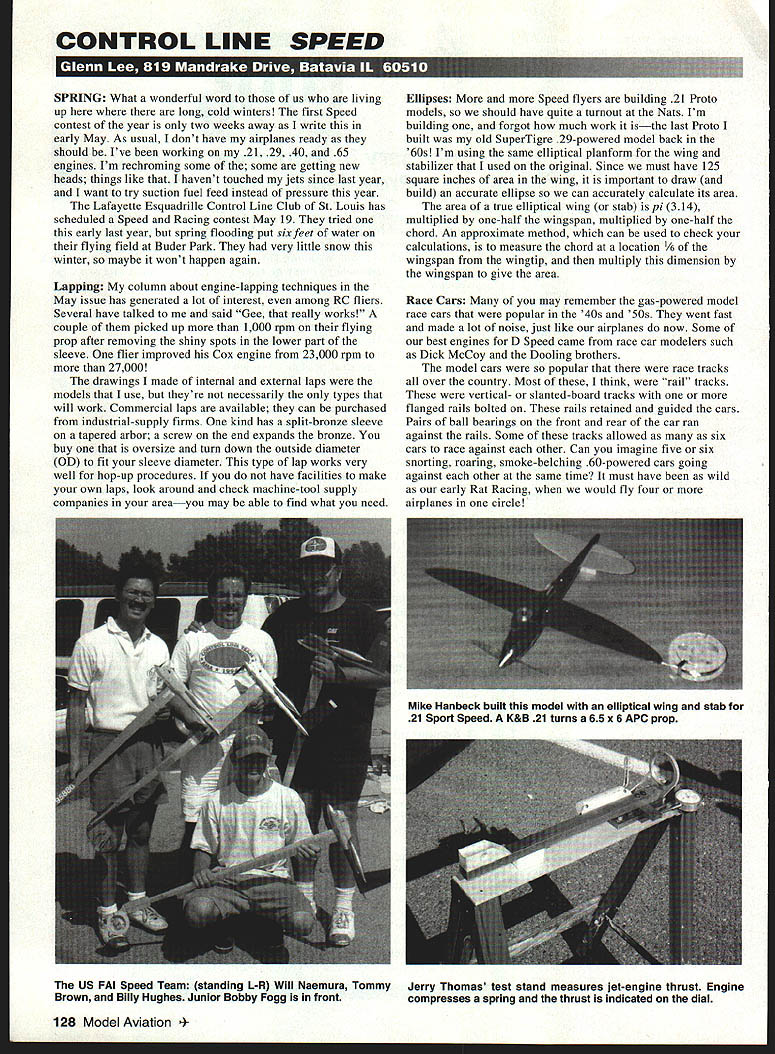
More and more Speed flyers are building .21 Proto models, so we should have quite a turnout at the Nats. I'm building one, and forgot how much work it is—the last Proto I built was my old SuperTigre .29-powered model back in the '60s! I'm using the same elliptical planform for the wing and stabilizer that I used on the original. Since we must have 125 square inches of area in the wing, it is important to draw (and build) an accurate ellipse so we can accurately calculate its area.
The area of a true elliptical wing (or stab) is pi (3.14) multiplied by one-half the wingspan, multiplied by one-half the chord. An approximate method, which can be used to check your calculations, is to measure the chord at a location 1/6 of the wingspan from the wingtip, and then multiply this dimension by the wingspan to give the area.
Race Cars
Many of you may remember the gas-powered model race cars that were popular in the '40s and '50s. They went fast and made a lot of noise, just like our airplanes do now. Some of our best engines for D Speed came from race car modelers such as Dick McCoy and the Dooling brothers.
The model cars were so popular that there were race tracks all over the country. Most of these, I think, were "rail" tracks. These were vertical- or slanted-board tracks with one or more flanged rails bolted on. These rails retained and guided the cars. Pairs of ball bearings on the front and rear of the car ran against the rails. Some of these tracks allowed as many as six cars to race against each other. Can you imagine five or six snorting, roaring, smoke-belching .60-powered cars going against each other at the same time? It must have been as wild as our early Rat Racing, when we would fly four or more airplanes in one circle!
Race car fans, just like Speed fliers, wanted faster models and found out tethered cars on a flat track would go faster. It wasn't long before rail tracks disappeared. Just as Control Line speeds started below 100 mph, they gradually increased as glow plugs and nitromethane phased in. Revival interest in tether cars has kindled once again. Modelers all over the country are building them; others are collecting and making race cars and engines like before. Prices of original cars and engines have skyrocketed—the McCoy and Dooling engines are like gold.
I heard a rumor that a new race track may be built on Long Island. Tracks I know of at the present time are in Anderson, Indiana, and in California near Whittier Narrows. I know almost nothing about race car club rules; I am trying to collect information. I heard a rumor we might try to organize a race at Anderson the weekend after the Control Line Nats; could see a run since it's not far from Muncie. I don't know whether car racing faded away; I wouldn't be surprised to see a revival. Individuals have new cars produced exactly like old ones and have installed engines like K&B RC. The side-exhaust non-piped engines should be contrasted with streamliner cars that use new Picco engines with full tuned pipes; those cars go 200 mph. FAI-type no-nitro-fuel old side-exhaust ringed-engine cars went close to 160 mph burning high-nitro fuel. I wouldn't be surprised if an ABC setup could beat that. I think it would be fun to run an old-car nostalgia class again.
The Start
The oldest reference I have seen concerning race cars is a set of plans in a 1936 book called The Giant Home Workshop Manual. The plans were for a tether car called the Tiny Tornado—it had reached a fantastic speed of 56.2 miles per hour! It was designed and built by Gordon Babb of Pasadena, California; he claimed that he built the first midget racer that started the hobby.
The Tiny Tornado used a 10cc model-airplane spark-ignition engine; it rotated a faucet washer against a disk that drove the front wheels. Other features included a remote carburetor to eliminate vapor lock, an air cleaner packed with copper scouring wool, roller-bearing-supported wheels, and spring suspension. It was built from balsa and hardwood.
The August 1951 issue of Air Trails had an excellent article about the Doolings and how they started in the race-car business. The following information came from that article.
Famous film actor Reginald Denny saw a car that Tom Dooling built (in 1936) after Tom crashed six or seven model airplanes. Mr. Denny was producing the Dennymite engines at the time, and ordered 25 cars that would take the Dennymite engine to sell at his Hollywood model shop.
Tom Dooling Jr., his father Tom Sr., and brothers Russell and Harris formed the Dooling Brothers Manufacturing Company. The company produced more than 25,000 model race cars before World War II. These cars were made from magnesium or aluminum castings; some had fiberglass tops. A 50-foot-diameter vacant lot next door to the company became the first Los Angeles race track.
During the war the Dooling machine shop worked on military contracts, including experimental bazookas and other classified projects. After the war, the Doolings wanted to build a good model engine, so they had four men working full-time for two years. They built at least 12 experimental engines at a cost of more than $50,000. The dynamometer equipment for model engines cost more than $3,000.
The 12 engines included two-stroke and four-stroke types, and even one twin-cylinder. Various porting designs, valve and bore-stroke ratios were tried. One four-stroke engine had a rotary divided tube across the top; it was driven by a train of spur gears up the rear of the engine. Fuel and air were compressed in the case as the piston came down, then were inducted into the cylinder through 360° of ports. This case-supercharging feature also provided lubrication for the gears and bearings in the engine. It would start easily, rev up to 28,000 rpm, and then lock up tight—throwing off the flywheel, which would hit the floor and scoot away like a rocket!
The engine they finally arrived at (and produced) was the famous Dooling .61. It was used in race cars and Control Line Speed airplanes for many years. It featured an oversquare bore-stroke ratio with a 1.015" bore and a .750" stroke. It also featured a ball-bearing-supported crankshaft, a rear-rotary-valve intake, needle bearings on the lower end of the conrod, two piston rings, a highly domed piston, and bypass induction through holes in the piston skirt.
Key features of the Dooling .61:
- Oversquare bore-stroke ratio (1.015" bore × .750" stroke)
- Ball-bearing-supported crankshaft
- Rear-rotary-valve intake
- Needle bearings on the lower end of the connecting rod
- Two piston rings and a highly domed piston
- Bypass induction through holes in the piston skirt
Bill Wisniewski won Senior D Speed at the Nats one year with his Dooling at a speed of 148 mph. He and his West Coast flying pals eventually attained speeds of more than 180 mph with modifications like Dykes rings and flat-top pistons. Schnuerle porting and ABC alloys outpaced the old engines around 1965. When tuned pipes and OPS engines were put in cars, speeds immediately jumped to the 170s, 180s, and then to more than 200 mph—just as they did in our airplanes.
Dooling also produced a nice .29 that flew in B Speed for many years. These, too, are collector's engines now.
Transcribed from original scans by AI. Minor OCR errors may remain.

