
CONTROL LINE SPEED
Glenn Lee 819 Mandrake Drive, Batavia IL 60510
1996 Nationals
When I wrote about the Nats a few months ago, I listed Perkins as the Open Jet Speed winner—that was not correct. The Perkins team won. Steve flies, while his father, Dimmitt, and brother, Dimmy Jr., handle the pitting. When I copied the results on that last hurried day of Speed flying, I just wrote down “Perkins” and I forgot that they fly as a team—I apologize.
Jet Speed is one event in which you need experienced help when starting those beasts. Most Speed competitors are good people who will readily help anyone who is shorthanded. Billy Hughes, Tommy and Slugger Brown, and other strong, young guys like to fly Speed models, so they fly many entrants' airplanes for them. Rules state that the entrant must either fly his or her model or start and set the model's engine. If you are alone but want to fly Speed, build an airplane and Speed fliers will help you get it into the air.
Proto Canopies
Those who are building (or contemplating building) a .21 Proto need the right-size canopy to meet the rules. Bob Whitney has a vacuum-forming jig that makes neat canopies quickly and easily. He has volunteered to make them for those who need them—for free. It would be nice if you would supply postage if you place an order. Bob's address is:
Bob Whitney 7840 NW 16 Court Pembroke Pines, FL 33024
You can also make your own canopy without too much trouble. Carve a wooden form to the right size and stretch clear heat-forming plastic over it. The clear-plastic soft-drink bottles are made of material that can be hot-formed by heating with a hot-air gun. Get someone to heat the plastic as you stretch it over the form, and wear gloves to protect your hands.
Too many modelers are afraid to attempt creating special parts just because they have never done it. If you try, you might find talents you never knew you possessed. Many guys, like Bob Whitney, have learned to make things such as:
- spinners
- remote needle-valve housings
- bellcranks
- special monoline units
- canopies
Many custom-made parts can be fabricated without going to a machine shop. It's all part of the fun of modeling and learning how to build something besides kit models.
Proto Design
When .21 Proto Speed started, quite a few builders were plagued by takeoff problems—the airplane would torque in toward the pilot. Some of these takeoffs could have been caused (or worsened) by having the exhaust opening on the wrong side of the fuselage. The blast of gases from the exhaust of a high-revving engine can have appreciable thrust, and if it is directed toward the outside of the fuselage it could produce enough thrust to cause a roll-in and sagging lines.
It is relatively simple to build exhaust openings on both sides of the fuselage for rear-exhaust engines—consider this when designing and building your Proto. An exhaust deflector can be made of two flat or curved pieces of thin aluminum; glue the pieces in with high-temperature RTV sealant to protect the wood.
Proto Scale
I haven't seen any Scale models built for the .21 Proto event, although the rules allow them as long as they have 125 square inches of wing area.
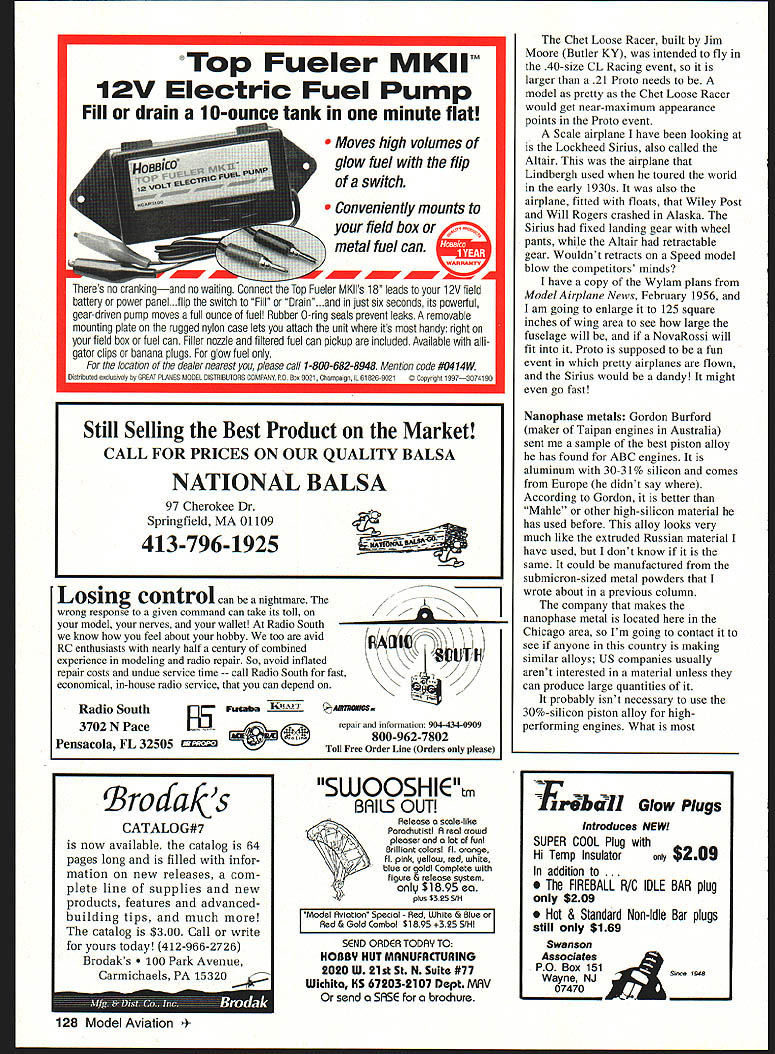
Most full-scale airplanes have huge cargo-carrying fuselages, but racing airplanes are more streamlined with thinner, sleeker bodies for maximum speed. If you look at plans from the "Golden Age" of air racing (prior to 1930), several racers had large wings in relation to the size of the fuselage. These models might be suitable to allow you to build a Scale model with drag low enough to compete.
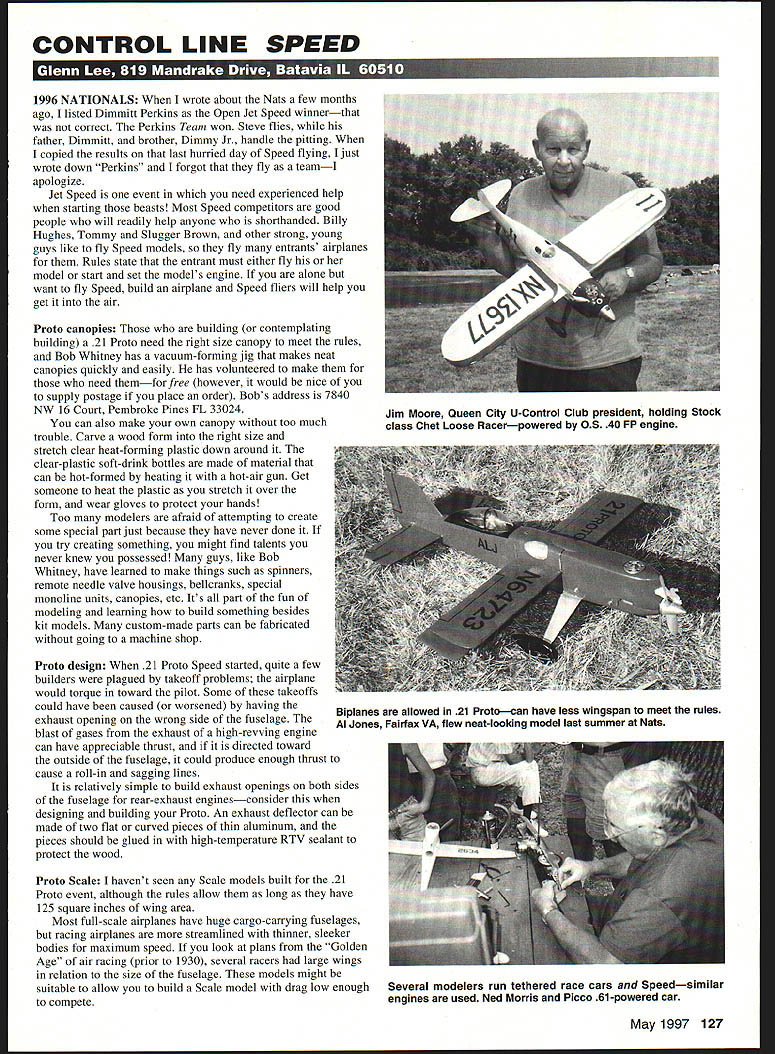
The Chet Loose Racer, built by Jim Moore (Butler, KY), was intended to fly in the .40-size CL Racing event, so it is larger than a .21 Proto needs to be. A model as pretty as the Chet Loose Racer would get near-maximum appearance points in the Proto event.
A Scale airplane I have been looking at is the Lockheed Sirius, also called the Altair. This was the airplane Lindbergh used when he toured the world in the early 1930s. It was also the airplane, fitted with floats, that Wiley Post and Will Rogers crashed in Alaska. The Sirius had fixed landing gear with wheel pants, while the Altair had retractable gear. Wouldn't retracts on a Speed model blow the competitors' minds?
I have a copy of the Wylam plans from Model Airplane News, February 1956, and I am going to enlarge it to 125 square inches of wing area to see how large the fuselage will be, and if a Nova Rossi will fit into it. Proto is supposed to be a fun event in which pretty airplanes are flown, and the Sirius would be a dandy. It might even go fast!
Nanophase Metals
Gordon Burford (maker of Taipan engines in Australia) sent me a sample of the best piston alloy he has found for ABC engines. It is aluminum with 30–31% silicon and comes from Europe (he didn't say where). According to Gordon, it is better than "Mahle" or other high-silicon material he has used before. This alloy looks very much like the extruded Russian material I have used, but I don't know if it is the same. It could be manufactured from the submicron-sized metal powders that I wrote about in a previous column.
The company that makes the nanophase metal is located here in the Chicago area, so I'm going to contact it to see if anyone in this country is making similar alloys; U.S. companies usually aren't interested in a material unless they can produce large quantities of it.
It probably isn't necessary to use the 30%-silicon piston alloy for high-performing engines. What is most important is that the piston alloy and the sleeve alloy match for the proper thermal expansion at operating rpm, and the alloys must have the proper shape, taper, and fit. The higher silicon percentage might result in less friction against the chrome, but this could only be proven by extensive testing. You can't depend on evidence from only one or two engines; machining-tolerance differences would probably cause more variation than slight differences in the materials used.
Edmonds Engines
Since I'm not into RC Pylon Racing, I was familiar with Nelson, Jett, Rossi, and O.S. engines, but I had never heard of the Edmonds engine until I talked to Don Jehlik. Apparently Greg Edmonds (who lives in Maryland) got interested in Pylon and wondered if he could build an engine that could compete with the ones currently used. By utilizing his complete machine shop and motorcycle-racing experience, he soon had .40-size engines that out-turned the "Brand X" engines by several hundred rpm.
The Edmonds engines were flown in competition, where they placed high but didn't win—so they weren't considered to be very good. But the pilot's ability wasn't even factored into the equation. Someone flipped the prop when the engine was hot, and it didn't "pop" over top center like the Brand X engine did. Again, it was "no good" since it didn't have compression when it was hot. Never mind that it ran faster!
To sell engines, Greg had to experiment with various alloys for the sleeve and piston until he arrived at a combination that would run as fast (or faster than) Brand X and would "feel good" when the engine was hot. Now he has a high-silicon, heat-treated piston and a special aluminum-alloy sleeve material that he chrome-plates for an A/AC combination. He has also found the proper piston shape and a proper taper in the sleeve to give consistent top performance. I'll get more information for my next column.
Transcribed from original scans by AI. Minor OCR errors may remain.

