
Control Line: Speed
Gene Hempel & Tom Upton
YOU ARE at the local speed contest when Sam Stopwatch turns 199.99 mph in Z speed, and the questions start flying. What was the engine? Was it a Rev‑Up or Top Flite prop, and how much nitro? Was it a suction or bladder tank? What was the timing; 195° exhaust and 106° intake, who do you think you are fooling? The discussion always gets to timing because it is one "secret" most people can understand. We are going to discuss the tools and how‑to of timing, plus give our "secret" rules‑of‑thumb which will fit most engines.
One revolution of the crankshaft covers 360° and timing numbers simply locate where the exhaust or intake ports open, and for how many crankshaft degrees they remain open. All production engines, except Foxes, have symmetrical cylinder timing: if the exhaust opens 80° before Bottom Dead Center (BDC), it will close 80° after BDC — giving a total port duration of 80° + 80° = 160°. Foxes are Desaxe designs, with the cylinder bore offset to one side of the crankshaft centerline and the ports will open and close at different crankshaft degrees.
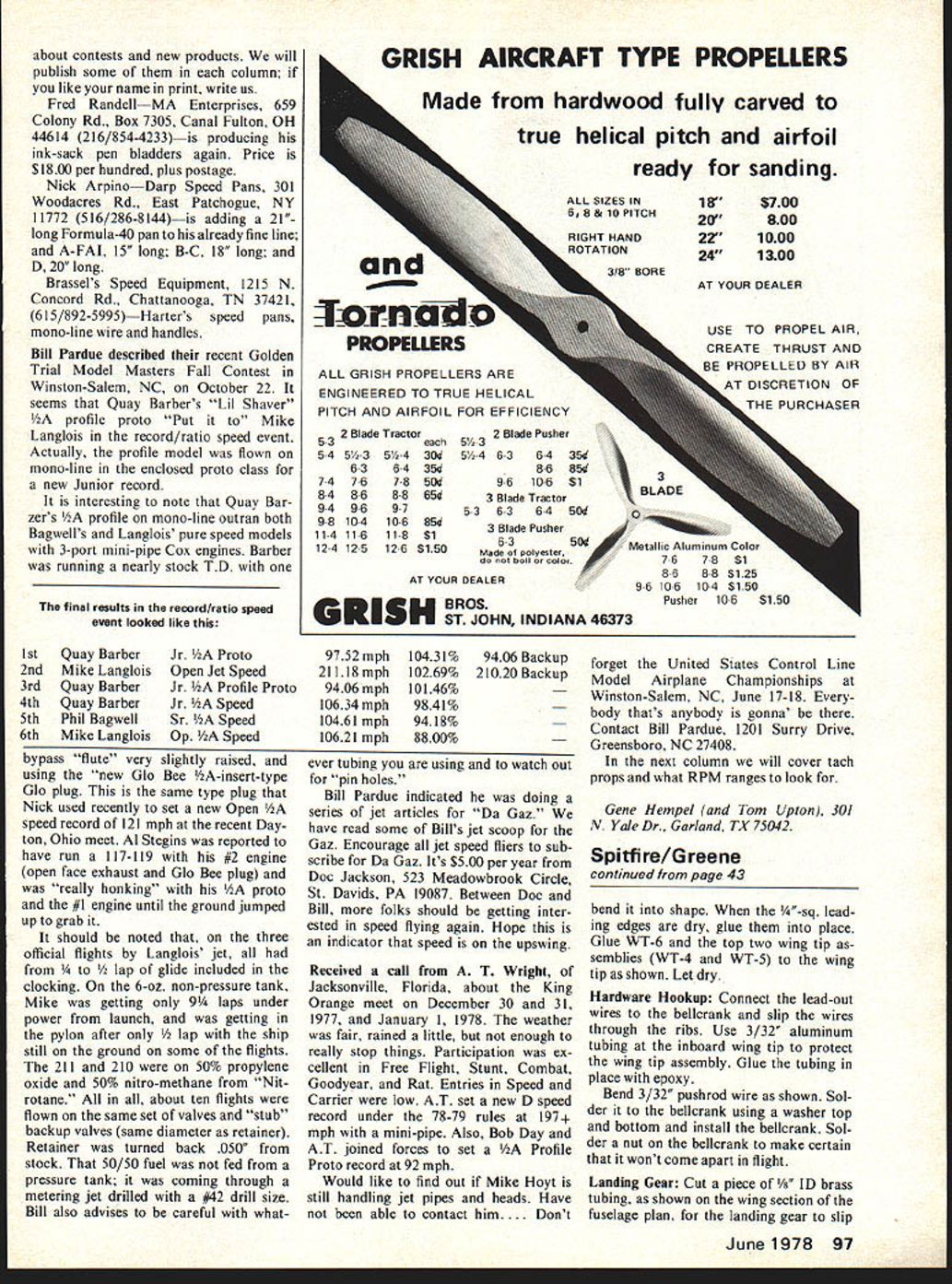
Timing an engine requires a 360° protractor, a fixed reference point attached to either the engine or a timing stand, a flashlight, and a depth micrometer. To determine exhaust or intake timing, install the protractor on the shaft and use a flashlight in a dark room, or a depth micrometer set at port height, to find where the port opens (example: 232°) and rotate the engine until it closes again (example: 72°). The difference in the two is the duration of the port opening (Example: 232° − 72° = 160° duration) and dividing the duration by two gives the opening or closing location (160°/2 = 80° before and after BDC).
The rotor or crankshaft (inlet) timing is a little more involved because TDC must be located before anything else can be done. With a depth micrometer or dial indicator touching the piston crown, turn the engine one direction, then the other, until you find TDC on your protractor. tractor (example: 17°). Use a flashlight to tell when the rotor or crank port closes (example: 72°) and opens (example: 232°). Now, take your closing (72°) and subtract 180° + TDC(17°) = 35°. Your inlet timing is open at 35° after BDC, and closed at 55° after TDC, with a total duration of 180° - 35° = 145° + 55° = 200°.
Now that we have thoroughly confused you, here are our "secret" timing numbers. Piped engines — 168°–172° exhaust, 128°–132° intake, and rotor open at 45° ABDC, and close at 65° ATDC. Mini-piped engines — 160°–166° exhaust, 124°–128° intake, and rotor open at 35° ABDC and close at 55° ATDC. These are general rules-of-thumb and give good results, but they are not necessarily the ultimate. We have run piped 29's with 176° exhaust and 134° intake with good results, but they become very sensitive.
We have been getting lots of mail telling about contests and new products. We will publish some of them in each column; if you like your name in print, write us.
Fred Randell—MA Enterprises, 659 Colony Rd., Box 7305, Canal Fulton, OH 44614 (216/854-4233)—is producing his ink-sack pen bladders again. Price is $18.00 per hundred, plus postage.
Nick Arpino—Darp Speed Pans, 301 Woodacres Rd., East Patchogue, NY 11772 (516/286-8144)—is adding a 21"-long Formula-40 pan to his already fine line: and A-FAI, 15" long; B-C, 18" long; and D, 20" long.
Brassel's Speed Equipment, 1215 N. Concord Rd., Chattanooga, TN 37421 (615/892-5995)—Harter's speed pans, mono-line wire and handles.
Bill Pardue described their recent Golden Trial Model Masters Fall Contest in Winston-Salem, NC, on October 22. It seems that Quay Barber's "Lil Shaver" 1/2A profile proto "put it to" Mike Langlois in the record/ratio speed event. Actually, the profile model was flown on mono-line in the enclosed proto class for a new Junior record.
It is interesting to note that Quay Barber's 1/2A profile on mono-line outran both Bagwell's and Langlois' pure speed models with 3-port mini-pipe Cox engines. Barber was running a nearly stock T.D. with one bypass "flute" very slightly raised, and using the "new Glo Bee 1/2A-insert-type" Glo plug. This is the same type plug that Nick used recently to set a new Open 1/2A speed record of 121 mph at the recent Dayton, Ohio meet. Al Stegins was reported to have run a 117–119 with his #2 engine (open face exhaust and Glo Bee plug) and was "really honking" with his 1/4-A proto and the #1 engine until the ground jumped up to grab it.
The final results in the record/ratio speed event looked like this:
1st Quay Barber Jr. 1/2A Proto 97.52 mph 104.31% 94.06 Backup 2nd Mike Langlois Open Jet Speed 211.18 mph 102.69% 210.20 Backup 3rd Quay Barber Jr. 1/2A Profile Proto 94.06 mph 101.46% — 4th Quay Barber Jr. 1/2A Speed 106.34 mph 98.41% — 5th Phil Bagwell Sr. 1/2A Speed 104.61 mph 94.18% — 6th Mike Langlois Op. 1/2A Speed 106.21 mph 88.00% —
It should be noted that, on the three official flights by Langlois' jet, all had from 1/4 to 1/2 lap of glide included in the clocking. On the .06 oz. non-pressure tank, Mike was getting only 9 1/4 laps under power from launch, and was getting in the pylon after only 1/2 lap with the ship still on the ground on some of the flights. The .21 and .210 were on 50% propylene oxide and 50% nitro-methane from "Nitrotane." All in all, about ten flights were flown on the same set of valves and "stub" backup valves (same diameter as retainer). Retainer was turned back .050" from stock. That 50/50 fuel was not fed from a pressure tank; it was coming through a metering jet drilled with a #42 drill size. Bill also advises to be careful with whatever tubing you are using and to watch out for "pin holes."
Bill Pardue indicated he was doing a series of jet articles for "Da Gaz." We have read some of Bill's jet scoop for the Gaz. Encourage all jet speed fliers to subscribe for Da Gaz. It's $5.00 per year from Doc Jackson, 523 Meadowbrook Circle, St. Davids, PA 19087. Between Doc and Bill, more folks should be getting interested in speed flying again. Hope this is an indicator that speed is on the upswing.
Received a call from A. T. Wright, of Jacksonville, Florida, about the King Orange meet on December 30 and 31, 1977, and January 1, 1978. The weather was fair, rained a little, but not enough to really stop things. Participation was excellent in Free Flight, Stunt, Combat, Goodyear, and Rat. Entries in Speed and Carrier were low. A.T. set a new D speed record under the '78–'79 rules at 197+ mph with a mini-pipe. Also, Bob Day and A.T. joined forces to set a 1/2A Profile Proto record at 92 mph.
Would like to find out if Mike Hoyt is still handling jet pipes and heads. Have not been able to contact him.... Don't forget the United States Control Line Model Airplane Championships at Winston-Salem, NC, June 17–18. Everybody that's anybody is gonna' be there. Contact Bill Pardue, 1201 Surry Drive, Greensboro, NC 27408.
In the next column we will cover tach props and what RPM ranges to look for.
Gene Hempel (and Tom Upton), 301 N. Yale Dr., Garland, TX 75042.
Transcribed from original scans by AI. Minor OCR errors may remain.

