
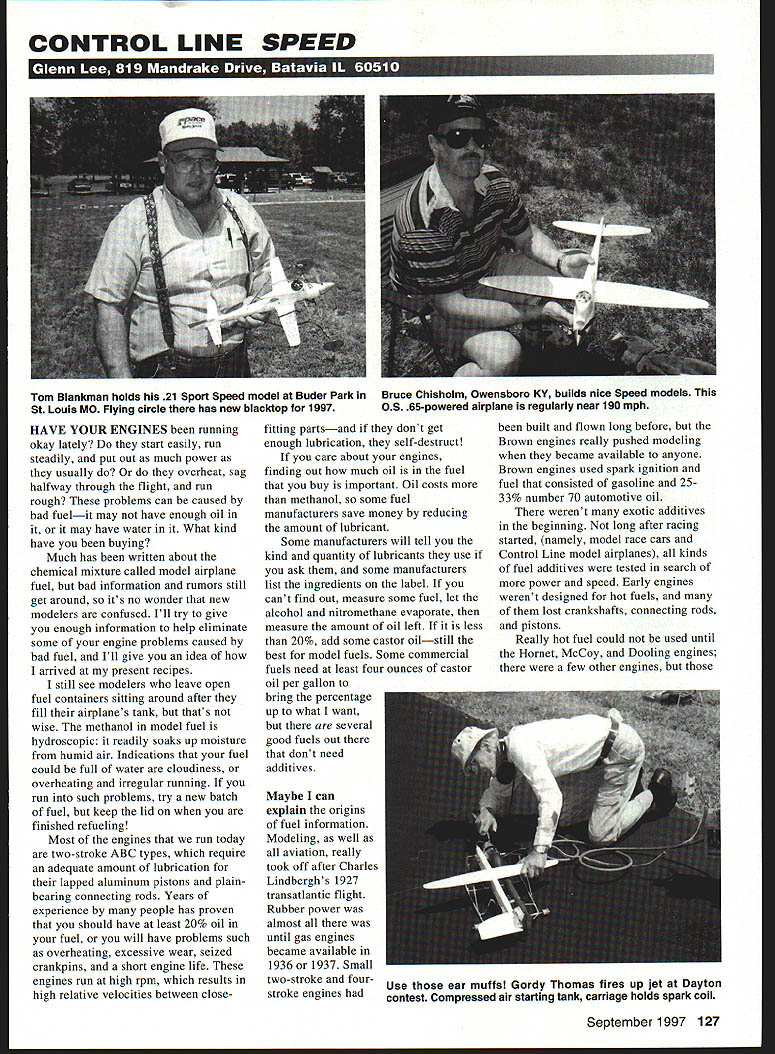
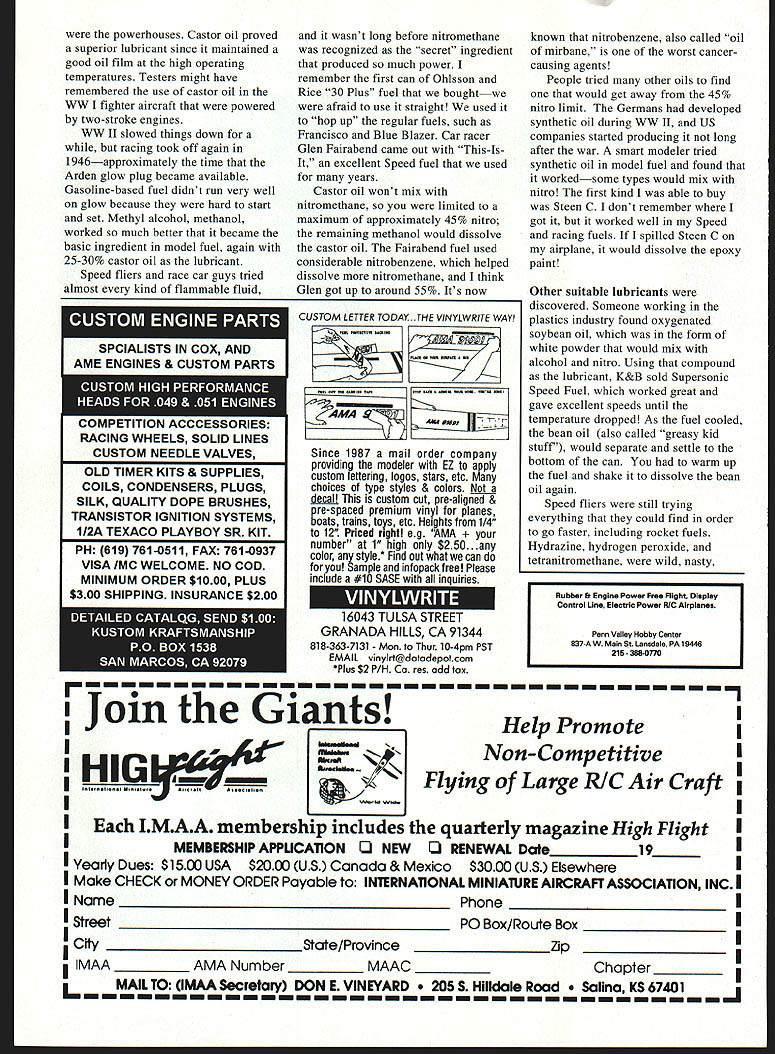
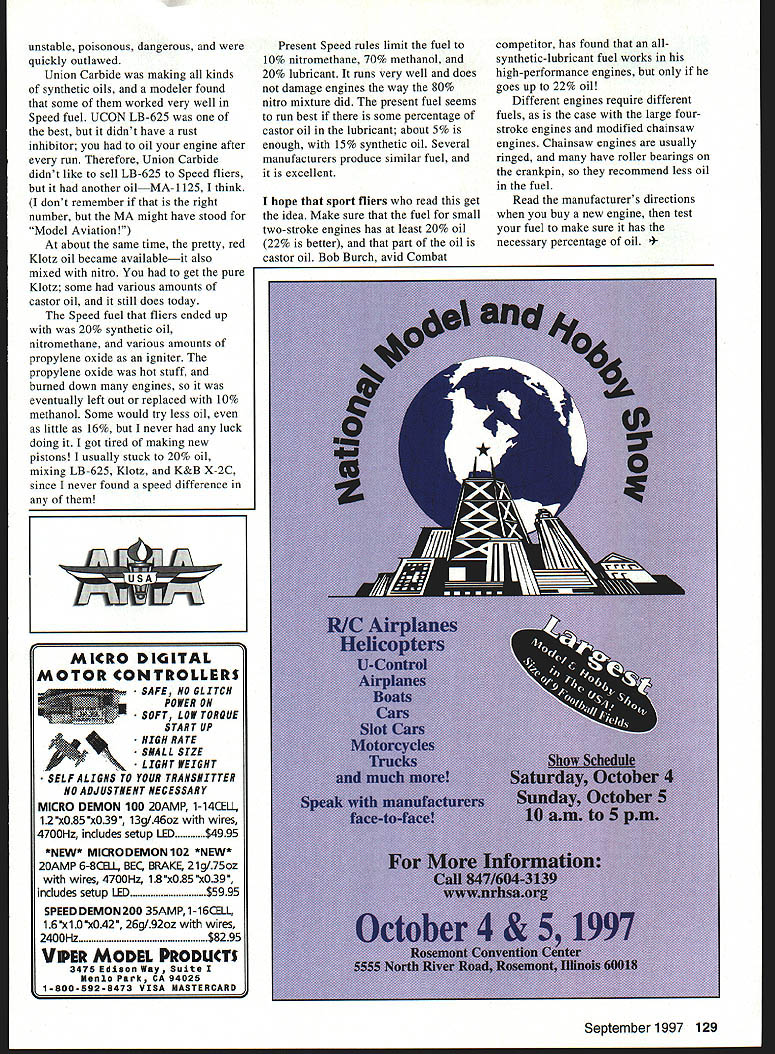
CONTROL LINE: SPEED
Glenn Lee — 819 Mandrake Drive, Batavia, IL 60510
Have your engines been running okay lately? Do they start easily, run steadily, and put out as much power as they usually do? Or do they overheat, sag halfway through the flight, and run rough? These problems can be caused by bad fuel — it may not have enough oil in it, or it may have water in it. What kind have you been buying?
Fuel contamination and storage
The methanol in model fuel is hygroscopic; it readily soaks up moisture from humid air. Indications that your fuel could be contaminated with water include:
- cloudiness,
- overheating, and
- irregular running.
I still see modelers who leave open fuel containers sitting around after they fill their airplane's tank, but that's not wise. If you run into the problems above, try a new batch of fuel — and keep the lid on when you are finished refueling.
Required oil percentage
Most of the engines we run today are two-stroke ABC types, which require adequate lubrication for their lapped aluminum pistons and plain-bearing connecting rods. Years of experience by many people has proven that you should have at least 20% oil in your fuel, or you will have problems such as overheating, excessive wear, seized crankpins, and a short engine life. These engines run at high rpm, which results in high relative velocities between close-fitting parts — and if they don't get enough lubrication, they self-destruct.
If you care about your engines, finding out how much oil is in the fuel you buy is important. Oil costs more than methanol, so some fuel manufacturers save money by reducing the amount of lubricant. Some manufacturers will tell you the kind and quantity of lubricants they use if you ask, and some list the ingredients on the label. If you can't find out, measure some fuel, let the alcohol and nitromethane evaporate, then measure the amount of oil left. If it is less than 20%, add some castor oil — still the best for model fuels. Some commercial fuels need at least four ounces of castor oil per gallon to bring the percentage up to what I want, but there are several good fuels out there that don't need additives.
History and development of model fuels
Modeling — as well as aviation — really took off after Charles Lindbergh's 1927 transatlantic flight. Rubber power was almost all there was until gas engines became available in 1936 or 1937. Small two-stroke and four-stroke engines had been built and flown long before, but the Brown engines really pushed modeling when they became available to anyone. Brown engines used spark ignition and fuel that consisted of gasoline and 25–33% number 70 automotive oil.
There weren't many exotic additives in the beginning. Not long after racing started (model race cars and control line model airplanes), all kinds of fuel additives were tested in search of more power and speed. Early engines weren't designed for hot fuels, and many of them lost crankshafts, connecting rods, and pistons.
Castor oil proved a superior lubricant since it maintained a good oil film at high operating temperatures. Testers might have remembered to use castor oil in WWI fighter aircraft powered by two-stroke engines. WWII slowed things down; racing took off again in 1946, approximately the time the Arden glow plug became available. Gasoline-based fuel didn't run very well on glow because it was hard to start. Methyl alcohol (methanol) worked much better and became the basic ingredient in model fuel again, plus 25–30% castor oil as lubricant.
Speed fuels and experimentation
Speed fliers and race car guys tried almost any kind of flammable fluid, and it wasn't long before nitromethane was recognized as the "secret" ingredient that produced so much power. I remember the first can of Ohlsson and Rice "30 Plus" fuel that we bought — we were afraid to use it straight! We used it to "hop up" the regular fuels, such as Francisco and Blue Blazer. Car racer Glen Fairabend came out with "This-Is-It," an excellent speed fuel that we used for many years.
Castor oil won't mix with nitromethane, so you were limited to a maximum of approximately 45% nitro; the remaining methanol would dissolve the castor oil. The Fairabend fuel used considerable nitrobenzene, which helped dissolve more nitromethane, and I think Glen got up to around 55%. It's now known that nitrobenzene, also called "oil of mirbane," is one of the worst cancer-causing agents.
People tried many other oils to get away from the 45% nitro limit. The Germans had developed synthetic oil during WWII and U.S. companies started producing it not long after the war. A smart modeler tried synthetic oil in model fuel and found that it worked — some types would mix with nitro! The first kind I was able to buy was Steen C; I don't remember where I got it, but it worked well in my speed and racing fuels. If I spilled Steen C on my airplane, it would dissolve the epoxy paint!
Other suitable lubricants were discovered. Someone working in the plastics industry found oxygenated soybean oil (in the form of a white powder) that would mix with alcohol and nitro. Using that compound as the lubricant, K&B sold Supersonic Speed Fuel, which worked great and gave excellent speeds until the temperature dropped. As the fuel cooled, the bean oil (also called "greasy kid stuff") would separate and settle to the bottom of the can. You had to warm up the fuel and shake it to redissolve the bean oil.
Speed fliers were still trying everything to go faster, including rocket fuels. Hydrazine, hydrogen peroxide, and tetranitromethane were wild, nasty, unstable, poisonous, dangerous, and were quickly outlawed.
Union Carbide was making all kinds of synthetic oils, and a modeler found that some of them worked very well in speed fuel. UCON LB-625 was one of the best, but it didn't have a rust inhibitor; you had to oil your engine after every run. Therefore, Union Carbide didn't like to sell LB-625 to speed fliers, but it had another oil — MA-1125, I think. (I don't remember if that is the right number, but the MA might have stood for "Model Aviation"!)
At about the same time, the pretty red Klotz oil became available — it also mixed with nitro. You had to get the pure Klotz; some had various amounts of castor oil, and it still does today.
Modern speed fuels and rules
The speed fuel that fliers ended up with was 20% synthetic oil, nitromethane, and various amounts of propylene oxide as an igniter. The propylene oxide was hot stuff, and burned down many engines, so it was eventually left out or replaced with 10% methanol. Some would try less oil, even as little as 16%, but I never had any luck doing it. I got tired of making new pistons! I usually stuck to 20% oil, mixing LB-625, Klotz, and K&B X-2C, since I never found a speed difference in any of them.
Present speed rules limit the fuel to 10% nitromethane, 70% methanol, and 20% lubricant. It runs very well and does not damage engines the way the 80% nitro mixtures did. The present fuel seems to run best if there is some percentage of castor oil in the lubricant; about 5% castor with 15% synthetic oil is enough. Several manufacturers produce similar fuel, and it is excellent.
Recommendations
- Make sure that the fuel for small two-stroke engines has at least 20% oil (22% is better), and that part of the oil is castor oil.
- Bob Burch, an avid Combat competitor, has found that an all-synthetic-lubricant fuel works in his high-performance engines, but only if he goes up to 22% oil.
- Different engines require different fuels. Large four-stroke engines and modified chainsaw engines may be ringed and have roller bearings on the crankpin, so they recommend less oil in the fuel.
- Read the manufacturer's directions when you buy a new engine, then test your fuel to make sure it has the necessary percentage of oil.
Transcribed from original scans by AI. Minor OCR errors may remain.

