
Control Line: Speed
Glenn Lee, 819 Mandrake Drive, Batavia IL 60510
Florida
Speed fliers are scattered around Florida, so I have been bugging Bob Whitney to put on a contest this winter. He found a site and will host the Florida State Speed Championships Cash Bash at the Pompano harness track, January 3–4, 1998. All classes except Jet will be there; that much noise is not permitted. I needed an excuse to go south this winter, so this sounds good. Get your stuff together and go!
Dayton
As I write this in early September, I'm getting ready for the Cold Cash Speed Bash in Dayton, Ohio. This traditional contest is normally the best-attended Speed meet all year, with competitors from as far away as Colorado, Florida, New York, and Canada. I'll probably have some photos for the next column. Weather is usually excellent for this event, so I wouldn't be surprised to see some records.
Oily rags
Someone recently wrote about the dangers of oily rags and spontaneous combustion. Modelers, using high-oil-content fuels, customarily end up wiping cloths or paper towels saturated with castor or synthetic oil after cleaning up their airplanes.
The spontaneous combustion problem arises when some oils generate heat as they dry—namely linseed oil. I doubt that Klotz X2-C or other synthetic oils do this; I have never heard of castor oil generating heat, although castor does turn to varnish in old engines. If you know whether castor oil generates heat as it dries, send the information and I'll pass it along.
Diesels for Speed
Someone wants to run a diesel engine in Speed, but the rules list the standard fuel as methanol with 20% lubricant and 10% nitro (nitromethane), a mixture on which diesels won't run. So, can a diesel be run using its own fuel? Should we limit the nitro content of his fuel? To my knowledge, diesels will run on mixtures of oil, nitro, and ether (nitroether), so it might be possible to get power out of such a formula.
The same question applies to other events, such as Racing, so some kind of decision needs to be made. I feel there should be demonstration flights and more information on what kind of fuel will be used before any ruling is set.
Errors (rotary engines and previous correction)
In the September issue I wrote about the development of model fuels and various lubricants and mentioned the use of castor oil in WWI fighter aircraft powered by two-stroke engines. Dave Segal, Philadelphia, PA, wrote to point out that those engines were four-stroke, not two-stroke.
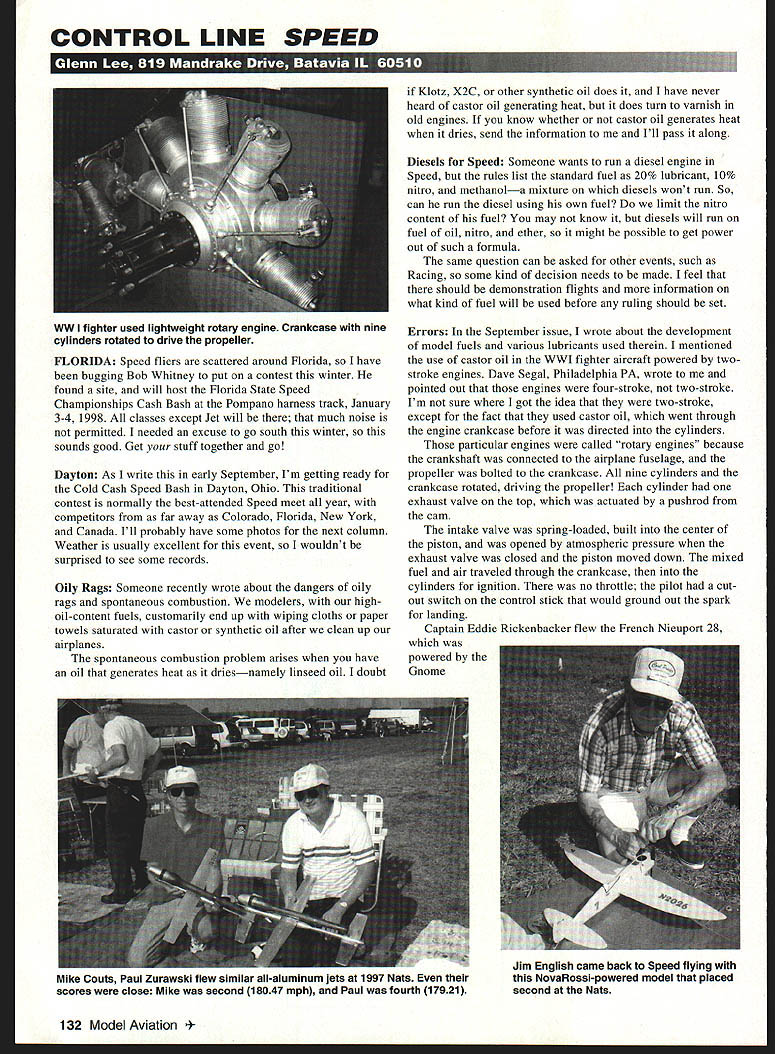
Those particular engines were called rotary engines because the crankcase was connected to the airplane fuselage and the propeller was bolted to the crankcase. All nine cylinders and the crankcase rotated, driving the propeller. Each cylinder had one exhaust valve on the top, actuated by a pushrod from the cam. The intake valve was spring-loaded, built into the center of the piston, and was opened by atmospheric pressure when the exhaust valve was closed and the piston moved down. The mixed fuel and air traveled through the crankcase and then into the cylinders for ignition. There was no throttle; the pilot had a cut-out switch on the control stick that would ground out the spark for landing.
Captain Eddie Rickenbacker flew the French Nieuport 28, which was powered by the Gnome Monosoupape 150 hp rotary engine. This engine weighed 330 pounds, giving a weight-to-power ratio of about 2.08 pounds per hp—one of the main reasons the design was used. It used roughly 125 liters of gasoline and 25 liters of pharmaceutical-grade castor oil, which gave about two hours of flying time. (I found this data in a 1956 Model Airplane News.)
Don Lockwood, who owns a couple of the old rotary engines, said there was a two-stroke rotary engine called the Fredrickson (spelling uncertain), in which the connecting rod moved side-to-side to open and close the intake port. It blew up on the test stand and cost the investors a bunch of money.
Duke Fox knew how to build a good engine. I visited the Fox factory once. To test an engine, they would bolt on several prop washers as a flywheel (no prop), connect the engine to a one-gallon fuel supply, start it by wrapping some tape around the flywheel, and then close the door on the test building and go away. The engine would scream until the can was empty!
Nitrobenzene and other additives
Don also sent data sheets on nitrobenzene, hydrazine, and tetranitromethane—some of the nasty, toxic additives that have been tried in model fuels. Besides model engines, nitrobenzene was used in full-scale race cars, and Don knew several people who died from exposure to it. It is toxic by ingestion, inhalation, and skin absorption. We didn't know that back when we used it, and now the gas-engine radio-control car boys are using it again. I hope someone clues them in on the hazards of such chemicals.
Notable toxic additives mentioned:
- Nitrobenzene
- Hydrazine
- Tetranitromethane
Team Racing
The old AMA Team Race (TR) was an event that contributed to the evolution and improvement of Speed engines. It is being revived in Florida and in the Arizona–California region. The rules are restrictive: you fly a Proto-size airplane powered by a .29 engine, running on a small fuel tank. It takes considerable work to develop an engine and fuel combination that goes fast, is economical, and restarts, so you end up experimenting with many fuel additives.
Rat Race was so much easier that it eliminated TR many years ago, but now the Rats are so fast and hard to fly that there aren't many entrants. So TR is being flown again, and the old engines—such as the Fox Stunt .29, McCoy Redhead .29, and ETA .29—are suddenly highly desirable. The race can be flown three- or four-up, and the models fly 100 mph or less, so it's a fun event with considerable action.
In the mid-1950s George Moir was one of the first fliers to hop up the Fox .29 Synt for TR. He won many contests, and it wasn't long before Duke came out with the .29R engine and newer, heavier, more powerful versions such as the Combat Special and the "bathtub" .29R, which was designed for Class B Speed. One of the best B Speed engines I ever had was a .29X—a .29-size Combat Special. I had it inverted in a Proto and kissed the concrete after a wingover takeoff. That bent the crankcase, and I've never built an inverted-engine Speed model since. And that was 40 years ago!
Proto
The same .29 engines were used in Proto Speed airplanes as in TR. For several years around 1957, Al Stegens was tough to beat with his McCoy .29-powered models. Harry Latshaw used ETA engines with great success, then Bill Wisniewski at K&B came out with excellent engines. Bill told me about a cast-iron alloy with 3% nickel that made good pistons. I managed to get some, worked all winter to make two pistons, spent many hours breaking them in, and won Proto at the 1963 Nats—my first Nats win in any Speed class. That was at 131 mph, and speeds kept climbing every year.
We went to the "Rattler" engines—a K&B case with SuperTiger internal parts—developed by Luke Roy and Bill Hustad, then to SuperTiger .29RVs. I won Proto again in 1968 at 148 mph using that engine. Then came the 1970s and Proto Speed died. Now we are trying to revive it with simple rules and .21 engines.
Very few young people compete nowadays, and we old graybeards want to return to the happy times when things were simple and we had fun. How long will it last?
Transcribed from original scans by AI. Minor OCR errors may remain.

