
CONTROL LINE SPEED
Glenn Lee
819 Mandrake Drive, Batavia, IL 60510
Bill Nusz
I was saddened to hear about the death of Bill Nusz, one of the recent years' prominent younger Speed fliers. He died when the Air Force T-38 he and a British exchange pilot were in collided with an F-16 while they were photographing a B-1 bombing exercise at high speed and low altitude.
Bill grew up in Lombard, IL (not far from where I live). He bought his first model jet engine from me about 20 years ago. He graduated from the University of Illinois in 1978 with a degree in Aeronautical and Astronautical Engineering; he obtained an MS in Astronautical Engineering at the Air Force Institute of Technology in 1979; and in 1984 he attended the USAF Test Pilot School for a Flight Test Engineer course.
He stayed in the Air Force, worked up to the rank of colonel, and attained single- and multiengine commercial pilot's licenses with instrument, glider, and flight instructor ratings for each. He flew Air Force jets, including the F-16, and became Director of Engineering for the 419th Flight Test Squadron.
Bill also loved flying models. He built his first Super Burp jet in 1982 and placed third at the Nationals (Nats). He competed in many AMA-sanctioned contests and won trophies in different Speed events, and had many flights in Class D and Jet in excess of 200 mph. Bill excelled in the Speed events that he flew, and would have been National Speed Champion at the 1993 Nats, but he didn't fly any of his 1/2A models that year! He held records in 1/2A Profile Proto, two in 1/2A Speed, D Speed, and Jet Speed.
Bill's Air Force duties kept him busy during the last two years, so we missed him in our Speed circles. Sincere condolences go out to his wife, Gail, and his family. (Most of this information came from the NASS [North American Speed Society] Speed Times newsletter.)
New F-40 Record
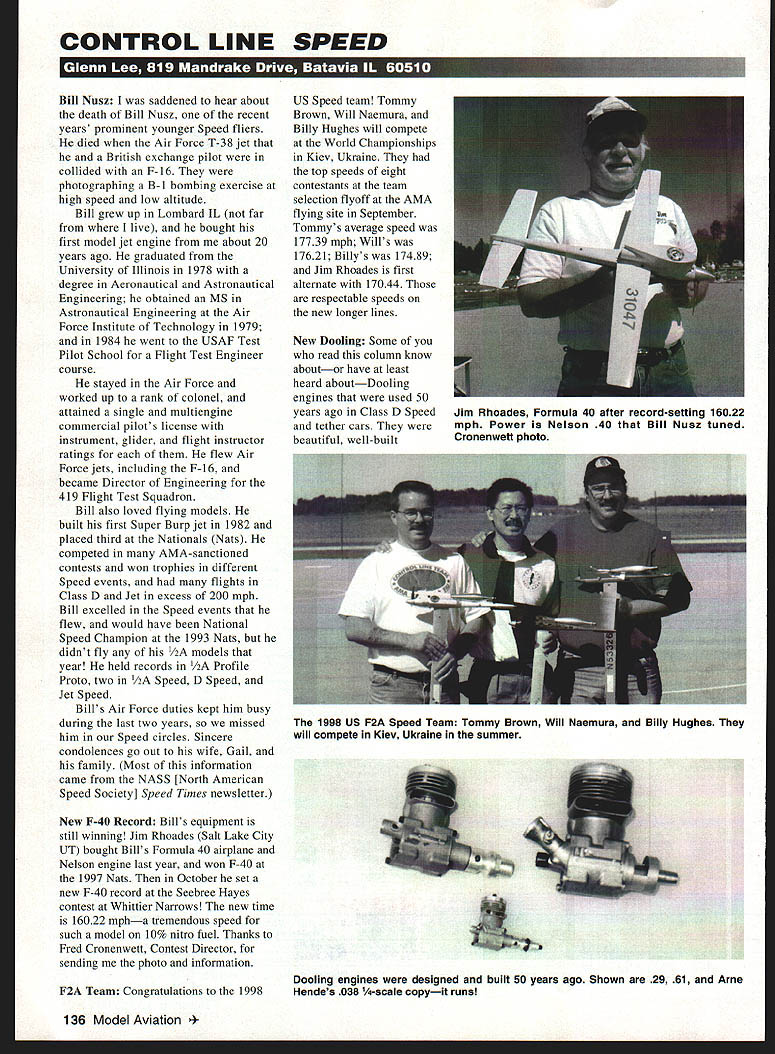
Bill's equipment is still winning! Jim Rhoades (Salt Lake City, UT) bought Bill's Formula 40 airplane and Nelson engine last year, and won F-40 at the 1997 Nats. Then in October he set a new F-40 record at the Seebree Hayes contest at Whittier Narrows. The new time is 160.22 mph — a tremendous speed for such a model on 10% nitro fuel. Thanks to Fred Cronenwett, Contest Director, for sending me the photo and information.
F2A Team
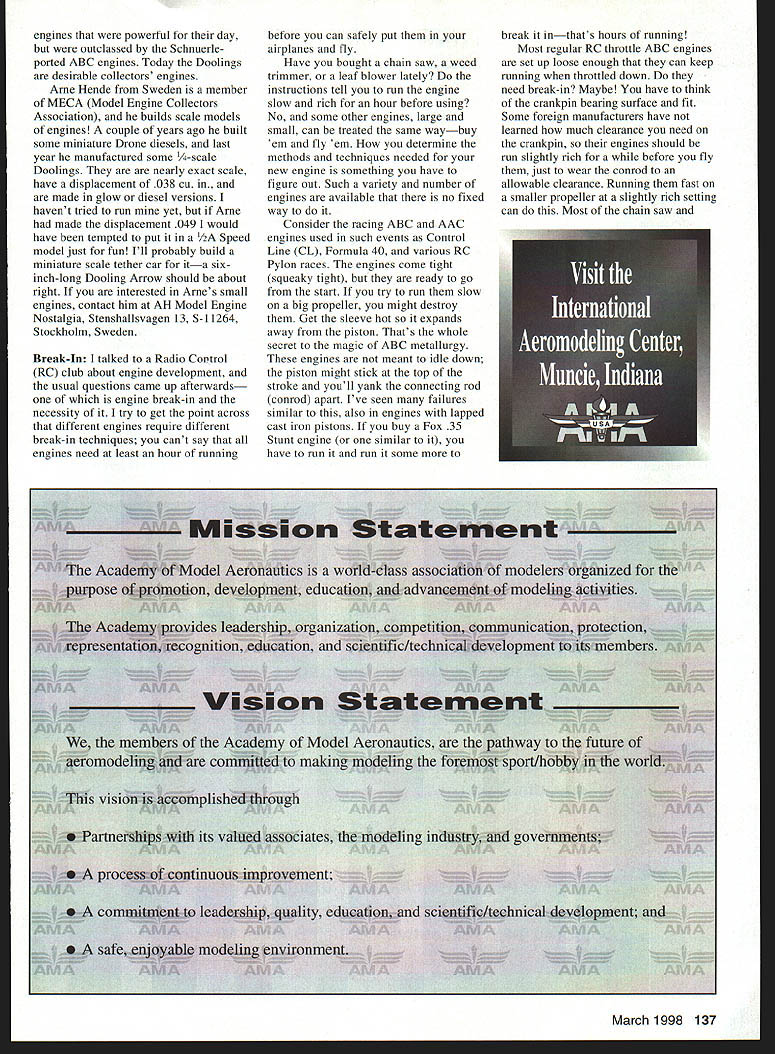
Congratulations to the 1998 US Speed team! Tommy Brown, Will Naemura, and Billy Hughes will compete at the World Championships in Kiev, Ukraine. They had the top speeds of eight contestants at the team selection flyoff at the AMA flying site in September.
- Tommy Brown: average speed 177.39 mph
- Will Naemura: average speed 176.21 mph
- Billy Hughes: average speed 174.89 mph
- Jim Rhoades: first alternate with 170.44 mph
Those are respectable speeds on the new longer lines.
New Dooling
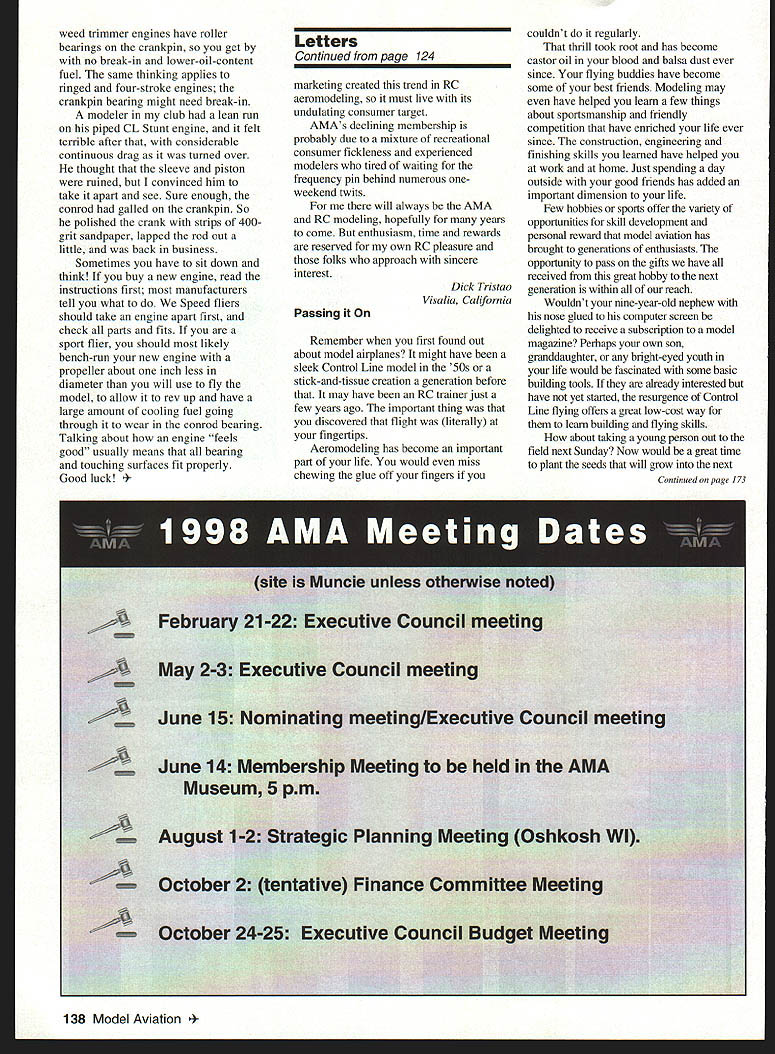
Some of you who read this column know about—or have at least heard about—Dooling engines that were used 50 years ago in Class D Speed and tether cars. They were beautiful, well-built, and powerful, and outclassed Schnuerle-ported ABC engines of the day. Today Doolings are desirable collectors' engines.
Arne Hende, Sweden, member MECA (Model Engine Collectors Association), builds scale model engines. A couple of years ago he built some miniature Drone diesels; last year he manufactured some 1/4-scale Doolings that are nearly exact scale and have a displacement of .038 cu. in. He made glow and diesel versions; I haven't tried to run them yet. Arne also made a .049 displacement that would have tempted me to put in a 1/2A Speed model just for fun. I'll probably build a miniature scale tether car; its six-inch-long Dooling Arrow should be about right.
Interested in Arne's small engines? Contact him: AH Model Engine Nostalgia, Stenshallsvägen 13, S-11264 Stockholm, Sweden.
Break-In
I talked to a Radio Control (RC) club about engine development. The usual questions came up afterward—about engine break-in and its necessity. I try to get the point across that different engines require different break-in techniques. I can't say engines need at least an hour running before they can safely be put in airplanes and flown.
Have you bought a chain saw, weed trimmer, or leaf blower lately? The instructions tell you to run the engine slow and rich for an hour before using it. No—some other engines, large or small, cannot be treated the same way. Buy 'em and fly 'em; determining the methods and techniques needed for a new engine is something you have to figure out. Such a variety and number of engines available means there is no fixed way.
Consider racing ABC/AAC engines used in such events as Control Line (CL) Formula 40 and various RC Pylon races. Engines come tight—squeaky tight—ready to go. Start them and try to run them slow with a big propeller and you might destroy them. Get the sleeve hot; it expands away from the piston. That's the whole secret—magic ABC metallurgy; engines meant to idle down.
The piston might stick at the top of the stroke and you'll yank the connecting rod (conrod) apart. I've seen many failures similar to this, also in engines with lapped cast-iron pistons. If you buy a Fox .35 Stunt engine (or one similar to it), you have to run it and run it some more to break it in—that's hours of running!
Most regular RC throttle ABC engines are set up loose enough that they can keep running when throttled down. Do they need break-in? Maybe! You have to think of the crankpin bearing surface and fit. Some foreign manufacturers have not learned how much clearance you need on the crankpin, so their engines should be run slightly rich for a while before you fly them, just to wear the conrod to an allowable clearance. Running them fast on a smaller propeller at a slightly rich setting can do this.
A modeler in my club had a lean run on his piped CL Stunt engine, and it felt terrible after that, with considerable continuous drag as it was turned over. He thought that the sleeve and piston were ruined, but I convinced him to take it apart and see. Sure enough, the conrod had galled on the crankpin. So he polished the crank with strips of 400‑grit sandpaper, lapped the rod a little, and was back in business.
Sometimes you have to sit down and think! If you buy a new engine, read the instructions first; most manufacturers tell you how to do it. We Speed fliers should take an engine apart first, and check all parts and fits. If you are a sport flier, you should most likely bench-run your new engine with a propeller about one inch less in diameter than you will use to fly the model, to allow it to rev up and have a large amount of cooling fuel going through it to wear in the conrod bearing. Talking about how an engine "feels good" usually means that all bearing and touching surfaces fit properly. Good luck!
Recommended quick checklist when you buy a new engine:
- Read the manufacturer's instructions.
- Inspect parts and fits before installation.
- Bench-run with a slightly smaller prop (and slightly rich) to break in bearings and conrod.
- If you encounter roughness or drag, disassemble and inspect before assuming sleeve/piston damage.
Transcribed from original scans by AI. Minor OCR errors may remain.

