
CONTROL LINE SPEED
Glenn Lee, 819 Mandrake Drive, Batavia, IL 60510
It's too cold here this time of year for any kind of Speed flying. The year 1997 is gone, so you should be getting ready for 1998 by building new airplanes and reworking engines. Meanwhile, I'm going to Bob Whitney's contest in Florida where it should be warm! I hope to bring back some nice photos.
Sidewinders
I need a new Class D airplane and one for Class B, so what should I build? Should they be conventional upright-style models or the boomerang-shaped "sidewinder" aircraft? Bob Ytuarte has been doing more than 195 mph with his O.S. .65-powered conventional model, but others, such as the FABS team, Phil McGee, Charlie Legg, and all of the FAI (Federation Aeronautique Internationale) fliers, are using sidewinders.
I don't like the looks or flying characteristics of sidewinders, probably because I've only built a couple of them and neither one flew very well. I don't think I built them correctly; they floundered through the air like wounded ducks! They didn't last long.
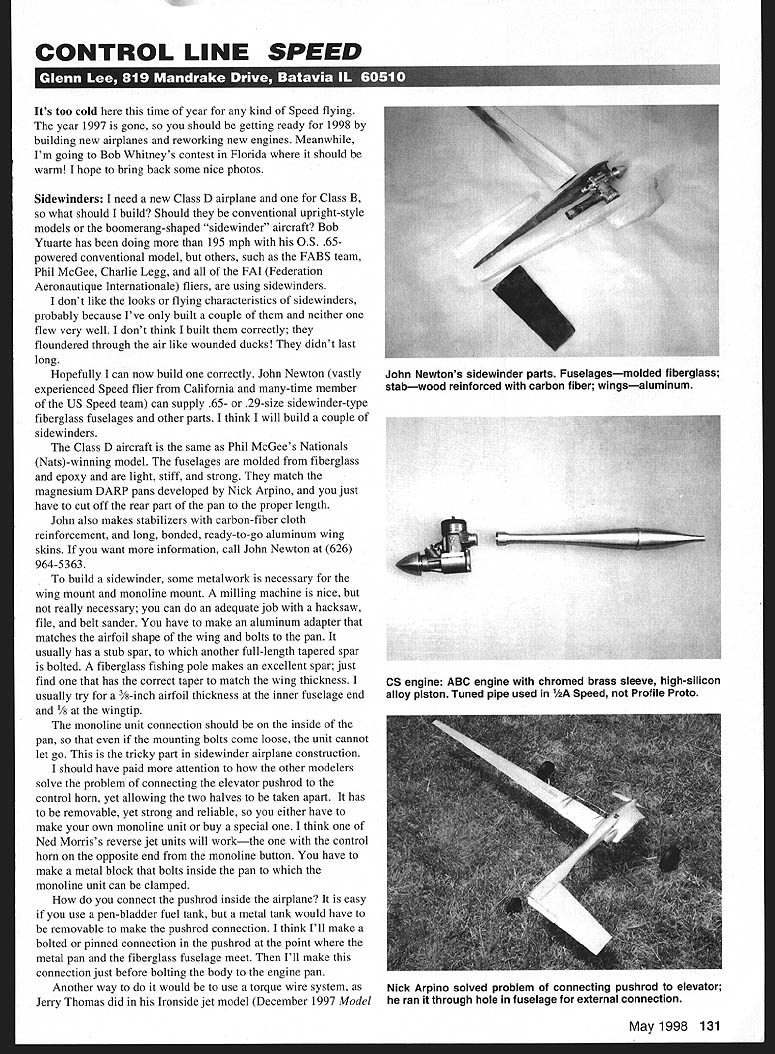
Hopefully I can now build one correctly. John Newton (vastly experienced Speed flier from California and many-time member of the US Speed team) can supply .65- or .29-size sidewinder-type fiberglass fuselages and other parts. I think I will build a couple of sidewinders.
The Class D aircraft is the same as Phil McGee's Nationals (Nats)-winning model. The fuselages are molded from fiberglass and epoxy and are light, stiff, and strong. They match the magnesium DARP pans developed by Nick Arpino, and you just have to cut off the rear part of the pan to the proper length.
John also makes stabilizers with carbon-fiber cloth reinforcement, and long, bonded, ready-to-go aluminum wing skins. If you want more information, call John Newton at (626) 964-5363.
To build a sidewinder, some metalwork is necessary for the wing mount and monoline mount. A milling machine is nice, but not really necessary; you can do an adequate job with a hacksaw, file, and belt sander. You have to make an aluminum adapter that matches the airfoil shape of the wing and bolts to the pan. It usually has a stub spar, to which another full-length tapered spar is bolted. A fiberglass fishing pole makes an excellent spar; just find one that has the correct taper to match the wing thickness. I usually try for a 3/8-inch airfoil thickness at the inner fuselage end and 1/8-inch at the wingtip.
The monoline unit connection should be on the inside of the pan, so that even if the mounting bolts come loose, the unit cannot let go. This is the tricky part in sidewinder airplane construction.
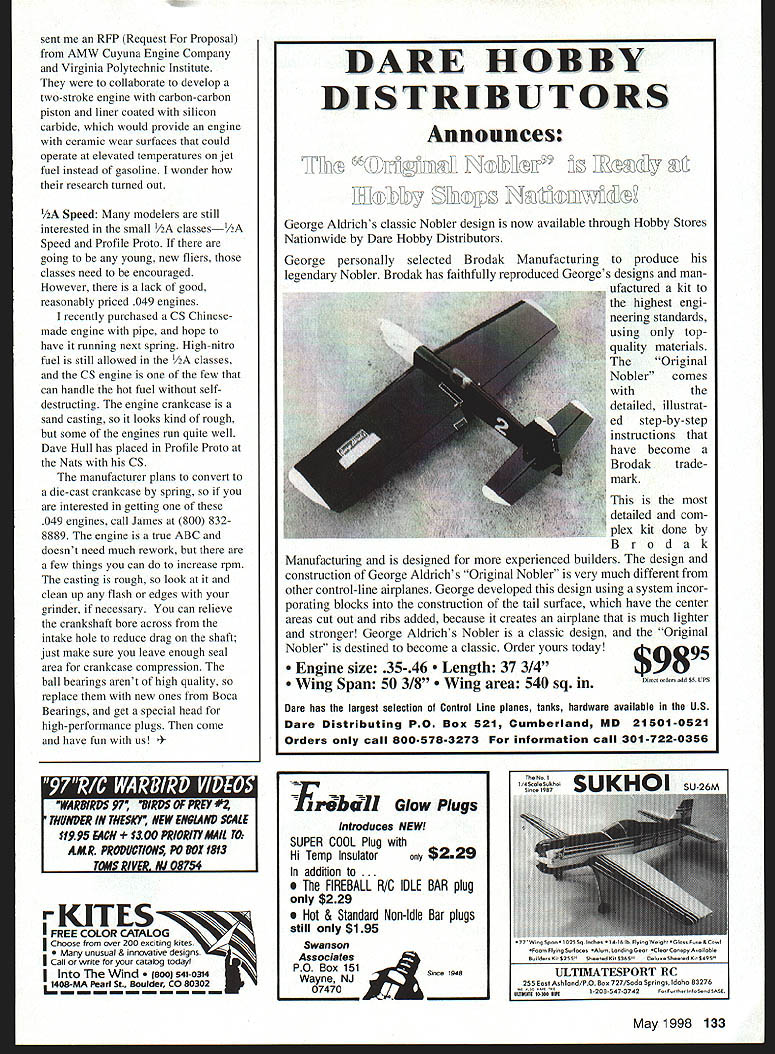
I should have paid more attention to how the other modelers solve the problem of connecting the elevator pushrod to the control horn, yet allowing the two halves to be taken apart. It has to be removable, yet strong and reliable, so you either have to make your own monoline unit or buy a special one. I think one of Ned Morriss's reverse-jet units will work—the one with the control horn on the opposite end from the monoline button. You have to make a metal block that bolts inside the pan to which the monoline unit can be clamped.
How do you connect the pushrod inside the airplane? It is easy if you use a pen-bladder fuel tank, but a metal tank would have to be removable to make the pushrod connection. I think I'll make a bolted or pinned connection in the pushrod at the point where the metal pan and the fiberglass fuselage meet. Then I'll make this connection just before bolting the body to the engine pan.
Another way to do it would be to use a torque wire system, as Jerry Thomas did in his Ironside jet model (December 1997 Model Aviation). You could make a block of metal, aluminum or brass, that bolts inside the pan; it would hold the short torque tube and the bolt for the flying wire. To take the airplane apart, you would unbolt the block and let it slide out the back after removing the wing and wing mounting adapter.
It isn't difficult to make your own monoline unit. You need three loops of .018 music wire for the torque unit, and they must be soldered securely to whatever mounting block you use. If I get my mounting parts finished, I'll photograph them for a future column.
Sport Jet
Jerry Thomas told me that Mike Hazel and others in the Northwest are getting interested in Sport Jet. They changed the Texas rules slightly, and now allow Dynajet engines that are stock except for having the cooling fins cut off. There are many used jet engines out there, but most of them had the fins cut off for ease of mounting and to reduce weight. They also fly on two 70-foot wires instead of 60-foot wires. It sounds as if a bunch of guys are going to fly them, so it should be fun. They use the same methanol-propylene oxide fuel that AMA Jets use, and it runs quite well in stock Dynajet engines.
Ceramics
There are always claims and rumors about ceramic pistons being used in small engines; I haven't seen any of them, but I have seen a few modelers using ceramic ball bearings in their Speed engines. These so-called hybrid bearings have conventional steel races and silicon nitride balls.
Silicon nitride ceramic is hard and possesses exceptional compressive strength—qualities that make it an excellent material for balls. It is only 40% as dense as steel, and lighter weight reduces centrifugal loading and skidding, allowing much higher operating speeds. Silicon nitride is about twice as hard as steel; hybrid ball bearings have three to five times the useful life of all-steel bearings, and the coefficient of friction is about 20% that of steel. However, the bearings are expensive; each ball costs almost as much as a complete steel bearing! More power and speed is never cheap.
Ceramic Engines
About a year ago, Lloyd Burkett (East Elmhurst, NY) sent me some information about ceramic pistons. He sent me an RFP (Request For Proposal) from AMW Cuyuna Engine Company and Virginia Polytechnic Institute. They were to collaborate to develop a two-stroke engine with a carbon-carbon piston and liner coated with silicon carbide, which would provide an engine with ceramic wear surfaces that could operate at elevated temperatures on jet fuel instead of gasoline. I wonder how their research turned out.
1/2A Speed
Many modelers are still interested in the small 1/2A classes—1/2A Speed and Profile Proto. If there are going to be any young, new fliers, those classes need to be encouraged. However, there is a lack of good, reasonably priced .049 engines.
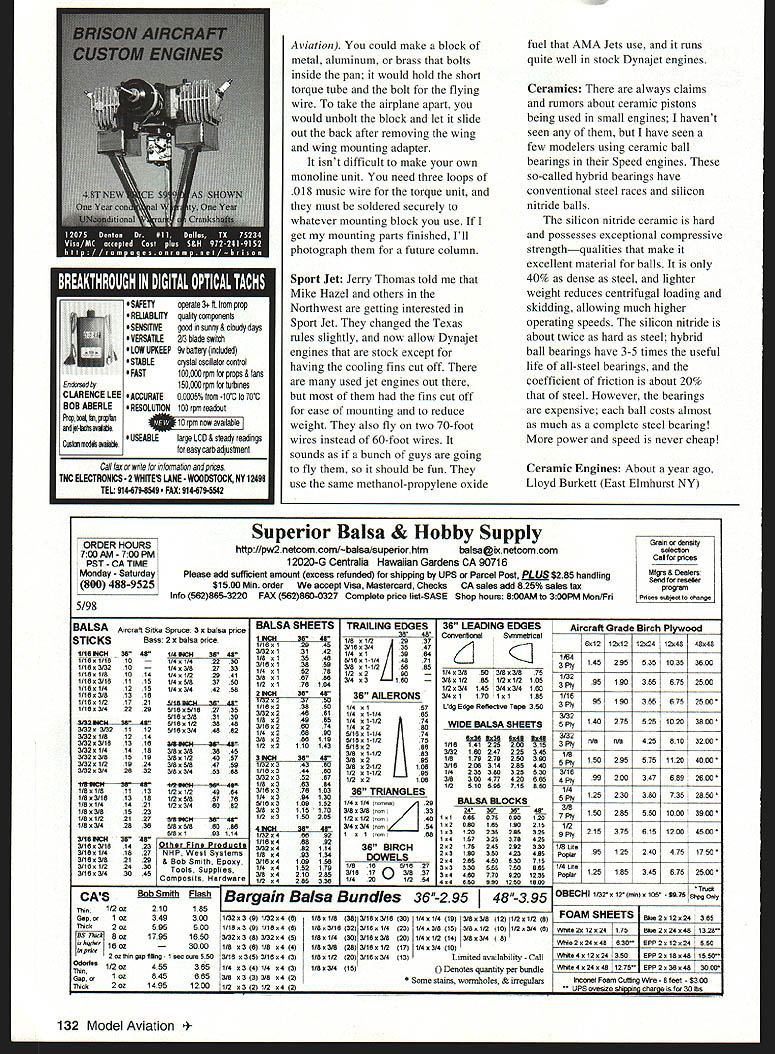
I recently purchased a CS Chinese-made engine with pipe, and hope to have it running next spring. High-nitro fuel is still allowed in the 1/2A classes, and the CS engine is one of the few that can handle the hot fuel without self-destructing. The engine crankcase is a sand casting, so it looks kind of rough, but some of the engines run quite well. Dave Hull has placed in Profile Proto at the Nats with his CS.
The manufacturer plans to convert to a die-cast crankcase by spring, so if you are interested in getting one of these .049 engines, call James at (800) 832-8889. The engine is a true ABC and doesn't need much rework, but there are a few things you can do to increase rpm:
- Inspect the casting and clean up any flash or edges with your grinder, if necessary.
- Relieve the crankshaft bore across from the intake hole to reduce drag on the shaft; just make sure you leave enough seal area for crankcase compression.
- Replace the ball bearings (they aren't of high quality) with new ones from Boca Bearings.
- Get a special head for high-performance plugs.
Then come and have fun with us!
Transcribed from original scans by AI. Minor OCR errors may remain.

