
CONTROL LINE: SPEED
Glenn Lee, 819 Mandrake Drive, Batavia IL 60510
Spring is almost here — I saw my first robin a couple of days ago — so it's time to get Speed models ready. The first Midwest contest will be in St. Louis, Missouri, in mid‑May, and I need two new airplanes. Instead I've been working on some race cars, but that's for a future column.
Florida Speed Meet
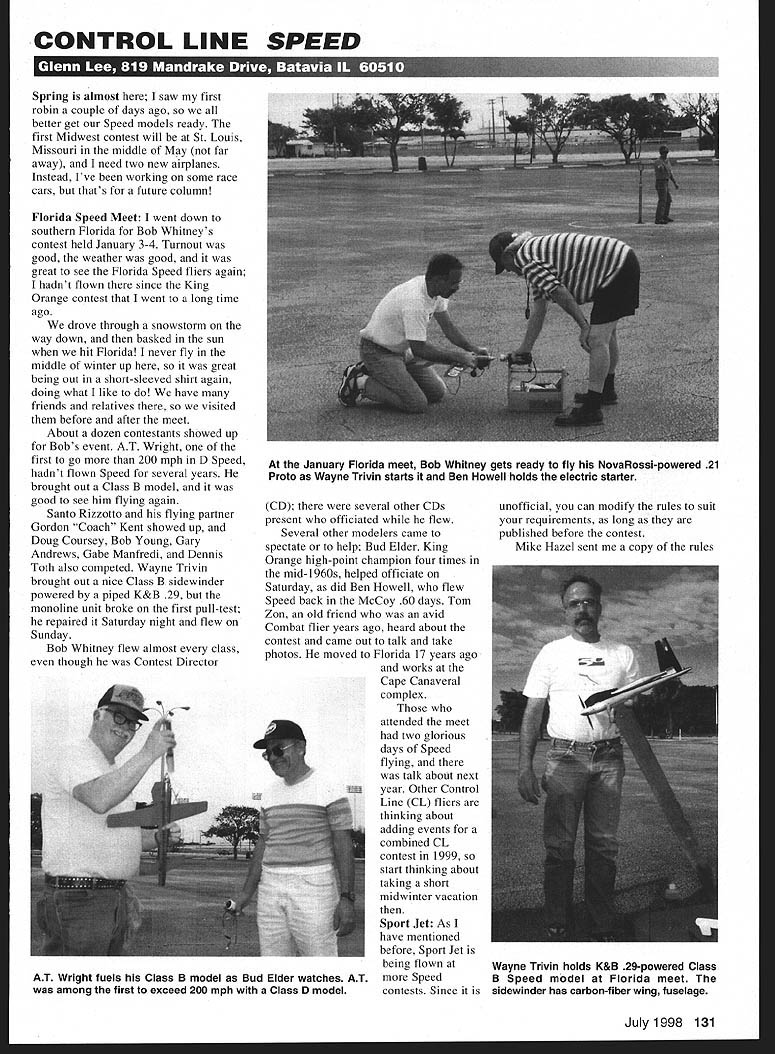
I went down to southern Florida for Bob Whitney's contest held January 3–4. Turnout and weather were good, and it was great to see the Florida Speed fliers again; I hadn't flown there since the King Orange contest a long time ago.
We drove through a snowstorm on the way down, then basked in the sun when we hit Florida. I never fly in midwinter up here, so it was wonderful to be out in a short‑sleeved shirt doing what I like to do. We visited friends and relatives before and after the meet.
About a dozen contestants showed up. Notable attendees included:
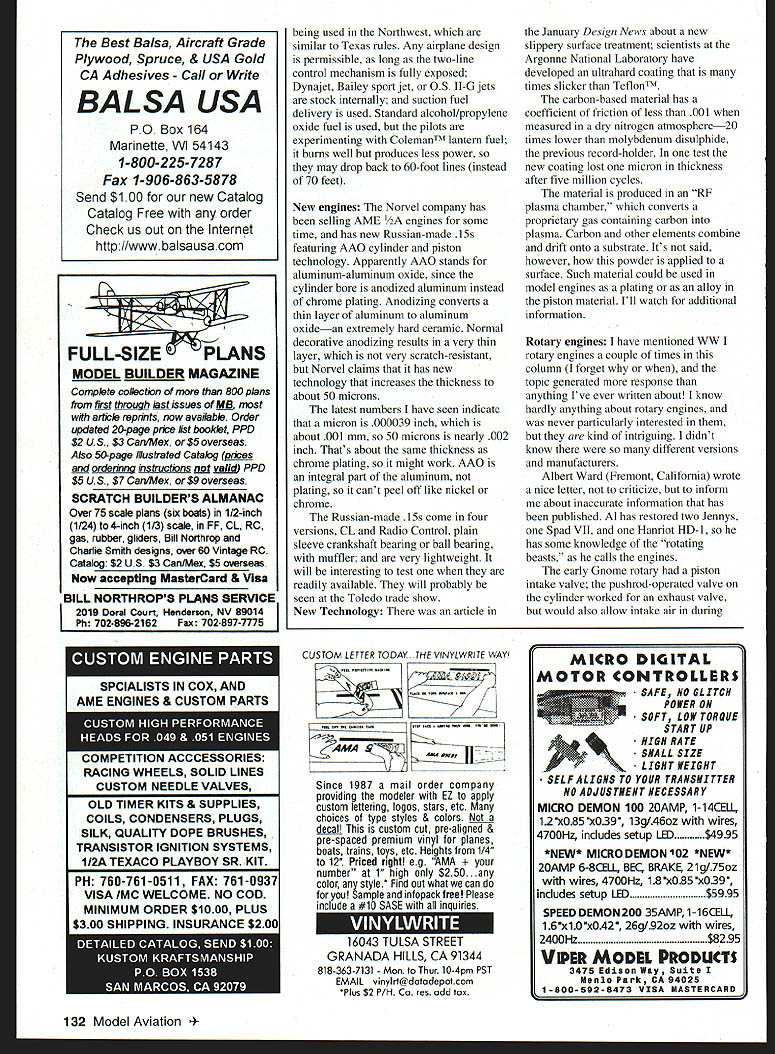
- A.T. Wright — one of the first to exceed 200 mph in D Speed; he hadn't flown Speed for several years and brought a Class B model.
- Santo Rizzotto and Gordon "Coach" Kent.
- Doug Coursey, Bob Young, Gary Andrews, Gabe Manfredi, and Dennis Toth.
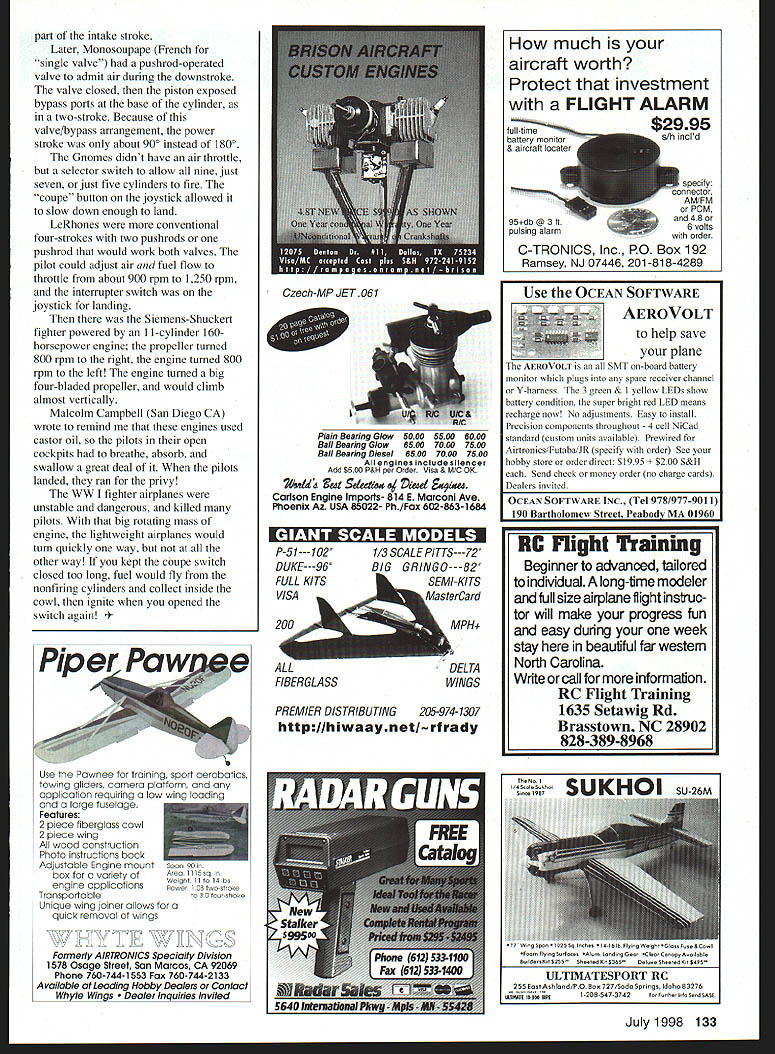
- Wayne Trivin — brought a nice Class B sidewinder powered by a piped K&B .29. The monoline unit broke on the first pull test; he repaired it Saturday night and flew on Sunday.
- Bob Whitney — flew almost every class even though he was Contest Director; several other CDs officiated while he flew.
Several modelers came to spectate or help:
- Bud Elder — King Orange high‑point champion four times in the mid‑1960s; helped officiate on Saturday.
- Ben Howell — flew Speed back in the McCoy .60 days.
- Tom Zon — an old friend and former avid Combat flier who moved to Florida 17 years ago and works at the Cape Canaveral complex; he came to talk and take photos.
Those who attended enjoyed two glorious days of Speed flying, and there was already talk about next year. Other control‑line fliers are considering adding events to a combined CL contest in 1999 — start thinking about a short midwinter vacation then.
Sport Jet
Sport Jet continues to be flown at more Speed contests. Since it is unofficial, contest organizers can modify the rules as long as the variations are published before the event. Mike Hazel sent a copy of the rules being used in the Northwest; similar Texas rules allow any airplane design so long as the two‑line control mechanism is fully exposed.
Typical equipment and fuel:
- Dynajet and Bailey Sport Jet .05 II‑G jets are commonly used, stock internally, with suction fuel delivery.
- Standard alcohol/propylene oxide fuels are used.
- Some pilots are experimenting with Coleman lantern fuel — it burns well but produces less power and may prompt a return to 60‑foot lines instead of 70‑foot lines.
New Engines (Norvel .15s)
Norvel, which has sold AME engines for some time, offers new Russian‑made .15 engines featuring AAO cylinder/piston technology. AAO appears to mean aluminum‑aluminum oxide: the cylinder bore is anodized aluminum instead of chrome‑plated. Anodizing converts the outer layer of aluminum to aluminum oxide, a very hard ceramic. Normal decorative anodizing produces a thin, scratch‑resistant layer; Norvel claims its process increases thickness by about 50 microns. (One micron ≈ 0.000039 inch ≈ 0.001 mm; 50 microns is nearly 0.002 inch.) Because the oxide layer is integral to the aluminum, it cannot peel off like nickel or chrome plating.
The Russian .15s come in four versions:
- CL (control line)
- Radio control (R/C)
- Plain‑sleeve crankshaft‑bearing version
- Ball‑bearing version with muffler
New Technology
An article in January Design News reported on an ultrathin, very low‑friction coating developed at Argonne National Laboratory. The carbon‑based material has a coefficient of friction below 0.001 when measured in a dry nitrogen atmosphere — about 20 times lower than molybdenum disulphide, the previous record holder. In one test the coating lost only one micron in thickness after five million cycles.
The coating is produced in an RF plasma chamber: a proprietary carbon‑containing gas is converted to plasma, and carbon and other elements combine and deposit on a substrate. It's not yet clear how the powder is applied to surfaces. Such material could be useful in model engines as a plating or as part of piston materials; I'll watch for more information.
Rotary Engines
I've mentioned WW I rotary engines previously, and the topic generated a lot of response. Albert Ward (Fremont, California) wrote to correct some inaccuracies and to share information. Al has restored two Jennys, one SPAD VII, and one Hanriot HD‑1, so he knows the "rotating beast" well. His input was informative and appreciated.
Transcribed from original scans by AI. Minor OCR errors may remain.

