
CONTROL LINE SPEED
Glenn Lee, 819 Mandrake Drive, Batavia IL 60510
Introduction
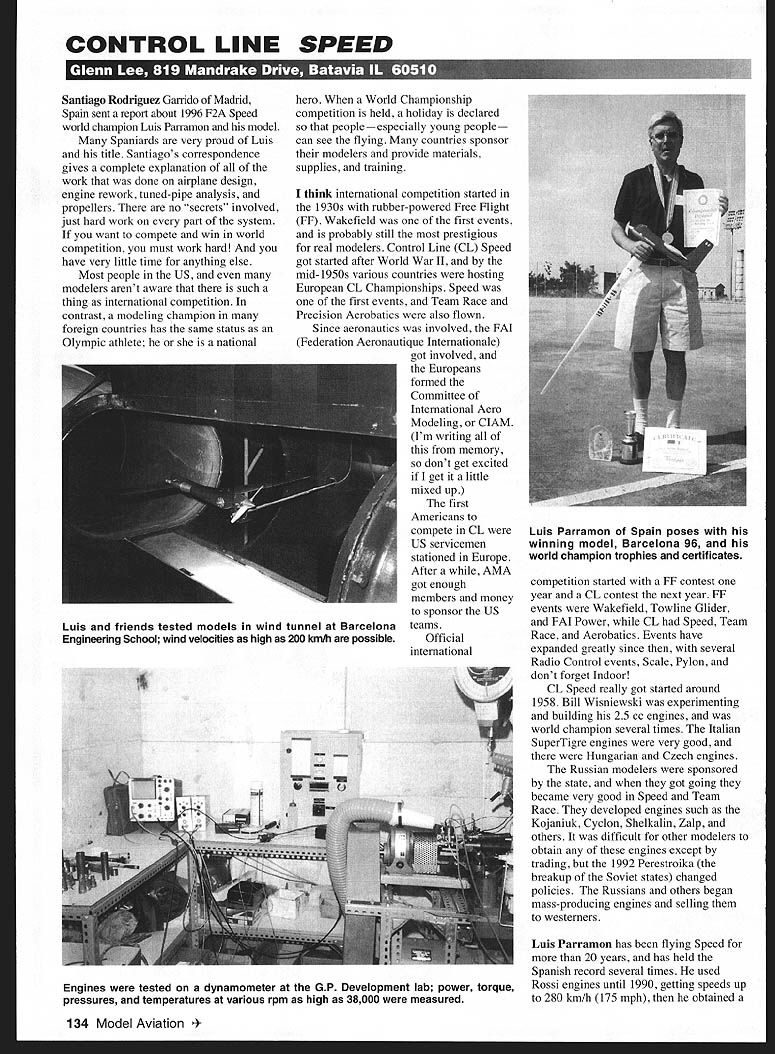
Santiago Rodriguez Garrido of Madrid, Spain sent a report about 1996 F2A Speed world champion Luis Parramon and his model. Many Spaniards are very proud of Luis and his title. Santiago's correspondence gives a complete explanation of work on airplane design, engine rework, tuned-pipe analysis, and propellers. There are no "secrets" involved, just hard work on every part of the system. If you want to compete and win in world competition, you must work hard—and you have very little time for anything else.
International competition and history
Most people in the US, and even many modelers, aren't aware that there is such a thing as international competition. In many foreign countries a modeling champion has the same status as an Olympic athlete and may be a national hero. When a World Championship competition is held, a holiday is sometimes declared so people—especially young people—can see the flying. Many countries sponsor their modelers and provide materials, supplies, and training.
International competition started in the 1930s with rubber-powered Free Flight (FF). Wakefield was one of the first events and is probably still the most prestigious for traditional modelers. Control Line (CL) Speed got started after World War II, and by the mid-1950s various countries were hosting European CL Championships. Speed was one of the first CL events; Team Race and Precision Aerobatics were also flown.
Because aeronautics was involved, the FAI (Fédération Aéronautique Internationale) became involved and the Europeans formed the Committee of International Aero Modelling (CIAM). The first Americans to compete in CL were US servicemen stationed in Europe. After a while, the AMA (Academy of Model Aeronautics) had enough members and funds to sponsor US teams.
Official international competition alternated between FF and CL in different years. FF events included Wakefield, Towline Glider, and FAI Power, while CL events included Speed, Team Race, and Aerobatics. Events have since expanded to include several Radio Control events, Scale, Pylon, and Indoor events.
CL Speed really got underway around 1958. Bill Wisniewski was experimenting with and building 2.5 cc engines and was world champion several times. The Italian Super Tigre engines were very good, and there were Hungarian and Czech engines. Russian modelers, sponsored by the state, became very strong in Speed and Team Race. They developed engines such as the Kojaniuk, Cyclon, Shelkalin, Zalp, and others. It was difficult for other modelers to obtain these engines except by trading, but after Perestroika in 1992 the Russians and others began mass-producing engines and selling them to westerners.
Luis Parramon — background and progression
Luis Parramon has been flying Speed for more than 20 years and has held the Spanish record several times. He used Rossi engines until 1990, reaching speeds up to 280 km/h (175 mph). In 1992 he obtained a Cyclon engine that broke the Spanish record at 291 km/h (182 mph). In Barcelona in 1993 he purchased a Profi engine and reached 299 km/h (187 mph). His next challenge was to reach 300 km/h.
To pursue that goal he worked with friends Lluis Roger, Jaume Porta, Jordi Fout, and Eduard Giro. They consulted books such as Two Stroke Performance Tuning (Graham Bell), Motorcycle Tuning Two Stroke Engines (John Robinson), and especially Design and Simulation of Two Stroke Engines (Gordon Blair). They used computing programs for thermodynamic simulation and other analysis. Lluis Roger handled propeller design, model design, and mathematical calculations.
Testing, analysis, and fabrication
In addition to mathematical calculations, the team performed extensive testing and analysis:
- Wind tunnel testing of models at the Barcelona Engineering School with Salvador Gonzalez.
- Engine testing on a dynamometer at the G.P. Development lab, measuring power and torque vs. rpm, head and exhaust temperatures, and crankcase pressures with transducers.
- Metallographic analysis and surface treatment analysis.
- Detailed work on crankshaft and ball-bearing assembly to achieve a perfect, low-friction fit with 0.05 mm axial clearance in the front bearing.
Model construction and components
Luis's sidewinder airplane featured:
- A traditional metal pan.
- A long, almost one-meter aluminum inner wing.
- Wood, fiberglass, and carbon-fiber for body and tail.
- Rohacell extruded polymethacrylate foam (vibration-resistant): 35 kg/m3 for the stabilizer and 50 kg/m3 for the tailboom.
- A symmetrical airfoil with the tip swept back.
- Front flying wire located 26 mm behind the center of gravity (CG). Line rake compensated for wire drag and allowed the model to fly a tangent circle with minimum drag.
- Model weight: 420 g (engine and pipe 205 g).
- Engine: Profi (manufactured in Ukraine).
Engine and propeller modifications
Luis made several engine and intake/exhaust modifications:
- Changed valve timing to 230°.
- Bored the crank to 9.0 mm ID.
- Bored the venturi to 9.5 mm.
- Modified transfer ports.
- Machined a hemispherical combustion chamber in the head.
- Extensive crankshaft and bearing work for low friction and precise clearances.
Propeller details:
- Single-blade carbon-fiber-and-resin propeller obtained from Ukraine.
- Radius: 74.2 mm.
- Pitch: 6.4 inches (propeller pitch given in inches historically).
- At top speed, prop tip velocity ≈ 1067 km/h (606 mph), about Mach 0.87.
- Propeller dimensions were modified according to simulations by Lluis Roger.
1996 World Championships — Norrköping, Sweden
The World Championships were held July 22–29, 1996 at an unused airbase near Norrköping, Sweden. After initial problems with officials on his first flight, Luis recorded a speed of 304 km/h on his second flight and then became world champion with a third flight of 311.2 km/h (194.5 mph).
Conclusion
Becoming a world champion requires detailed engineering, exhaustive testing, teamwork, and persistence. The Spanish effort illustrates that success comes from thorough work on all parts of the system—airframe, engine, propeller, and tuned pipe—rather than from any single "secret."
Transcribed from original scans by AI. Minor OCR errors may remain.

