
CONTROL LINE SPEED
Glenn Lee, 819 Mandrake Drive, Batavia IL 60510
Contests
As I write this at the end of June, it's flying season! There is some kind of CL (control line) contest every weekend, and several have Control Line Speed events.
Last week we went to Cincinnati, OH for a two-day meet hosted by the Queen City U-Control Club. Turnout was excellent, with contestants from several states, and many flights were completed Saturday. However, rain was forecast for Sunday, and sure enough, it wiped out flying.
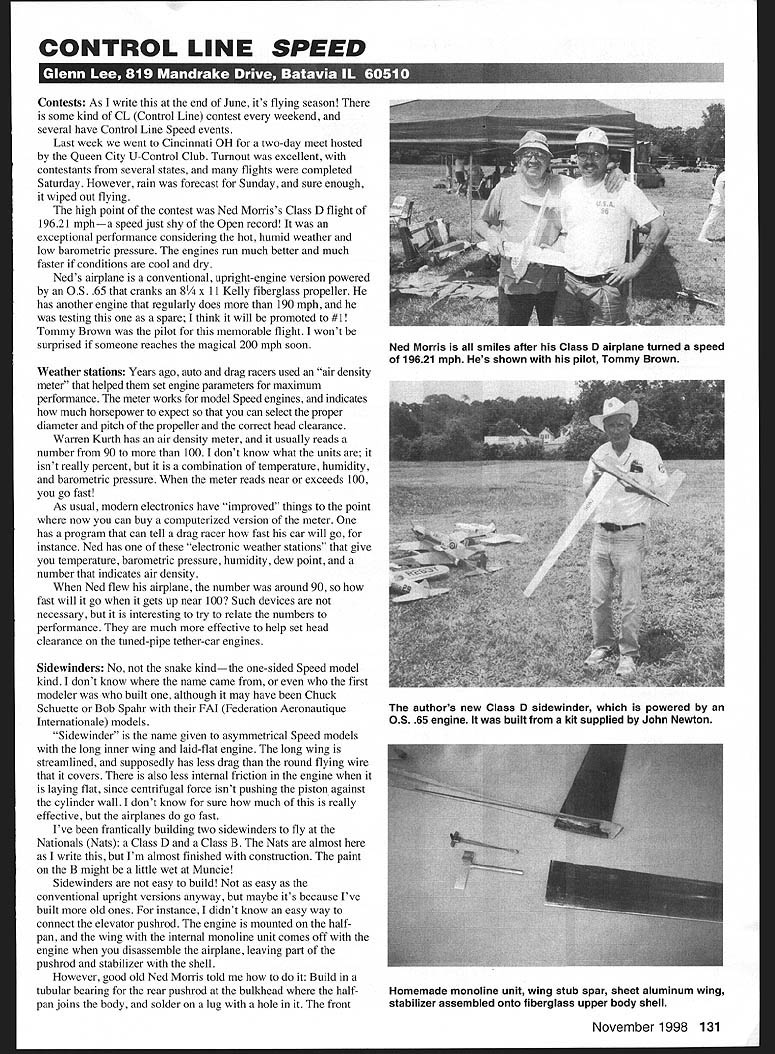
The high point of the contest was Ned Morris's Class D flight of 196.21 mph — a speed just shy of the Open record! It was an exceptional performance considering the hot, humid weather and low barometric pressure. The engines run much better and much faster if conditions are cool and dry.
Ned's airplane is a conventional, upright-engine version powered by an O.S. .65 that cranks an 8 1/4 x 11 Kelly fiberglass propeller. He has another engine that regularly does more than 190 mph, and he was testing this one as a spare; I think it will be promoted to #1! Tommy Brown was the pilot for this memorable flight. I won't be surprised if someone reaches the magical 200 mph soon.
Weather stations
Years ago, auto and drag racers used an "air density meter" that helped them set engine parameters for maximum performance. The meter works for model speed engines, and indicates how much horsepower to expect so that you can select the proper diameter and pitch of the propeller and the correct head clearance.
Warren Kurth has an air density meter, and it usually reads a number from 90 to more than 100. I don't know what the units are; it isn't really percent, but it is a combination of temperature, humidity, and barometric pressure. When the meter reads near or exceeds 100, you go fast!
As usual, modern electronics have "improved" things to the point where now you can buy a computerized version of the meter. One has a program that can tell a drag racer how fast his car will go, for instance. Ned has one of these "electronic weather stations" that give you temperature, barometric pressure, humidity, dew point, and a number that indicates air density.
When Ned flew his airplane, the number was around 90, so how fast will it go when it gets up near 100? Such devices are not necessary, but it is interesting to try to relate the numbers to performance. They are much more effective to help set head clearance on the tuned-pipe tether-car engines.
Sidewinders
No, not the snake kind — the one-sided speed model kind. I don't know where the name came from, or even who the first modeler was who built one, although it may have been Chuck Schuette or Bob Spahr with their FAI (Federation Aeronautique Internationale) models.
"Sidewinder" is the name given to asymmetrical speed models with the long inner wing and a laid-flat engine. The long wing is streamlined, and supposedly has less drag than the round flying wire that it covers. There is also less internal friction in the engine when it is laying flat, since centrifugal force isn't pushing the piston against the cylinder wall. I don't know for sure how much of this is really effective, but the airplanes do go fast.
I've been frantically building two sidewinders to fly at the Nationals (Nats): a Class D and a Class B. The Nats are almost here as I write this, but I'm almost finished with construction. The paint on the B might be a little wet at Muncie!
Sidewinders are not easy to build — not as easy as the conventional upright versions anyway; but maybe it's because I've built more of the old ones. For instance, I didn't know an easy way to connect the elevator pushrod. The engine is mounted on the half-pan, and the wing with the internal monoline unit comes off with the engine when you disassemble the airplane, leaving part of the pushrod and stabilizer with the shell.
However, Ned Morris told me a simple method:
- Build in a tubular bearing for the rear pushrod at the bulkhead where the half-pan joins the body, and solder on a lug with a hole in it.
- The front pushrod from the monoline unit is bent at 90° at the end and fits into this hole when you join the two parts.
- The bent end is long enough that it can't slip out of the hole, and centrifugal force holds it in during flight.
The Class B fiberglass top shell didn't fit my pan or engine since it was designed for a 1/2-inch spinner. Since the shell is fiberglass and epoxy, I sawed it in half at the front, pulled it back together, and epoxied glass cloth inside and out. Mat glass and epoxy was used for filler where needed.
Charlie Legg flies 1/2A sidewinders very successfully. The first time he built one, the blast from the propeller hit the cowl and blew the airplane into the ground. His solution was to put in a new crankshaft to reverse the rotation of the engine! The propeller blast doesn't affect the wing since it is so far back.
The engine cows on most speed models are too close to the propeller, resulting in excessive drag and line tension during flight. I filled the inside of the Newton kit cowls with glass and epoxy, ground the front back to what looked better, and reinforced it with more fiberglass and epoxy. Now there is more clearance between the cowl and the propeller; I hope it helps.
The FAI fliers end up with a little positive incidence in the wing. I didn't know how to easily measure that either, until Billy Hughes told me: assemble the airplane, block the engine crankshaft stub in the lathe, and measure from the flat bed rails up to the leading and trailing edges. If you don't have a lathe, you can clamp the crankshaft in a V-block on any flat surface. Use this same method to mark the slot for the stabilizer before gluing it in.
I made my own monoline unit, but you can buy them from Ned Morris. The unit has a flange that bolts on the inside of the pan, so there's no way it can pull out, even if the screws vibrate loose. These screws bolt into the wing-mounting stub. A solid fiberglass fishing rod is used for the wing spar — turn the end down and glue it into a hole in the wing spar.
The wing is constructed of .010-inch thick 2024-T3 aluminum sheet bent to form, and the trailing edge is epoxied. It is difficult to get anything to really stick to aluminum, and part of my wing popped loose on the first test flight. So I reglue it, then put in some 1/16-inch aluminum rivets. I have made short aluminum sheet wings by gluing the trailing edge with Pliobond and rubber-base contact cement. You apply the glue to the surfaces you want to bond, bake it at a high temperature, let it cool, clamp the trailing edge, and bake it again. I have never had one of these joints fail. I don't have an oven long enough for the sidewinder wings, so they have to be epoxy.
Vibration will make your fuel foam, so try to shock-mount the tank if you can. I have some rubber pads underneath the mounting lugs, and it seemed to work. The FAI guys just set the tank in foam, and that works too.
Transcribed from original scans by AI. Minor OCR errors may remain.

