
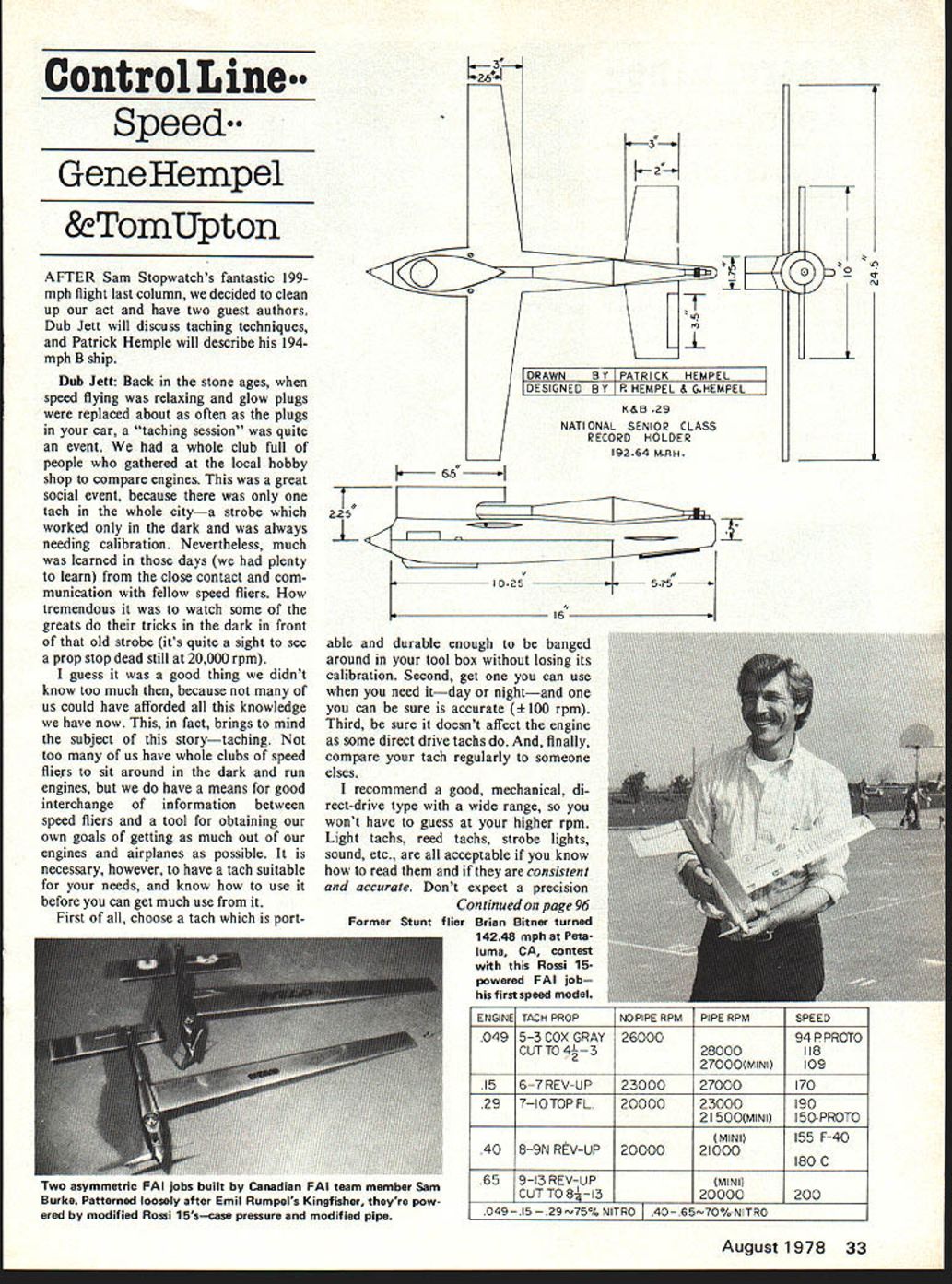
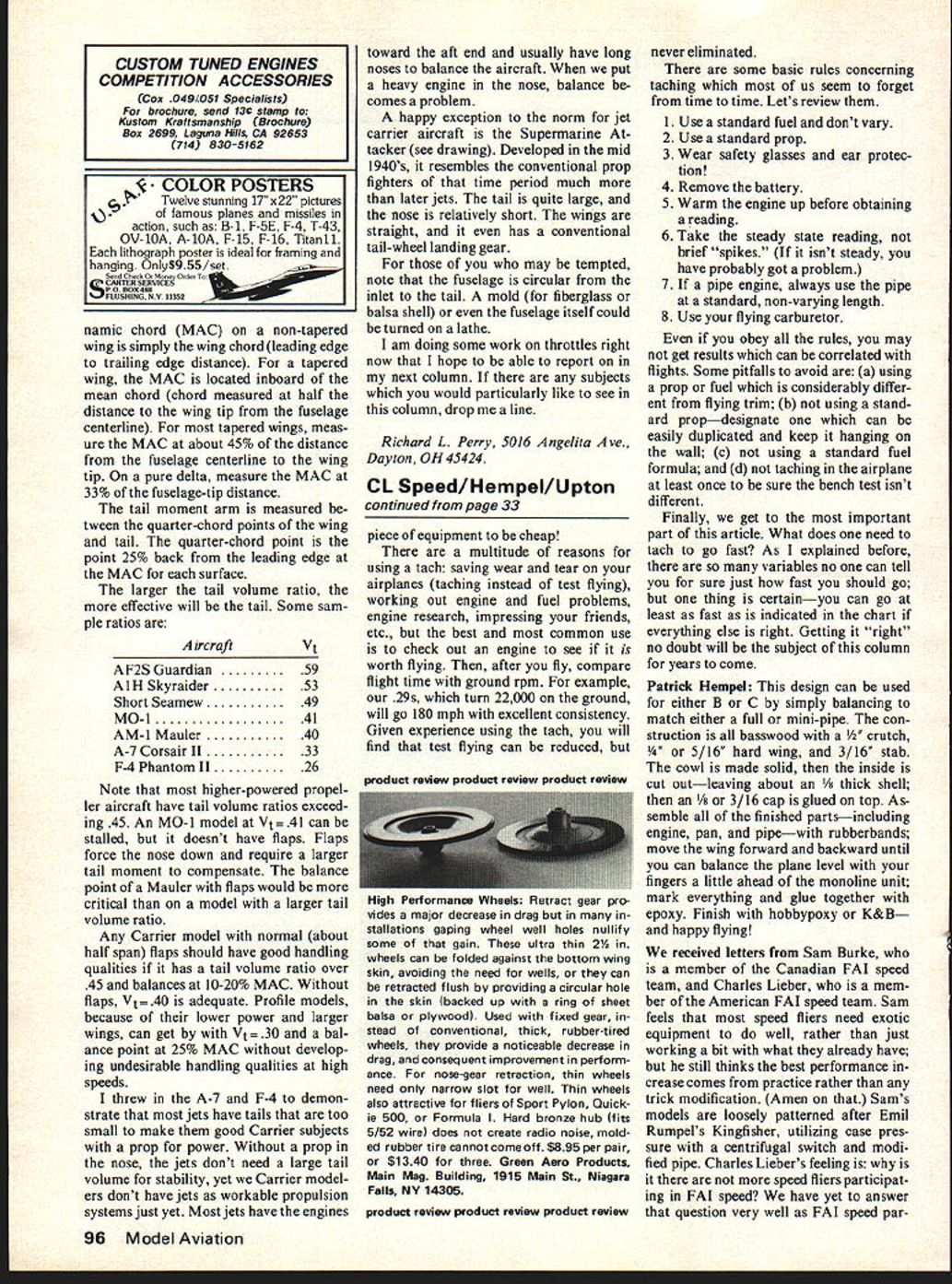
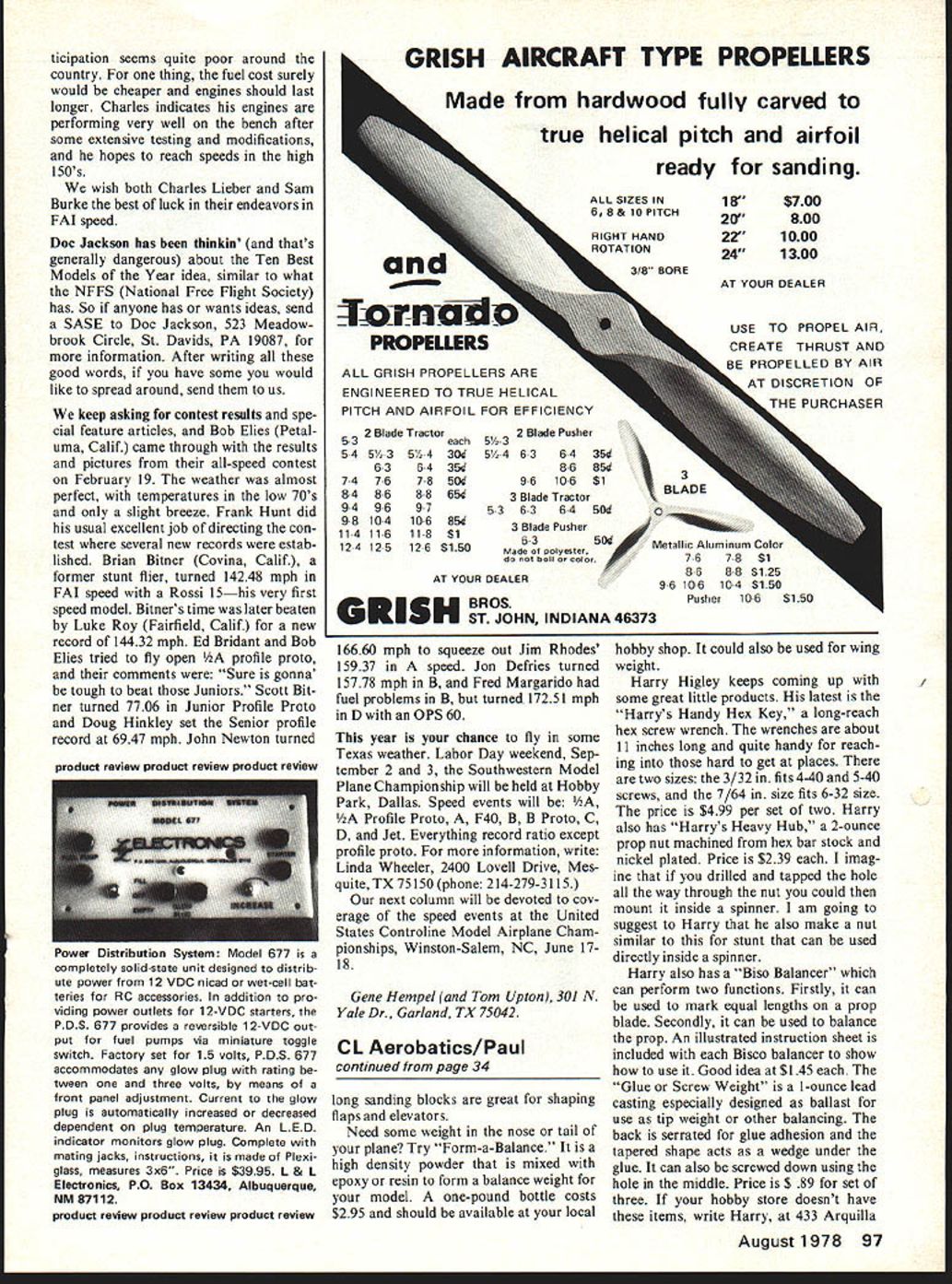
Control Line.. Speed..
Gene Hempel & Tom Upton
AFTER Sam Stopwatch's fantastic 199-mph flight last column, we decided to clean up our act and have two guest authors. Dub Jett will discuss taching techniques, and Patrick Hemple will describe his 194-mph B ship.
Dub Jett: Back in the stone ages, when speed flying was relaxing and glow plugs were replaced about as often as the plugs in your car, a "taching session" was quite an event. We had a whole club full of people who gathered at the local hobby shop to compare engines. This was a great social event, because there was only one tach in the whole city—a strobe which worked only in the dark and was always needing calibration. Nevertheless, much was learned in those days (we had plenty to learn) from the close contact and communication with fellow speed fliers. How tremendous it was to watch some of the greats do their tricks in the dark in front of that old strobe (it's quite a sight to see a prop stop dead still at 20,000 rpm).
I guess it was a good thing we didn't know too much then, because not many of us could have afforded all this knowledge we have now. This, in fact, brings to mind the subject of this story—taching. Not too many of us have whole clubs of speed fliers to sit around in the dark and run engines, but we do have a means for good interchange of information between speed fliers and a tool for obtaining our own goals of getting as much out of our engines and airplanes as possible. It is necessary, however, to have a tach suitable for your needs, and know how to use it before you can get much use from it.
First of all, choose a tach which is portable and durable enough to be banged around in your tool box without losing its calibration. Second, get one you can use when you need it—day or night—and one you can be sure is accurate (±100 rpm). Third, be sure it doesn't affect the engine as some direct drive tachs do. And, finally, compare your tach regularly to someone else's.
I recommend a good, mechanical, direct-drive type with a wide range, so you won't have to guess at your higher rpm. Light tachs, reed tachs, strobe lights, sound, etc., are all acceptable if you know how to read them and if they are consistent and accurate. Don't expect a precision
CL Speed/Hempel/Upton
piece of equipment to be cheap!
There are a multitude of reasons for using a tach: saving wear and tear on your airplanes (taching instead of test flying), working out engine and fuel problems, engine research, impressing your friends, etc., but the best and most common use is to check out an engine to see if it is worth flying. Then, after you fly, compare flight time with ground rpm. For example, our .29's, which turn 22,000 on the ground, will go 180 mph with excellent consistency. Given experience using the tach, you will find that test flying can be reduced, but never eliminated.
There are some basic rules concerning taching which most of us seem to forget from time to time. Let's review them.
- Use a standard fuel and don't vary.
- Use a standard prop.
- Wear safety glasses and ear protection!
- Remove the battery.
- Warm the engine up before obtaining a reading.
- Take the steady state reading, not brief "spikes." (If it isn't steady, you have probably got a problem.)
- If a pipe engine, always use the pipe at a standard, non-varying length.
- Use your flying carburetor.
Even if you obey all the rules, you may not get results which can be correlated with flights. Some pitfalls to avoid are: (a) using a prop or fuel which is considerably different from flying trim; (b) not using a standard prop—designate one which can be easily duplicated and keep it hanging on the wall; (c) not using a standard fuel formula; and (d) not taching in the airplane at least once to be sure the bench test isn't different.
Finally, we get to the most important part of this article. What does one need to tach to go fast? As I explained before, there are so many variables no one can tell you for sure just how fast you should go; but one thing is certain—you can go at least as fast as is indicated in the chart if everything else is right. Getting it "right" no doubt will be the subject of this column for years to come.
Patrick Hempel: This design can be used for either B or C by simply balancing to match either a full or mini-pipe. The construction is all basswood with a 1/8" crutch, 1/4" or 5/16" hard wing, and 3/16" stab. The cowl is made solid, then the inside is cut out—leaving about an 1/8" thick shell; then an 1/8 or 3/16 cap is glued on top. Assemble all of the finished parts—including engine, pan, and pipe—with rubberbands; move the wing forward and backward until you can balance the plane level with your fingers a little ahead of the monoline unit; mark everything and glue together with epoxy. Finish with hobbycote or K&B—and happy flying!
We received letters from Sam Burke, who is a member of the Canadian FAI speed team, and Charles Lieber, who is a member of the American FAI speed team. Sam feels that most speed fliers need more exotic equipment to do well, rather than just working a bit with what they already have; but he still thinks the best performance increase comes from practice rather than any trick modification. (Amen on that.) Sam's models are loosely patterned after Emil Rumpel's Kingfisher, utilizing case pressure with a centrifugal switch and modified pipe. Charles Lieber's feeling is: why is it that there are not more speed fliers participating in FAI speed? We have yet to answer that question very well as FAI speed par- ticipation seems quite poor around the country. For one thing, the fuel cost surely would be cheaper and engines should last longer. Charles indicates his engines are performing very well on the bench after some extensive testing and modifications, and he hopes to reach speeds in the high 150's.
We wish both Charles Lieber and Sam Burke the best of luck in their endeavors in FAI speed.
Doc Jackson has been thinkin' (and that's generally dangerous) about the Ten Best Models of the Year idea, similar to what the NFFS (National Free Flight Society) has. So if anyone has or wants ideas, send a SASE to Doc Jackson, 523 Meadowbrook Circle, St. Davids, PA 19087, for more information. After writing all these good words, if you have some you would like to spread around, send them to us.
We keep asking for contest results and special feature articles, and Bob Elies (Petaluma, Calif.) came through with the results and pictures from their all-speed contest on February 19. The weather was almost perfect, with temperatures in the low 70's and only a slight breeze. Frank Hunt did his usual excellent job of directing the contest where several new records were established. Brian Bitner (Covina, Calif.), a former stunt flier, turned 142.48 mph in FAI speed with a Rossi 15—his very first speed model. Bitner's time was later beaten by Luke Roy (Fairfield, Calif.) for a new record of 144.32 mph. Ed Bridant and Bob Elies tried to fly open 1/2A profile proto, and their comments were: "Sure is gonna be tough to beat those Juniors." Scott Bitner turned 77.06 in Junior Profile Proto and Doug Hinkley set the Senior profile record at 69.47 mph. John Newton turned 166.60 mph to squeeze out Jim Rhodes' 159.37 in A speed. Jon Defries turned 157.78 mph in B, and Fred Margarido had fuel problems in B, but turned 172.51 mph in D with an OPS 60.
This year is your chance to fly in some Texas weather. Labor Day weekend, September 2 and 3, the Southwestern Model Plane Championship will be held at Hobby Park, Dallas. Speed events will be: 1/2A, 1/4A Profile Proto, A, F40, B, B Proto, C, D, and Jet. Everything record ratio except profile proto. For more information, write: Linda Wheeler, 2400 Lovell Drive, Mesquite, TX 75150 (phone: 214-279-3115.)
Our next column will be devoted to coverage of the speed events at the United States Control Line Model Airplane Championships, Winston-Salem, NC, June 17-18.
Gene Hempel (and Tom Upton), 301 N. Yale Dr., Garland, TX 75042.
Transcribed from original scans by AI. Minor OCR errors may remain.

