
CONTROL LINE SPEED
Glenn Lee, 819 Mandrake Dr., Batavia IL 60510
Dayton: The last Speed contest of the year for me, the Dayton Cold Cash Speed Bash in Dayton, OH, is a week away as I write this. I'm frantically building a new F-40 airplane, reworking some of the old ones, putting a new piston in a NovaRossi .21, and reworking fiberglass propellers.
There is never enough time to have all of the equipment finished and ready when the contest date arrives; it's been that way for me as long as I can remember. It might be easier if I reduced the number of events that I fly, but that wouldn't be much fun. In the first competition in which I ever flew, I was still painting my Speed model at the contest! I won second place, though. I guess I'll never learn.
Engine Modifications
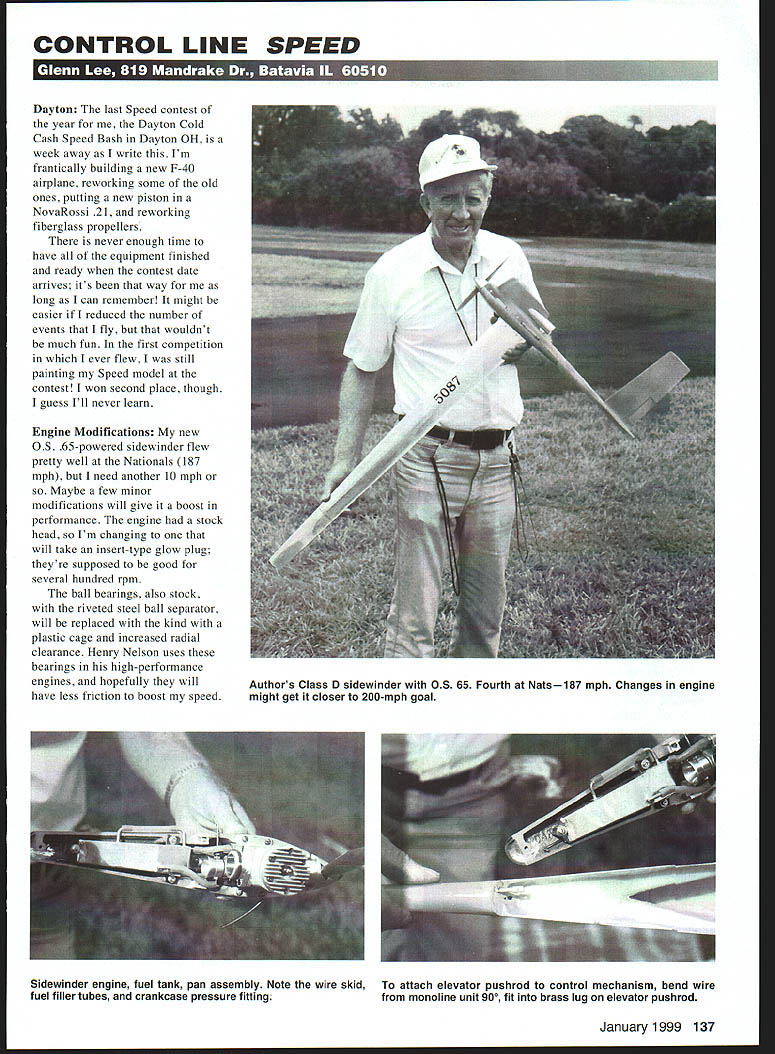
My new O.S. .65-powered sidewinder flew pretty well at the Nationals (187 mph), but I need another 10 mph or so. Maybe a few minor modifications will give it a boost in performance. The engine had a stock head, so I'm changing to one that will take an insert-type glow plug; they're supposed to be good for several hundred rpm.
The ball bearings, also stock, with the riveted steel ball separator, will be replaced with the kind with a plastic cage and increased radial clearance. Henry Nelson uses these bearings in his high-performance engines, and hopefully they will have less friction to boost my speed.
The sleeve in my engine looked a little out of round; it had some scuff marks below the seal area, so Tim Gillott is going to hone it for me. It will be interesting to see if, and how much, these modifications will increase the speed.
Sidewinder Problems
Since I didn't glue the fiberglass spars in the aluminum wings for my Class D and B airplanes, they were vibrating and rattling during flight, slowing the airplanes down.
The epoxied trailing edges popped loose in a couple of spots too, so I reglued them and put in a few more rivets. To give added support and strength to the trailing edge, I tapered balsa strips and glued them in. Then I put epoxy on two sides of the fiberglass fishing-pole main spars, inserted them, and rotated them into position. Now the wings feel as solid as rock! I hope they work better.
I also worked down a couple of fiberglass propellers to eight inches in diameter, and adjusted the pitch from about eight inches near the center to 11 inches at the tip. They were old Rat Race propellers, and now I'm using them on a .65 Speed engine.
My Class B sidewinder was powered by an old, and I mean old, OPS .29 — one of those with a linen phenolic rotor. It was worn out and tired, so I called Henry Nelson for one of his front-intake .29s. He uses the same crankcase as in the .40, so I had to turn the fins down so it would fit in my cowl. I got it in, but haven't run it yet. It's an AAC engine with a chromed aluminum sleeve and high-silicon-alloy aluminum piston, so I'll see how it goes.
I've been told that the front-rotary-valve engines run faster than the rear-intake ones, but I haven't had any way to experiment for myself. Almost all of the .15s used in FAI (Fédération Aéronautique Internationale) Speed are front-intake types; Carl Dodge was one of the last to use a rear-intake engine. Nobody I've talked to knows why the front intakes are faster. Is there a "tuned" intake effect? Is there less friction?
Florida
Dayton may be my last Speed contest this year, but I hope to make it to Florida on January 2–3, 1999. The control-line fliers there are planning a contest with several events other than Speed, so check the magazine. There's nothing like a warm vacation in the middle of a cold winter, and a chance to fly Speed! Tom Zon called and told me about it; maybe I'll have my stuff ready by then.
Safety
Nobody likes to be nagged about safety, but most of us need to be kicked awake now and then. Santo Rizzotto is one of the Florida Speed fliers planning the January contest. For months before the Nats, he and Gordon Kent were building new airplanes, working on new engines, testing, and getting ready.
In early July, Santo got his hand cut on a propeller as they were testing an engine, and neglected to clean, sterilize, and care for it properly. The Friday before the Nats, Santo ended up in the hospital with blood poisoning — a nasty infection. He stayed there instead of going to the Nats.
Props can give you bad wounds, which need to be taken care of quickly and properly.
At the Nats quite a few years ago, I was flying in the Free Flight Helicopter event, and a competitor stuck his hand in the prop of his .15-powered model; I heard the brrrp as two of his fingers were chewed up, and when I looked over, he had stuck them in his mouth. That's about the worst thing you can do — your mouth is a hotbed of germs. The flier got an infection that took several months and many antibiotics to cure.
Props aren't the only hazard. I used to fly Speed in St. Louis during the months of July and August at Buder Park, which sits in a tree-sheltered hole along the river. On one occasion, it got so hot that a friend's knee, exposed by a hole in his jeans, was burned when he knelt on the blacktop.
Warren Kurth ran out of drinking water one year, so he drank the water from melted ice in his Styrofoam cooler. Bad decision: it had warmed up, and he contracted an intestinal infection that took several months to cure.
So be careful, and take care of your injuries. Think before you act, and never fly alone. Use ear plugs or muffs when you run an engine, or you'll end up with tinnitus — ringing in the ears, like I have. I hear a constant zzzzz, and several other old Speed fliers I know have the same problem.
Joe Sullivan of Plano, Texas, wrote asking for more information about ceramic bearings.
Composite bearings are manufactured by the Norton Advanced Ceramics Company of East Granby, Connecticut. The rolling elements, or balls, are silicon nitride (a material almost as hard as diamond), and the races are normal, hard, high-strength steel alloy. These bearings are capable of extremely high speeds, and have greater stiffness, hardness, fatigue resistance, and many times the life of all-steel bearings. The balls are impervious to corrosion, and require much less lubrication.
Composites sound perfect for high-rpm Speed engines, don't they? I tried to obtain some several years ago, but the sales engineer told me that they were unsuitable for two-stroke engines; they had been tried, but there was some trouble with them.
We old-time Speed fliers have been experimenting with different bearings since the Hornet, McCoy, and Dooling days, and one of the first we tried were "precision bearings." The manufacturing dimensions are controlled so that all parts are rounder, more concentric, and closer to design dimensions — millionths of an inch or less. They weren't worth the extra cost, though; they didn't help the engines at all.
Much of the friction in bearings is caused by the balls rubbing against the cage — the ball separator. I had good luck with split ball bearings, made by the Split Ball Bearing Company, where the outer race was fractured and spread apart, allowing balls to be dropped one-by-one into a one-piece linen phenolic cage. Two snap rings then clamped the outer race back together.
I used the split ball bearings in my TVA .29 engine that I built in 1965, and they are still good.
Not long after the K&B 6.5 engine came out, Bill Wisniewski made nylon cages for its bearings, and now they are standard for K&Bs and for many other engines. Sometime along the way, someone figured out that bearings with increased radial clearance lasted longer and gave better performance in Speed engines, so now they too are standard equipment in most high-performance engines.
I wonder if the Norton Company used standard dimensions and metal cages when they tested their ceramic composite bearings in engines. Would the bearings work if we added increased radial clearance and nonmetallic cages? When I find time, I'll try to get the answers.
Materials
I've been making parts, such as intake venturis and spinners, so I needed some aluminum bar stock. It's difficult to find short pieces of stock and it's expensive to buy 20-foot lengths when you only need a few inches.
I learned of a company that will sell steel, aluminum alloys, brass, cast iron, and plastics, in many sizes and forms, by the inch. If I want a foot of 2024 aluminum, I can get it from Metal Express Company. There are several outlets, so call (800) 657-0721 if you want a catalog.
Transcribed from original scans by AI. Minor OCR errors may remain.

