
CONTROL LINE SPEED
Glenn Lee 819 Mandrake Dr., Batavia IL 60510
Speed Records
There was a contest at Whittier Narrows, California on December 6, 1998, for Toys for Tots, and two speed records were set:
- Jim Rhoades, Formula 40 record-holder, increased his record from 160.2 mph to 161.87 mph flying his bright-yellow Nelson .40-powered airplane built by the late Bill Nusz. Jim uses a carbon-fiber propeller 7-7/8" diameter by 7-3/4" pitch, and top speed during the flight was approximately 170 mph.
- The FABS Team, using Connie Aloise's .21 Sport Speed model, broke Frank Puleo's record of 154.8 mph. Connie's airplane, powered by one of Carlos Aloise's ACE (Aloise Competition Engines) engines, turned a speed just under 159 mph. The propeller was clipped during landing, so the backup flight was 156 mph.
These records are impressive!
New Engine
I'm continually amazed by the number of people who read this column, and many of them are not Speed fliers. I get calls and letters asking questions about many other things, so once in a while I write about engines or information I think you may be interested in.
There is a new .020-displacement engine available. There isn't a 1/4A Speed event yet, but Free Flight people do use this size engine in competition. The Cox TD .020 is no longer available; too many have been lost in OOS (Out Of Sight) flights, and used engines are selling for big money.
The new VA .020 engine is being imported from Europe. It is a front-intake, rear-exhaust, Schnuerle-ported ABC power plant that weighs 26 grams—less than an ounce!
I bought a VA .020 from the importer, R. Neville Palmer (Box 609, Palisades NY 10964-0609), but I haven't run it yet—the temperature here was 30°F this morning! I'll keep you informed of future developments, and I'll try to get a photo.
Proto
The .21 Proto Speed event is slowly gaining momentum, and more fliers are building Proto models. The class is fun, good equipment is readily available, the models fly very well, and they are beautiful.
The photo on page 10 of the December Model Aviation shows some of the models flown at the Nationals; you can see the variety of designs and how nice they look.
If you have been thinking about building a Speed model and want to have some fun, consider a Proto. They are a little more difficult to build than conventional Speed models, but you don't need a dolly, and you rarely break a propeller on landing. If built properly, Protos are nice fliers!
The dominant engine in all .21 classes continues to be the NovaRossi. This engine is also used in radio control cars and boats, and there are several versions with different porting arrangements. I don't know how many NovaRossi designs are available—there are so many it's confusing. I might write to Mr. Rossi and try to get a rundown of how many .21 engines he has and the special characteristics of each one.
Nelson Engines
Henry Nelson provides fully competitive engines right out of the box, so you now have to find an "expert" to give you a hop-up job if you buy a new engine. I bought a .40 and a .29 from Henry, and I have them in Formula 40 and Class B sidewinder models.
The F-40 went 155 mph at Dayton in September. That's the fastest I've flown in that class since going to 10% nitromethane fuel, so I'll experiment with different propellers at the Florida contest to try for more speed.
The .40 is an AAC (aluminum-aluminum-chrome) version with a chrome-plated aluminum sleeve and a high-silicon-content piston. This is about an ounce lighter than a brass-sleeved engine, and the aluminum ones run very well. For the first time, I didn't take the engine apart before flying it; I just put it in the airplane and went!
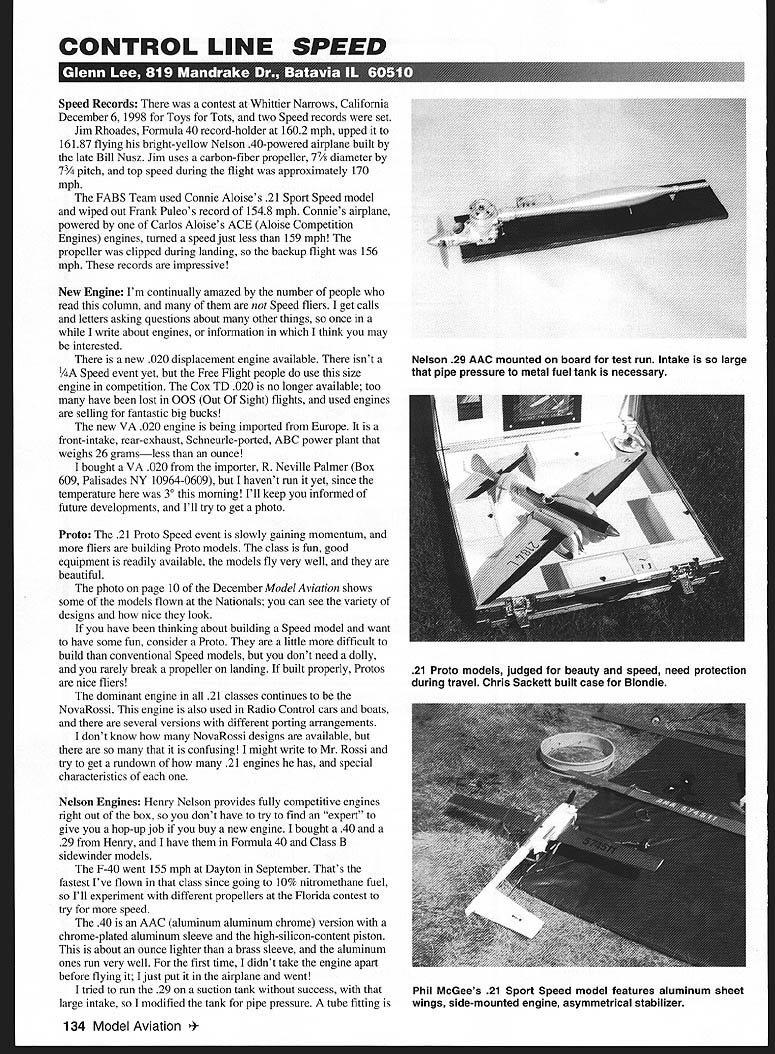
I tried to run the .29 on a suction tank without success because of the large intake, so I modified the tank for pipe pressure. A tube fitting is large enough to do the job, but pipe pressure to the metal fuel tank is necessary.
In Combat we used K&B .35s—the hottest engines available at that time.
The aluminum propeller driver was located on the crankshaft by a 1/8-inch ball that fit in a pocket in the crankshaft and a notch in the aluminum driver. After a few flights the propeller driver would become loose and have some slop because the 1/8-inch ball would beat its way into the aluminum notch.
Pay attention: the distortion and damage were not from thrust, as you might think. Apparently the propeller was being unloaded during sharp turns and would bang against the ball. Is it possible the airplane could speed up during the turns? When you watch a Combat match, they look faster in the turns. My theory is that when you have your engine set up or down, the wing wants to roll but can't with all that air against the surface. Therefore it "squirts" forward, like squeezing a watermelon seed in your fingers. It accelerates enough to rotate the propeller faster and beat that ball into the aluminum. I think this is the reason so many crankshafts were broken during Combat flying.
Henry Nelson was having trouble with ball bearings fracturing in his Combat .35 engines, so he tried bearings in which he replaced the steel balls with silicon nitride balls. They solved the problem and ran fine with a longer lifetime, but they are expensive. They should work in Speed engines too, so I'll probably try some next year.
Monoline Handles
Some fliers have asked about the availability of monoline handles. Slugger Brown has made a short run of them and will sell them with or without the aluminum handles. If you need one, give him a call at (602) 491-0902 during the day, or (602) 786-9453 in the evening.
Transcribed from original scans by AI. Minor OCR errors may remain.

