
CONTROL LINE SPEED
Glenn Lee, 819 Mandrake Dr., Batavia IL 60510
Florida: Terrific! That's the way I describe a Speed contest in the middle of the winter with sunshine, temperatures in the 70s, a beautiful flying site, and good friends. As we were flying, we kept hearing about the blizzard and two feet of snow at home.
The contest, January 2–3 at Titusville, FL, was held at Astronaut High School. The principal, Dr. Mike Krupp, believes that since taxpayers pay for the school property, they should be allowed to use it. Therefore, many social functions are held at the school, and the contest is one of them.
The parking lot where we flew is smooth, flat, and perfect for a Speed contest. Santo Rizzotto, his girlfriend Nancy, Gordon Kent, and several other helpers did an excellent job of officiating, and the meet went off without any hassles or problems. During the two days of flying, competitors put up 61 official flights besides the typical numerous attempts.
Mike Couts and "Jet Bill" Capinjola brought their wives down from Ohio for a little vacation and jet-flying; Chuck Serie brought his jet from Lebanon, IN; Ned Morris drove down from Indianapolis and had a slight auto accident during the trip; and Joey Mathison flew in from Las Vegas to hang onto Ned's airplanes.
I put up a few flights, bounced my Class B model off the blacktop without much damage, and did a wingover with my jet when the dolly hung up on the stabilizer. Luckily, I had enough control of the jet to pull out with just a light touch of the ground, and completed the flight.
Ned Morris monitored the air density with his electronic weather station. Air density gives a good indication of what kind of performance to expect from engines—the higher the reading, the higher the horsepower.
Late Sunday afternoon a cool front came through; the air density went up, and Ned got his team of Joey as pilot and Chuck Whitler as pit man, and put up his big Class D Speed model.
After some ignition problems with the glow plug, they got the model up for a roaring flight in the mid-190s, with a half-lap coasting—a good indication that they might be able to top the record!
Ned fired the model up again, Joey got it into the air, and a speed of 197.36 mph was recorded. This was faster than the reported record, so we thought Ned had it. It turned out that the Fogg-Brown Team's record was approved a few days earlier, and it is about a half-mile-per-hour faster.
Ned's flight was spectacular, and his airplane is a conventional, upright-engine type. I don't know if a sidewinder-type model is really faster or not, but I won't be surprised to see flights faster than 200 mph this summer.
I goofed up my camera, so I don't have any photos yet. Fliers are already talking about "next year"!
New DARP Pan
Various Speed fliers provide special Speed equipment, including:
- Jerry Thomas
- Chris Sackett
- Slugger Brown
- Mike Hazel
- Nick Arpino
- Phil McGee
- and others
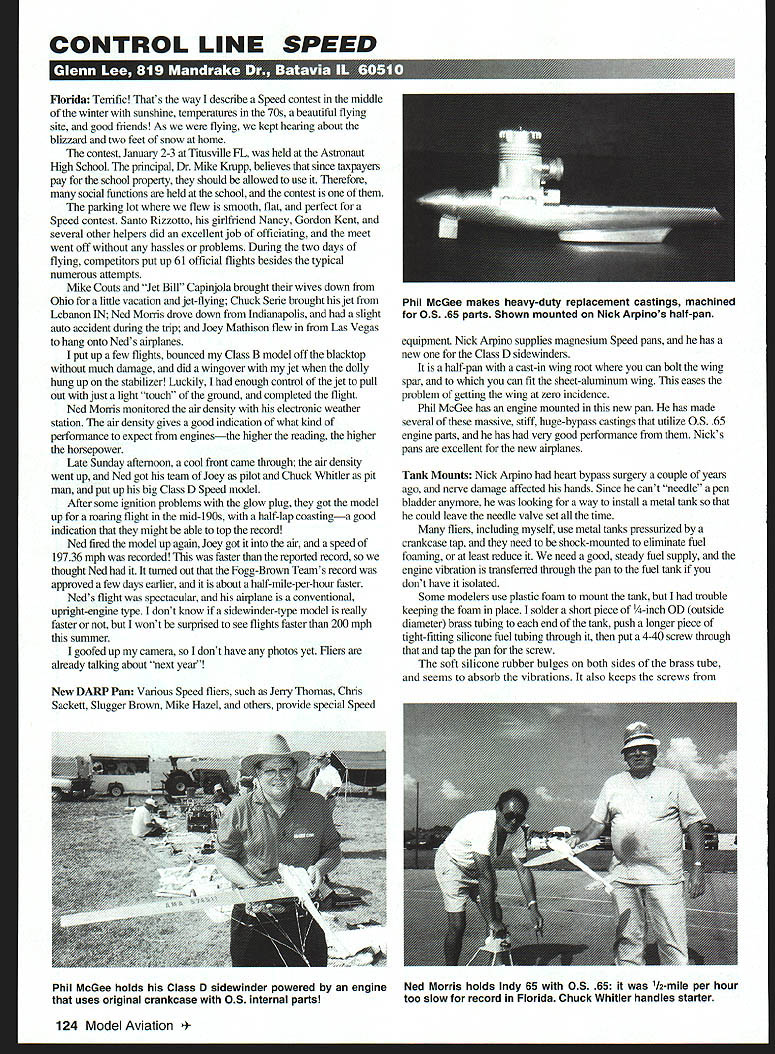
Nick Arpino supplies magnesium Speed pans, and he has a new one for the Class D sidewinders. It is a half-pan with a cast-in wing root where you can bolt the wing spar and to which you can fit the sheet-aluminum wing. This eases the problem of getting the wing at zero incidence.
Phil McGee has an engine mounted in this new pan. He has made several of these massive, stiff, huge-bypass castings that utilize O.S. .65 engine parts, and he has had very good performance from them. Nick's pans are excellent for the new airplanes.
Tank Mounts
Nick Arpino had heart bypass surgery a couple of years ago, and nerve damage affected his hands. Since he can't needle a pen bladder anymore, he was looking for a way to install a metal tank so that he could leave the needle valve set all the time.
Many fliers, including myself, use metal tanks pressurized by a crankcase tap, and they need to be shock-mounted to eliminate fuel foaming, or at least to reduce it. We need a good, steady fuel supply, and engine vibration is transferred through the pan to the fuel tank if you don't have it isolated.
Some modelers use plastic foam to mount the tank, but I had trouble keeping the foam in place. My solution:
- Solder a short piece of 1/4-inch OD (outside diameter) brass tubing to each end of the tank.
- Push a longer piece of tight-fitting silicone fuel tubing through the brass tubes.
- Put a 4-40 screw through that assembly and tap the pan for the screw.
The soft silicone rubber bulges on both sides of the brass tube and seems to absorb the vibrations. It also helps keep the screws from loosening. You can adjust the tank position if you want it farther in or out in relation to the intake to ease lean or rich settings.
With metal tanks it is very important to have tight fuel lines so the entire system is sealed, so use good fuel-line tubing.
More Early Speed Experiences
In the March column I wrote about Les McBrayer and his Sidewinder Speed model powered by an O&R .23. Jack Wilson from Brookings, OR, wrote to me about him.
Then I received a letter from Keith Conrad, who believes that it was probably Les McBrayer—not McBride. McBrayer had several sizes of models with different power plants, such as the O&R .23, K&B Torp .29, and the Bunch Aero-Tiger .45. The models featured engines laying on their sides, but Keith says that they had inboard and outboard wing panels.
Several modelers who flew only Speed got together and formed a club, and that's how the FAST (First All Speed Team) Club was born. Original members were Les McBrayer, Keith Storey, Norm Morgan, Ed Miller, Jim Baker, Keith Conrad and his father Leighton Conrad.
The FAST Club had many contests going on around Southern California in the late 1940s. Keith Conrad flew his Torp .29 in Senior Class II, and was at the Rosecrans & Western meet when Tony Naccarato had the 102+ mph flight. John Brodbeck and Tony’s wife were there, and were just as excited as the pilot and other spectators.
In 1947 Les McBrayer, Keith Storey and Keith Conrad went on the West Coast Team through contest eliminations. Harry Rice (of Ohlsson & Rice) flew the team to East St. Louis in the O&R DC-3 to challenge the East Coast Team.
Conrad qualified for the West Coast Team as a Senior in Class IV, with a V-8 .35 at about 70 mph. Ray Arden sent all participants a copy of the new glow plugs, plus a pint of fuel and its recipe. Conrad set a Class I record with an Arden .099 at the East/West Challenge meet.
The Babcocks—Ernie Jr. and Sr.—were the key Speed fliers on the East Team. There was also a Precision Aerobatics (aka Stunt) competition at the meet, but Keith couldn’t remember who the flyers were.
The West Team was the Speed winner big time, taking first places in Class I (.099) through Class VI (.60).
The FAST Club also formulated the rules and procedures for a new event called "Team Racing," and they flew many demonstration flights to get it going.
Les McBrayer passed away several years ago, and Leighton Conrad died in 1994. Keith Conrad has retired and lives in Midland, Texas. He’s been active again and flies radio control with the Odessa Propbusters.
Many thanks to Keith for sending me his interesting part of modeling history and Speed flying. I hope you enjoyed it.
Transcribed from original scans by AI. Minor OCR errors may remain.

