
CONTROL LINE SPEED
Glenn Lee, 819 Mandrake Dr., Batavia IL 60510
In the high-nitromethane-fuel days, there was the 200 Mph Club, which consisted of all of the Speed fliers who had flown 200 mph or faster in any class.
With the rule change to 10% nitro fuel, no one has achieved that speed except the Fogg-Brown Team, who hit 200 in D but had no backup flight for a record. I expected the Class D record to be faster than 200 mph this summer, and it didn't take long!
Ned Morris took his O.S. .65-powered Indy Sixty airplane out to California for a contest on March 14, and told people beforehand that he was going to do 202 mph. However, Ned got sick before the contest — he picked up a vicious flu bug or a bad case of food poisoning, and ended up sitting in his motel room.
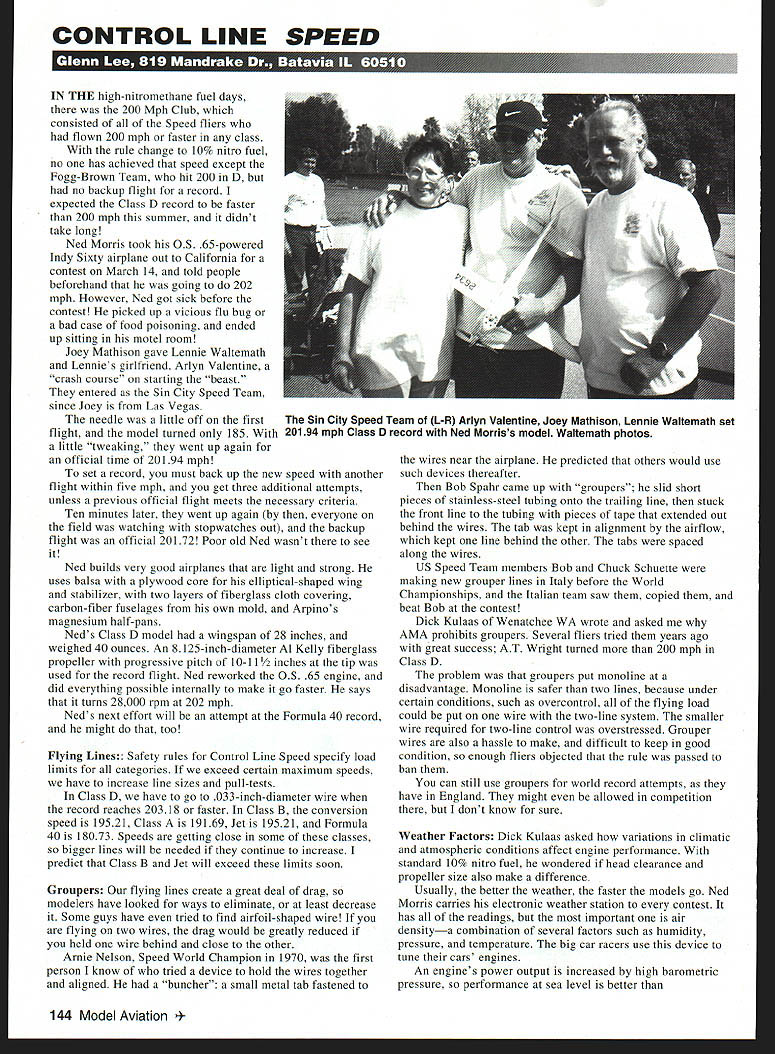
Joey Mathison gave Lennie Waltemath and Lennie's girlfriend, Arlyn Valentine, a "crash course" on starting the "beast." They entered as the Sin City Speed Team, since Joey is from Las Vegas.
The needle was a little off on the first flight, and the model turned only 185 mph. With a little tweaking, they went up again for an official time of 201.94 mph.
To set a record, you must back up the new speed with another flight within five mph, and you get three additional attempts, unless a previous official flight meets the necessary criteria. Ten minutes later, they went up again (by then, everyone on the field was watching with stopwatches out), and the backup flight was an official 201.72 mph. Poor old Ned wasn't there to see it!
Ned builds very good airplanes that are light and strong. He uses balsa with a plywood core for his elliptical-shaped wing and stabilizer, with two layers of fiberglass cloth covering, carbon-fiber fuselages from his own mold, and Arpino's magnesium half-pans.
Ned's Class D model had a wingspan of 28 inches and weighed 40 ounces. An 8.125-inch-diameter Al Kelly fiberglass propeller with progressive pitch of 10–11.5 inches at the tip was used for the record flight. Ned reworked the O.S. .65 engine and did everything possible internally to make it go faster. He says that it runs 28,000 rpm at 202 mph.
Ned's next effort will be an attempt at the Formula 40 record, and he might do that, too!
Flying Lines
Safety rules for Control Line Speed specify load limits for all categories. If we exceed certain maximum speeds, we have to increase line sizes and pull-tests.
Conversion speeds (when larger line sizes are required):
- Class D: 203.18 mph and faster — must go to .033-inch-diameter wire.
- Class B: 195.21 mph.
- Class A: 191.69 mph.
- Jet: 195.21 mph.
- Formula 40: 180.73 mph.
Speeds are getting close in some of these classes, so bigger line sizes will be needed if they continue to increase. I predict that Class B and Jet will exceed these limits soon.
Groupers
Our flying lines create a great deal of drag, so modelers have looked for ways to eliminate, or at least decrease, it. Some guys have even tried to find an airfoil-shaped wire. If you are flying on two wires, the drag would be greatly reduced if you held one wire behind and close to the other.
Arnie Nelson, Speed World Champion in 1970, was the first person I know who tried a device to hold the wires together and aligned. He had a "buncher" — a small metal tab fastened to the wires near the airplane. He predicted that others would use such devices thereafter.
Then Bob Spahr came up with "groupers": he slid short pieces of stainless-steel tubing onto the trailing line, then stuck the front line to the tubing with pieces of tape that extended out behind the wires. The tab was kept in alignment by the airflow, which kept one line behind the other. The tabs were spaced along the wires.
US Speed Team members Bob and Chuck Schuette were making new grouper lines in Italy before the World Championships, and the Italian team saw them, copied them, and beat Bob at the contest!
Dick Kulaas of Wenatchee, WA wrote and asked me why AMA prohibits groupers. Several fliers tried them years ago with great success. A.T. Wright turned more than 200 mph in Class D.
The problem was that groupers put monoline at a disadvantage. Monoline is safer than two lines, because under certain conditions, such as overcontrol, all of the flying load could be put on one wire with the two-line system. The smaller wire required for two-line control was overstressed. Grouper wires are also a hassle to make and difficult to keep in good condition, so enough fliers objected that the rule was passed to ban them. You can still use groupers for world record attempts, as they have in England. They might even be allowed in competition there, but I don't know for sure.
Weather Factors
Dick Kulaas asked how variations in climatic and atmospheric conditions affect engine performance. With standard 10% nitro fuel, he wondered if head clearance and propeller size also make a difference.
Usually, the better the weather, the faster the models go. Ned Morris carries his electronic weather station to every contest. It has all of the readings, but the most important one is the density — a combination of several factors such as humidity, pressure, and temperature. The big car racers use this device to tune their cars' engines.
An engine's power output is increased by high barometric pressure, so performance at sea level is better than at higher elevations. Fliers in Denver have much lower performance because of their mile-high site.
Radio-control fliers can compensate by adding nitro to their fuel to get more oxygen to the engines, but Speed fliers can't do that with our rule restricting nitro to a maximum of 10%.
Humidity and temperature also change the situation. Our power output depends on the mass of gas that we can put through the engine. Water molecules weigh much less than oxygen and nitrogen, and cool air is denser than hot air.
We Speed fliers haven't put a NASCAR chip on our engines yet, but people are talking about it! Then you could run or fly the engine, plug in the computer, and see how to change things such as compression, sleeve timing, intake timing, head clearance, etc.
Head clearance is not the same as compression ratio; the distance from the top of the piston to the glow plug is important. Squish-band clearance usually has to be increased on hot, humid days. Then you have to select a propeller diameter and pitch to suit the power that you have obtained. Old Speed fliers know some of this lore, and some never learn!
There are all kinds of things to do if you want to get serious, but meanwhile, the rest of us will be flying and having fun!
Flying Season
It's finally almost nice enough to go flying, this being the first part of May. I'm trying to get a new Jet built — a sidewinder type, almost all aluminum, with a new head for the engine. I have built special Jet heads before, but some of them wouldn't even run! I don't know much about them, so what I try is pure conjecture. If it doesn't run, I'll put a different engine on the airplane.
I picked up a NovaRossi .21 at a swap shop, so of course I had to "hop it up"! There are a few things that make NovaRossis run better and faster, so I ground out the center hole in the crankshaft .030 off-center to help balance the shaft and reduce the load on the bearings.
I inspected the sleeve very carefully and lapped out any scuff marks on the sidewalls, which gives a little more clearance for the piston. I was careful not to lap the sealing area at the top of the stroke, because engines don't go without compression!
A new head will take the Nelson Glo-Bee–type insert plug, and I found a newer backplate that has the steel plate where the connecting rod rubs.
That about does it for this month. Beware the warp!
Transcribed from original scans by AI. Minor OCR errors may remain.

