
CONTROL LINE SPEED
Glenn Lee 819 Mandrake Dr. Batavia, IL 60510
Ceramic Bearings
In previous columns I have written about composite bearings that feature steel races and silicon nitride ceramic balls.
A few years ago, if you wanted ceramic balls you had to take your steel bearing apart, measure the diameters of the balls, then order the ceramic replacements — for approximately $14 per ball. Production has reduced the price to about a third of that, but it is still expensive when you need seven or eight balls per bearing.
Some modelers did not have a micrometer capable of measuring the diameter of the balls to 50 millionths of an inch. The balls needed to suit the dimensions of the races, so to replace the balls you needed to measure them to less than a tenth of a thousandth of an inch. Those problems have been eliminated: now you can order complete ceramic replacement bearings from Boca Bearing, a specialty bearing supplier in Boca Raton, FL. (See the address and telephone number in the Parts Suppliers section.)
Manufacturers of the small model turbine jets quickly learned they needed these bearings as well.
And yes — ceramic bearings do make a difference. I have heard rumors of engines increasing several hundred rpm with them, but I don't have tested data to verify specific numbers; I can only report on observed performance.
Ned Morris has had ceramic bearings in his O.S. .65 for several years, and he holds the Class D Speed record at just under 202 mph. He says his engine has to be turning 28,000 rpm to attain this speed with a 10- to 11-inch-pitch prop. Normal steel bearing lifetime at that rpm is very short, but the lifetime of ceramic balls and a plastic ball separator is much longer.
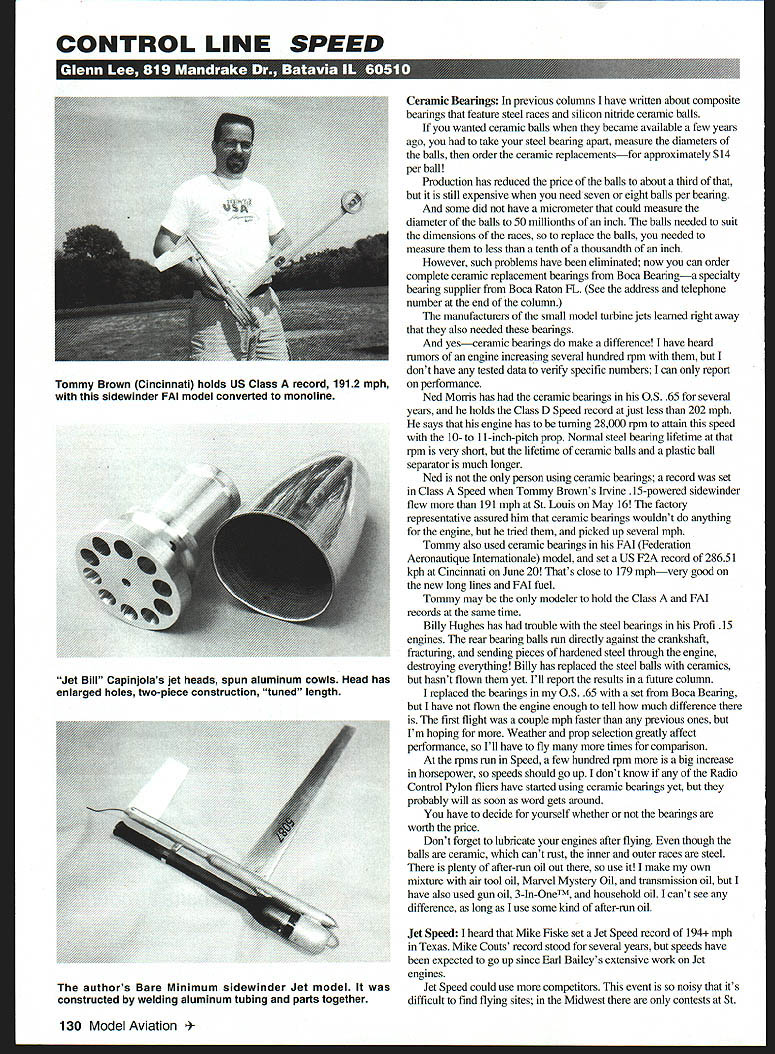
Ned is not the only person using ceramic bearings. A record was set in Class A Speed when Tommy Brown's Irvine .15-powered sidewinder flew more than 191 mph at St. Louis on May 16. The factory representative assured him that ceramic bearings wouldn't do anything for the engine, but he tried them and picked up several mph.
Tommy also used ceramic bearings in his FAI model and set a US F2A record of 286.51 kph at Cincinnati on June 20 — close to 179 mph, which is very good on the new long lines and FAI fuel. Tommy may be the only modeler to hold the Class A and FAI records at the same time.
Billy Hughes has had trouble with the steel bearings in his Profi .15 engines. The rear bearing balls run directly against the crankshaft, fracturing and sending pieces of hardened steel through the engine, destroying everything. Billy has replaced the steel balls with ceramics but hasn't flown them yet. I'll report the results in a future column.
I replaced the bearings in my O.S. .65 with a set from Boca Bearing, but I have not flown the engine enough to tell how much difference there is. The first flight was a couple mph faster than any previous ones, but I'm hoping for more. Weather and prop selection greatly affect performance, so I'll have to fly many more times for a reliable comparison.
At the rpms run in Speed, a few hundred rpm more is a big increase in horsepower, so speeds should go up. I don't know if any of the Radio Control Pylon fliers have started using ceramic bearings yet, but they probably will as soon as word gets around. You have to decide for yourself whether the bearings are worth the price.
Don't forget to lubricate your engines after flying. Even though the balls are ceramic and can't rust, the inner and outer races are steel. There is plenty of after-run oil available, so use it. I make my own mixture with air tool oil, Marvel Mystery Oil, and transmission oil, but I have also used gun oil, 3-In-One, and household oil. I can't see any difference, as long as some kind of after-run oil is used.
Jet Speed
I heard that Mike Fiske set a Jet Speed record of 194+ mph in Texas. Mike Couts' record stood for several years, but speeds have been expected to go up since Earl Bailey's extensive work on jet engines.
Jet Speed could use more competitors. It seems so noisy that it's difficult to find flying sites; in the Midwest there are only contests at St. Louis, Cincinnati, Dayton, OH, and at the AMA field at Muncie.
Jet is fun to fly and different from any other event. There are two classes: AMA Jet Speed and unofficial Sport Jet, which is restricted to stock engines such as the Dyna Jet, O.S. Jet, or the Bailey Sport Jet.
In Sport Jet, the models are flown on two 60-foot-long × .018-inch-diameter lines, and the controls must be mounted externally. Fuel is the same as for Fast Jet — 80% methanol and 20% propylene oxide — and the stock engines run quite well on it.
If you are interested in jet flying, why not build a Sport Jet and have some fun with us? Many supplies for jets are available, so it's no problem to get the necessary equipment.
Jerry Thomas of J.T. Products has all kinds of model parts for his Ironsides airplane, as well as valves, valve retainers, and starting probes for engines.
Earl Bailey of Bailey Machine Service has Fast Jet engines, stock Sport Jet engines, and all of the parts for them, including tire pumps for starting.
Ned Morris has flying wire, torque units, bellcranks, and other model equipment, such as bearings for two-stroke engines.
George Brown III has monoline handles and other items, such as spinners.
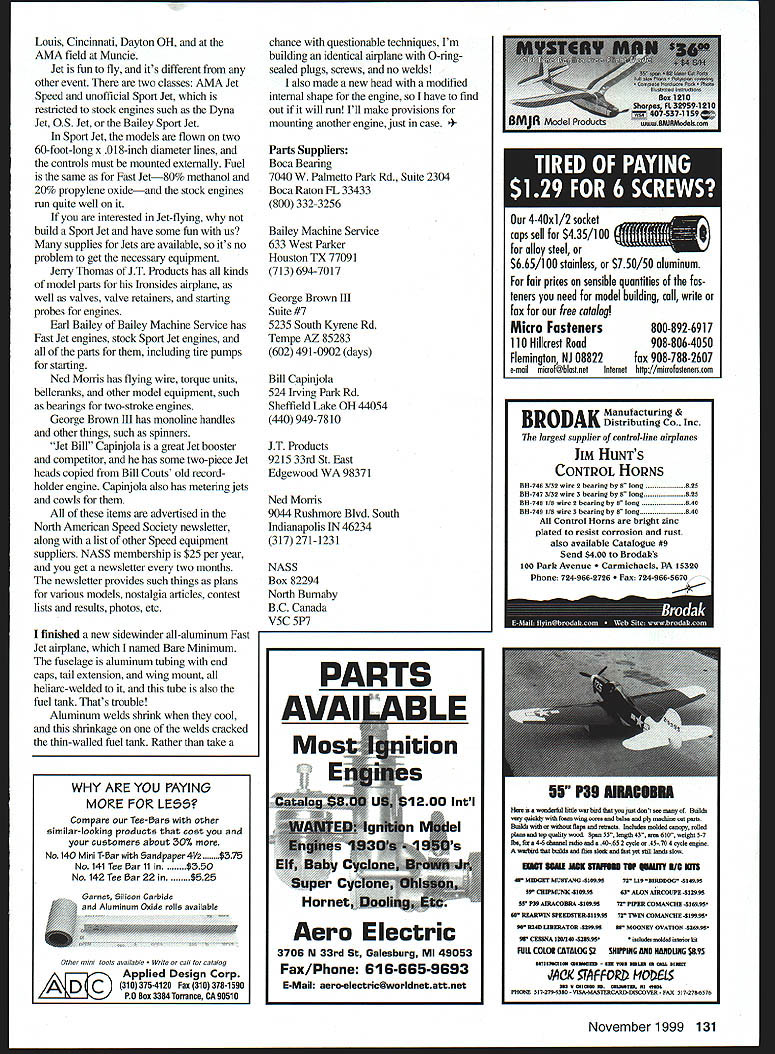
"Jet Bill" Capinjola is a great jet booster and competitor. He has some two-piece jet heads copied from Bill Couts' old record-holder engine, and he also has metering jets and cowlings for them.
All of these items are advertised in the North American Speed Society (NASS) newsletter, along with a list of other speed equipment suppliers. NASS membership is $25 per year and you get a newsletter every two months. The newsletter provides plans for various models, nostalgia articles, contest lists and results, photos, and more.
I finished a new sidewinder all-aluminum Fast Jet airplane, which I named Bare Minimum. The fuselage is aluminum tubing with end caps, tail extension, and wing mount, all heliarc-welded to it, and this tube is also the fuel tank. That's trouble: aluminum welds shrink when they cool, and this shrinkage on one weld cracked the thin-walled fuel tank. Rather than take a chance with questionable techniques, I'm building an identical airplane with O-ring-sealed plugs, screws, and no welds.
I also made a new head with a modified internal shape for the engine, so I have to find out if it will run. I'll make provisions for mounting another engine, just in case.
Parts Suppliers
- Boca Bearing
7040 W. Palmetto Park Rd., Suite 2304 Boca Raton, FL 33433 (800) 332-3256
- Bailey Machine Service
633 West Parker Houston, TX 77091 (713) 694-7017
- George Brown III
Suite #7 5235 South Kyrene Rd. Tempe, AZ 85283 (602) 491-0902 (days)
- Bill Capinjola
524 Irving Park Rd. Sheffield Lake, OH 44054 (440) 949-7810
- J.T. Products
9215 33rd St. East Edgewood, WA 98371
- Ned Morris
9044 Rushmore Blvd. South Indianapolis, IN 46234 (317) 271-1231
- NASS (North American Speed Society)
Box 82294 North Burnaby, B.C. V5C 5P7 Canada
Transcribed from original scans by AI. Minor OCR errors may remain.

