
Control Line: Speed
Gene Hempel & Tom Upton
Meet reports and news
With the Nats over we have an opportunity to print information from some of the letters we have received.
- Congratulations to Glen Van Sant who entered the Cleveland Junior Air Races in Ohio on July 1–2, 1978. Glen won the high point trophy by a 50-point margin over Quay Barber, who had previously won it for two years. Several records were set by Glen Van Sant and Quay Barber.
- At the BRM All Speed Meet, Robert Moher, CD, reported very good speeds, with the rain holding off until awards were complete.
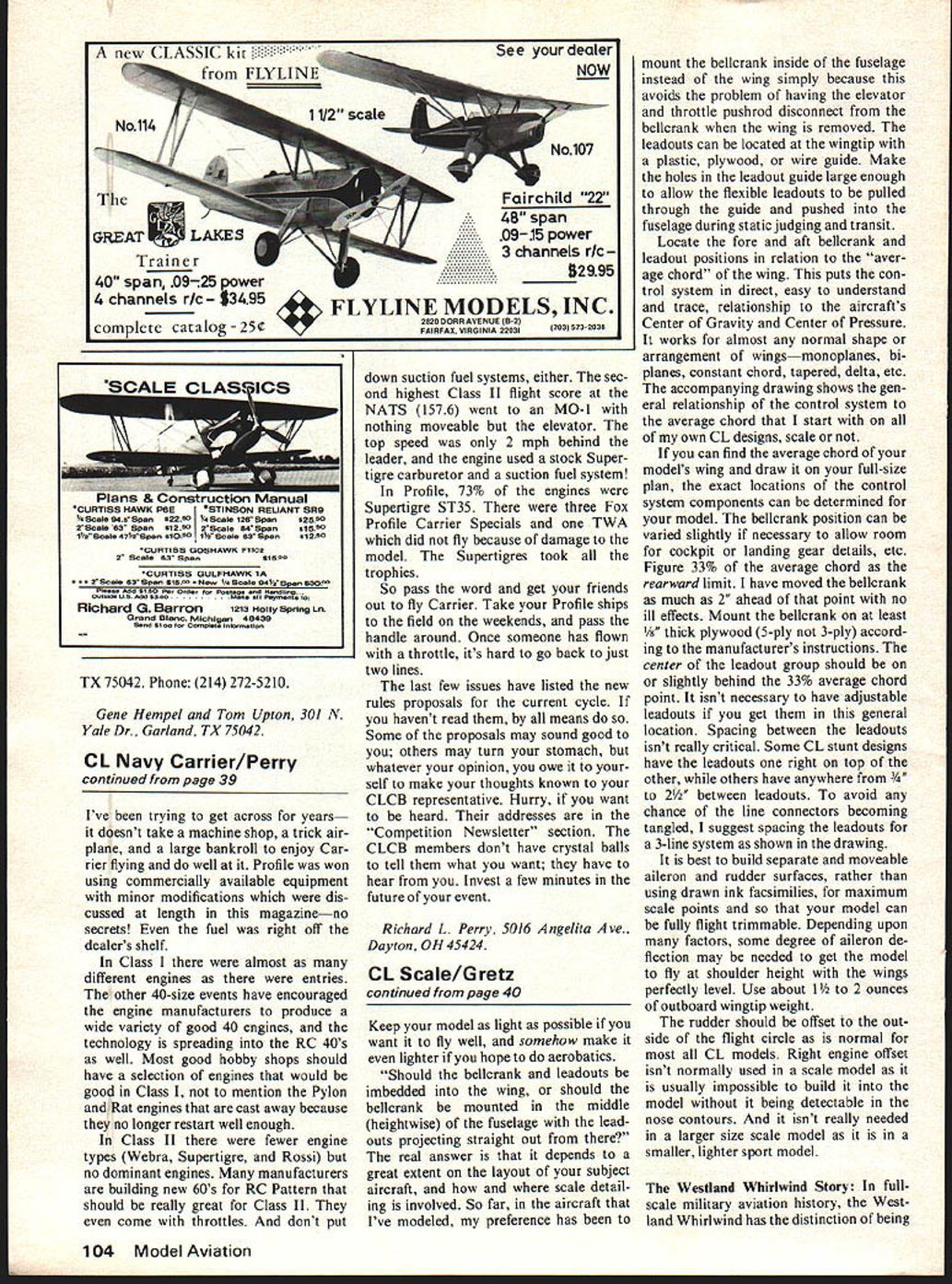
- The Texas gang held their Annual Southwestern Model Championships at Hobby Park over Labor Day weekend in Dallas, Texas. Al Stegens from Cleveland, Ohio and the Ytuarte family from New York attended. Numerous records were established, with the majority going to Dennis Ytuarte of New York. The trophies were etched glass vases — a nice change from the usual pot metal trophies. Saturday night featured a banquet at Bedford's Steak House.
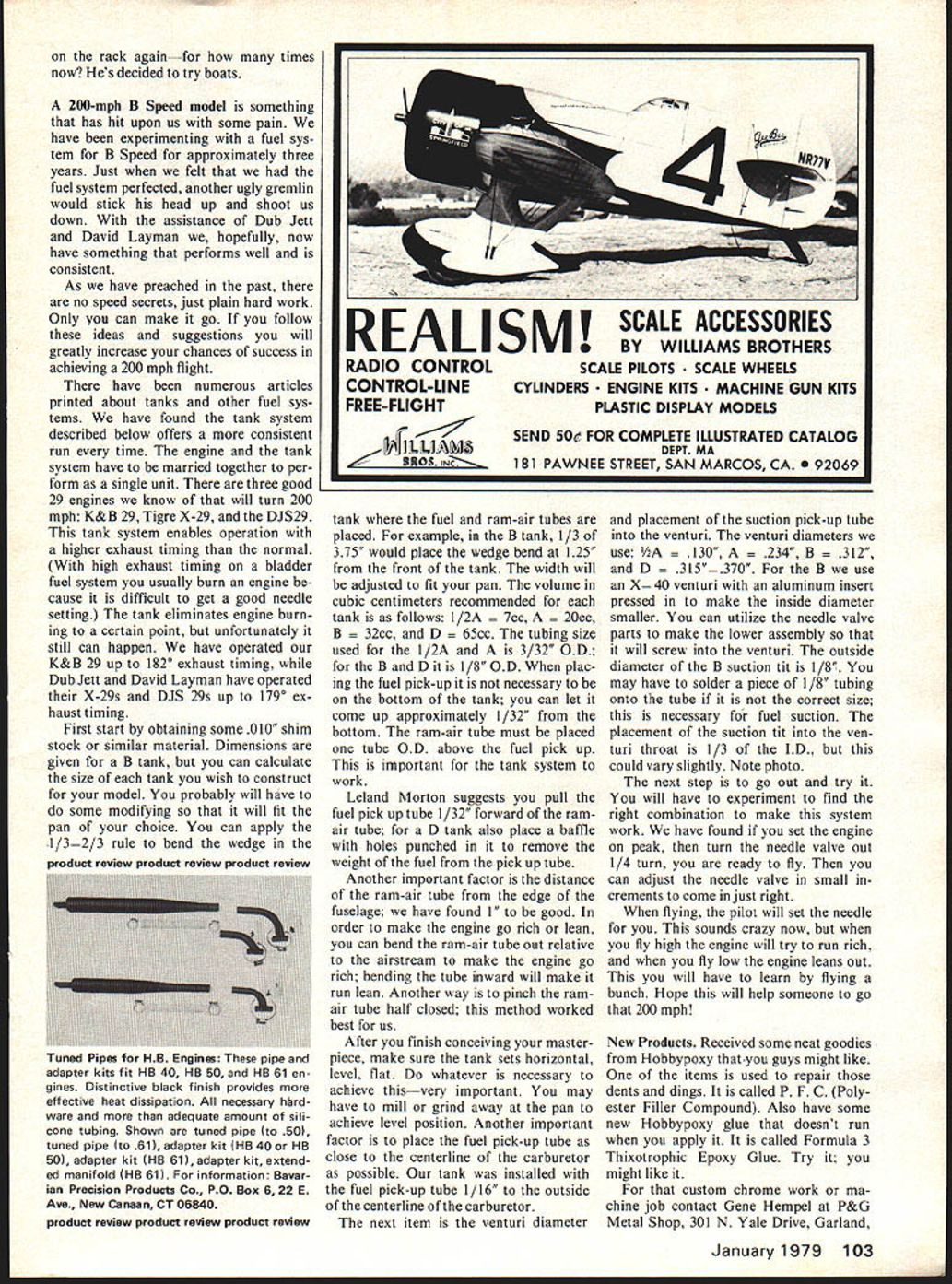
- We announce the formation of a new speed team composed of Charlie Davis, his wife Lynn Davis, and Franco Marcenario — affectionately dubbed the "Mickey Mouse Team." Charlie recorded 209.95 mph for first in Jet Speed at the Southwestern Model Championships using a modified Raven head in sidewinder mode. The fuel was a mixture of 2 parts nitro to 1 part prop. He hopes to knock Bill Pardue from the jet throne.
- Richard Shannon from Dresden, TN visited Texas to observe current D Speed operation under the new mini-pipe rule. We hope he returns to flying.
- Tom Upton has decided to hang his flying hat on the rack again — for how many times now? He's decided to try boats.
If you have jet activity or other speed items, write and tell us — we can't report it if you don't write.
200-mph B Speed model — overview
A 200-mph B Speed model has been a tough goal. We've been experimenting with a fuel system for B Speed for approximately three years. Just when we felt we had the fuel system perfected, another gremlin would show up. With assistance from Dub Jett and David Layman, we now have a system that performs well and is consistent.
As we have said before, there are no speed secrets — just plain hard work. Only you can make it go. Follow these ideas and suggestions to greatly increase your chances of achieving a 200 mph flight.
Recommended engines and timing
There are three 29 engines we know of that will turn 200 mph:
- K&B 29 — we've operated ours up to 182° exhaust timing.
- Tigre X-29 — Dub Jett has operated up to 179°.
- DJS 29 — David Layman has operated up to 179°.
This tank system enables operation with higher exhaust timing than normal. With a high-exhaust-timing bladder fuel system you often burn an engine because it's difficult to get a good needle setting. The tank described here reduces the chance of burning the engine, though it can still happen.
Tank construction and dimensions
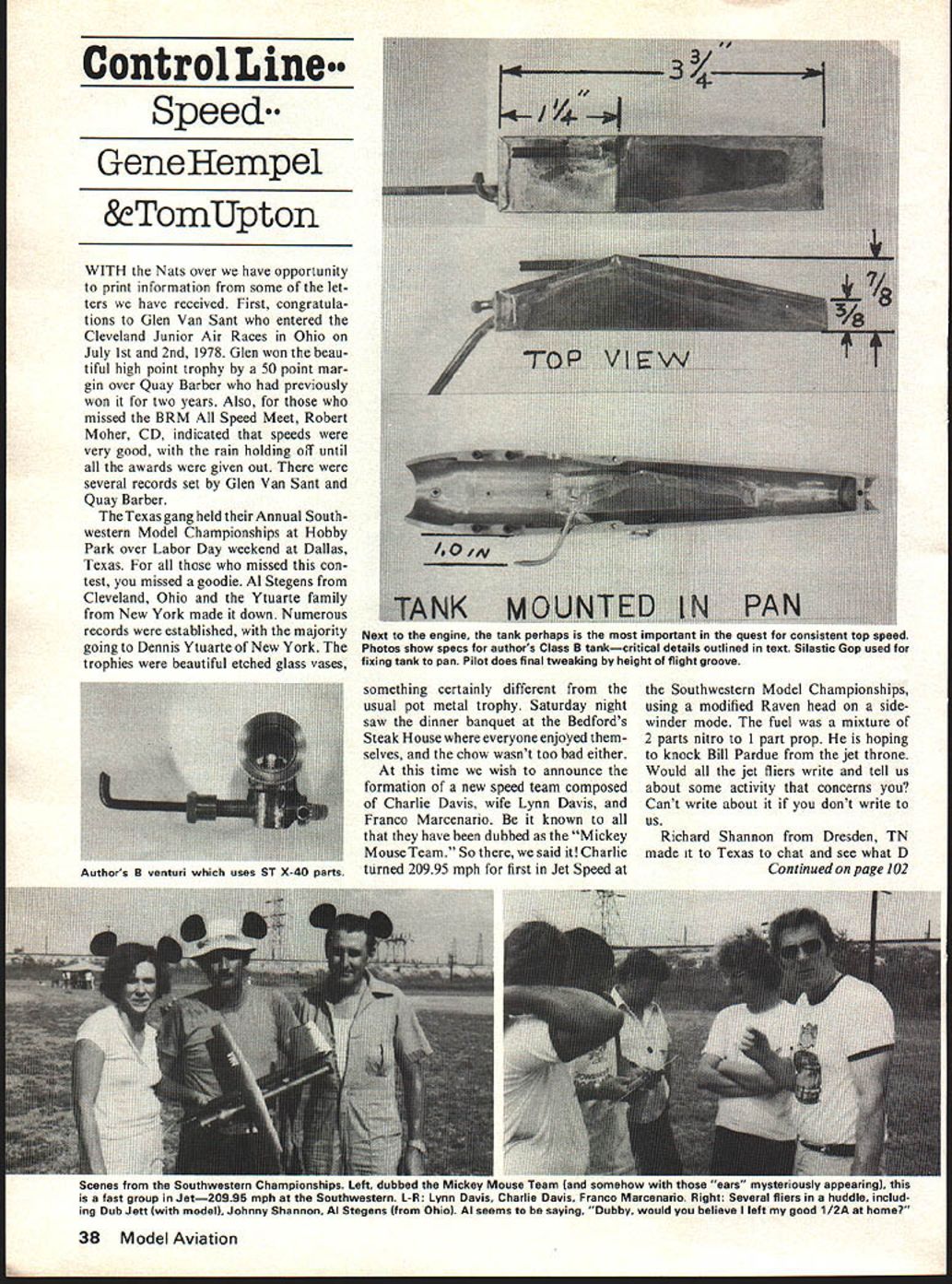
Start with .010" shim stock or similar material. Dimensions given are for a B tank; adjust sizes for other tanks and to fit your chosen pan. You may need to modify the pan so the tank sits correctly.
- Use the 1/3–2/3 rule to place the wedge bend where the fuel and ram-air tubes are placed. Example: for a B tank 3.75" long, 1/3 of 3.75" places the wedge bend 1.25" from the front of the tank.
- Recommended tank volumes (cubic centimeters):
- 1/2A — 7 cc
- A — 20 cc
- B — 32 cc
- D — 65 cc
- Tubing sizes:
- 1/2A and A: 3/32" O.D.
- B and D: 1/8" O.D.
- Fuel pick-up: It is not necessary to have the pick-up on the bottom; it may come up approximately 1/32" from the bottom.
- Ram-air tube: Must be placed one tube O.D. above the fuel pick-up. This is important for the tank system to work.
- Leland Morton suggests pulling the fuel pick-up tube 1/32" forward of the ram-air tube. For a D tank, also include a baffle with holes punched in it to reduce the weight of fuel on the pick-up tube.
- Distance from ram-air tube to fuselage edge: we have found 1" to be good.
- To richen or lean the engine: bend the ram-air tube outward relative to the airstream to richen; bend it inward to lean. Another method is to pinch the ram-air tube half closed — this worked best for us.
- Ensure the tank sits horizontal, level, and flat. Mill or grind the pan as necessary to achieve level position.
- Place the fuel pick-up tube as close to the centerline of the carburetor as possible. Our tank had the fuel pick-up tube 1/16" to the outside of the carburetor centerline.
Venturi and suction pick-up
- Venturi inside diameters we use:
- 1/2A = .130"
- A = .234"
- B = .312"
- D = .315"–.370"
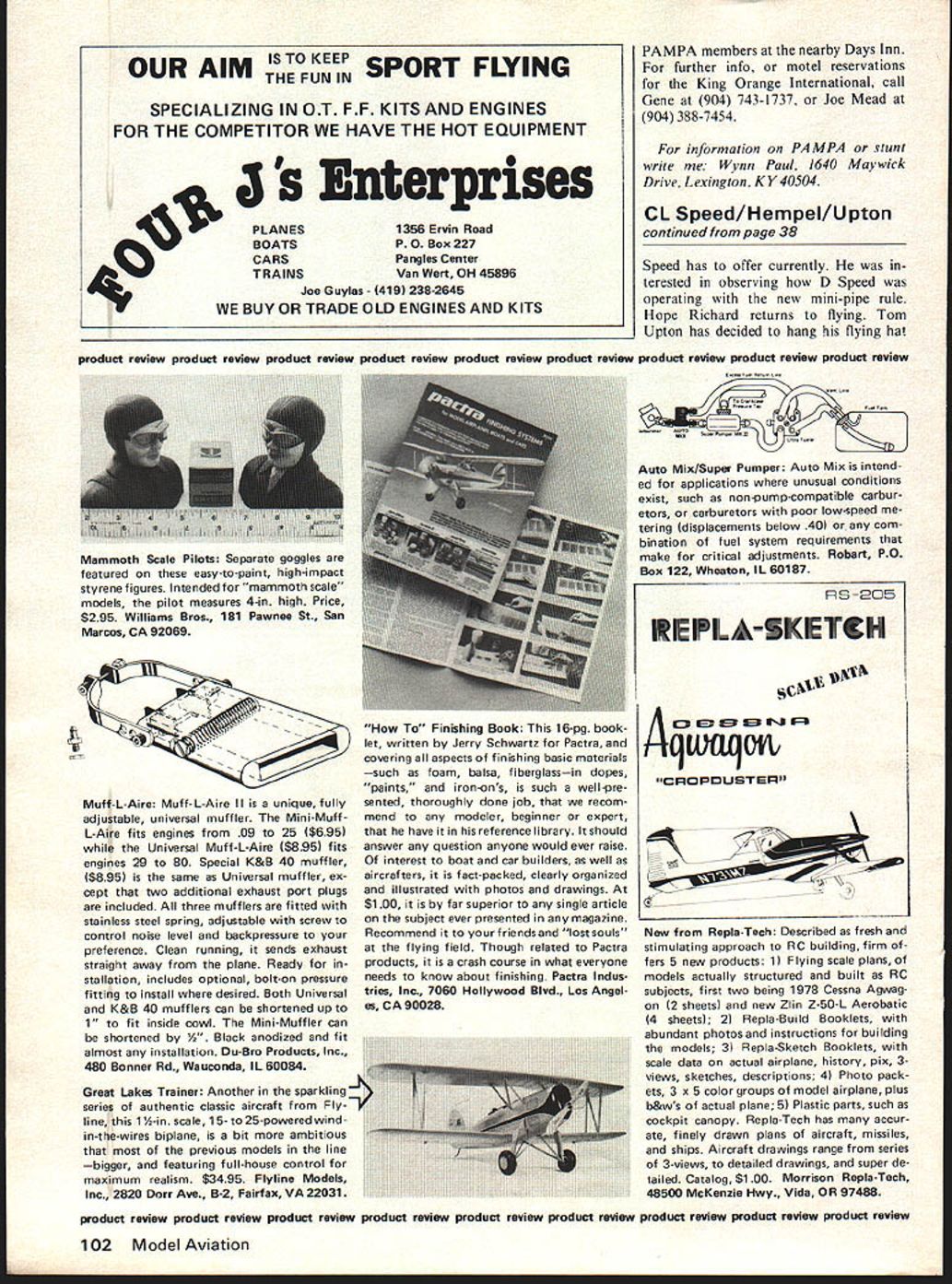
- For the B tank we use an X-40 venturi with an aluminum insert pressed in to reduce the inside diameter.
- You can use needle valve parts to make the lower assembly so it will screw into the venturi.
- The outside diameter of the B suction is 1/8". If your tube is not the correct size, solder a piece of 1/8" tubing onto it — this is necessary for proper fuel suction.
- Placement of the suction into the venturi throat: approximately 1/3 of the I.D., though this may vary slightly.
Tuning and flying tips
- Start tuning on the ground: set the engine on peak, then turn the needle valve out 1/4 turn; you should be ready to fly. Adjust the needle in small increments from there.
- In flight, have the pilot set the needle for you. When flying high the engine tends to run rich; when flying low the engine leans out. Learn these tendencies by flying a lot.
- Expect to experiment to find the right combination of tank, timing, venturi, and needle settings. Persistence pays off.
New products
Received some new items from Hobbypoxy:
- P.F.C. (Polyester Filler Compound) — useful for repairing dents and dings.
- Formula 3 Thixotropic Epoxy Glue — a thicker epoxy that doesn't run when applied. Try them; you might like them.
Contact
For custom chrome work or machine jobs contact:
- Gene Hempel, P&G Metal Shop, 301 N. Yale Drive, Garland, TX 75040
Rules proposals
The last few issues have listed the new rules proposals for the current cycle. If you haven't read them, do so. Some proposals may appeal to you; others may not. Whatever your opinion, make your thoughts known to your CLCB representative — their addresses are in the "Competition Newsletter" section. The CLCB members don't have crystal balls; they need to hear from you. Invest a few minutes in the future of your event.
Transcribed from original scans by AI. Minor OCR errors may remain.

