
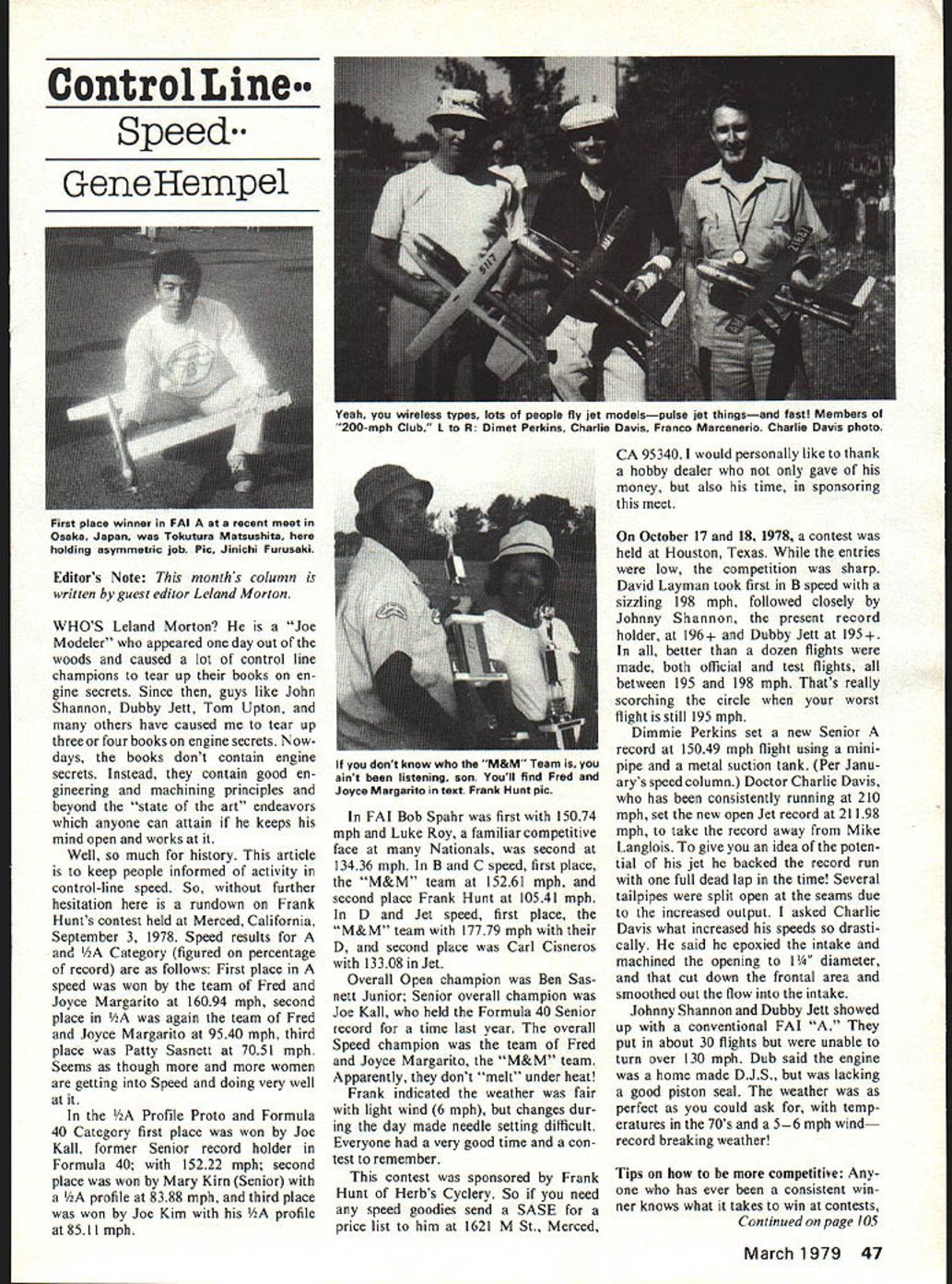
Control Line: Speed
Editor's Note
This month's column is written by guest editor Leland Morton.
Who's Leland Morton?
Who's Leland Morton? He is a "Joe Modeler" who appeared one day out of the woods and caused a lot of control-line champions to tear up their books on engine secrets. Since then, guys like John Shannon, Dubby Jett, Tom Upton, and many others have caused me to tear up three or four books on engine secrets. Nowadays, the books don't contain engine secrets. Instead, they contain good engineering and machining principles and beyond the "state of the art" endeavors which anyone can attain if he keeps his mind open and works at it.
Well, so much for history. This article is to keep people informed of activity in control-line speed.
Merced, California contest — September 3, 1978
Frank Hunt's contest was held at Merced, California, on September 3, 1978. Speed results (figured on percentage of record) are as follows:
- A speed: 1st — Fred and Joyce Margarito, 160.94 mph (overall Speed champions)
- 1/2A speed: 2nd — Fred and Joyce Margarito, 95.40 mph
- 1/2A speed: 3rd — Patty Sasnett, 70.51 mph
1/2A Profile Proto and Formula 40:
- 1st — Joe Kall (former Senior record holder in Formula 40), 152.22 mph
- 2nd — Mary Kim (Senior), 83.88 mph (1/2A profile)
- 3rd — Joe Kim, 85.11 mph (1/2A profile)
FAI:
- 1st — Bob Spahr, 150.74 mph
- 2nd — Luke Roy, 134.36 mph
B and C speed:
- 1st — "M&M" team, 152.61 mph
- 2nd — Frank Hunt, 105.41 mph
D and Jet speed:
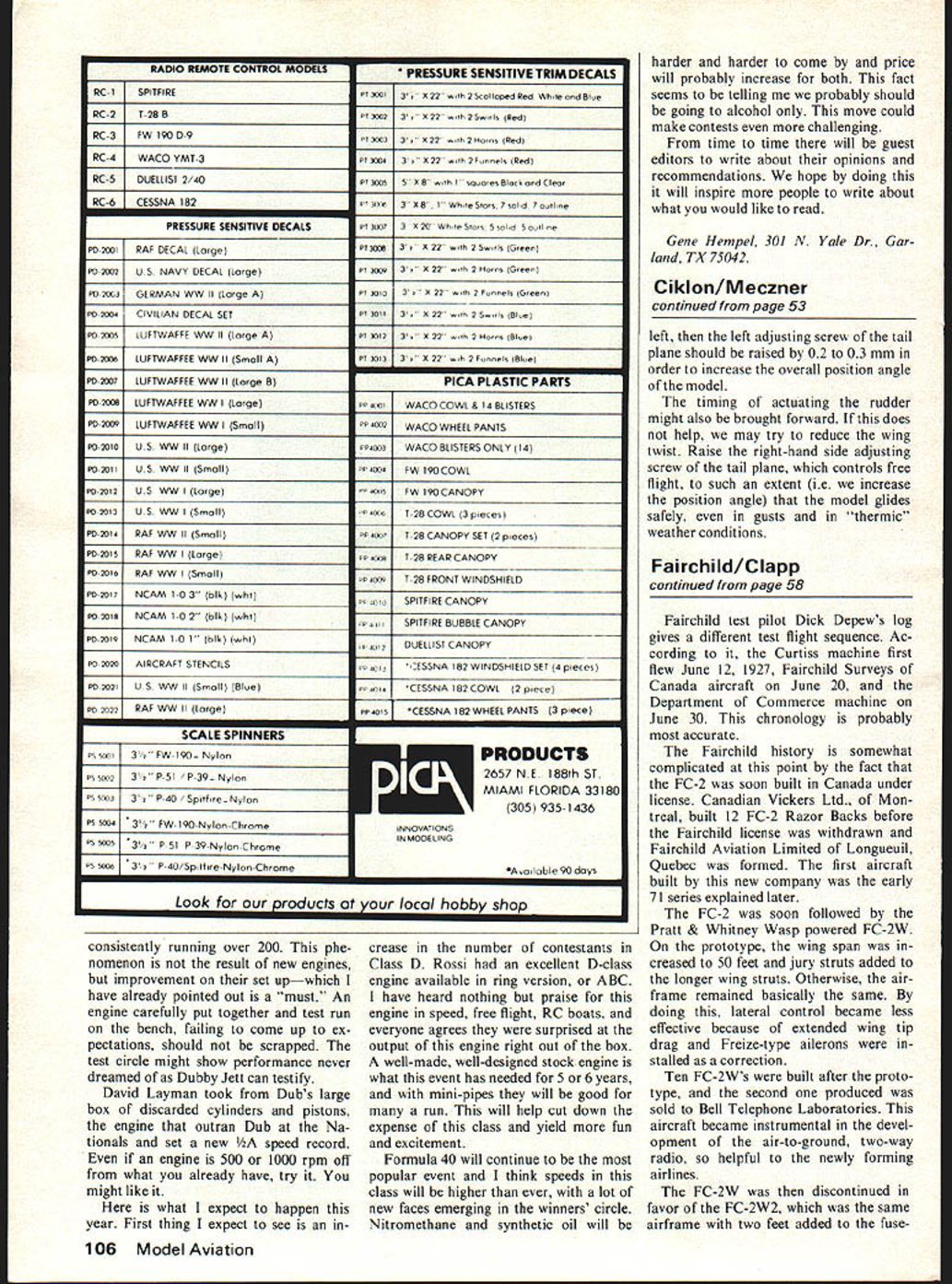
- 1st — "M&M" team (D), 177.79 mph
- 2nd — Carl Cisneros (Jet), 133.08 mph
Overall champions:
- Open champion (Junior): Ben Sasnett
- Senior overall champion: Joe Kall
- Overall Speed champions: Fred and Joyce Margarito ("M&M" team)
Frank reported fair weather with light wind (about 6 mph), though changes during the day made needle setting difficult. Everyone had a very good time; it was a contest to remember. The meet was sponsored by Frank Hunt of Herb's Cyclery. For speed supplies, send an SASE for a price list to Herb's Cyclery, 1621 M St., Merced, CA 95340.
Houston, Texas contest — October 17–18, 1978
Entries were low but competition was sharp.
- B speed: 1st — David Layman, 198 mph; close contenders Johnny Shannon (196+) and Dubby Jett (195+). Over a dozen flights (official and test) were all between 195 and 198 mph.
- Senior A record: Dimmie Perkins set a new Senior A record at 150.49 mph using a minipipe and a metal suction tank.
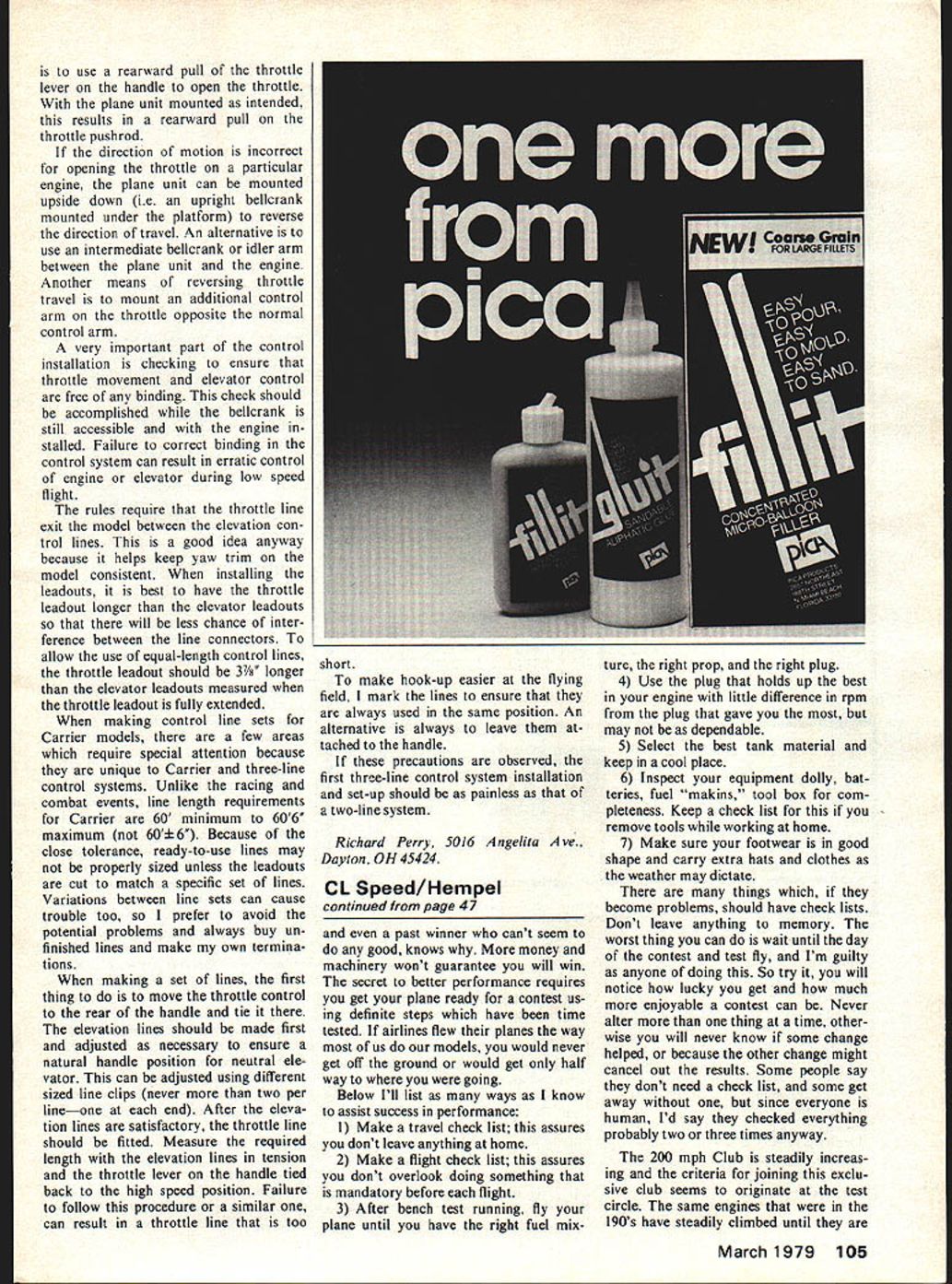
- Open Jet record: Dr. Charlie Davis set a new open Jet record at 211.98 mph, taking the record from Mike Langlois. To show the potential of his jet, he backed the record run with one full dead lap in the same time; several tailpipes split open at the seams from increased output. Davis credited his improvement to epoxying the intake and machining the opening to 1 1/4" diameter to reduce frontal area and smooth flow into the intake.
Johnny Shannon and Dubby Jett flew a conventional FAI "A" and logged about 30 flights but couldn't exceed 130 mph; the engine (a homemade DJS) lacked a good piston seal. Weather was excellent, temperatures in the 70s with a 5–6 mph wind — ideal for record attempts.
Tips on how to be more competitive
Anyone who has been a consistent winner knows what it takes to win at contests. More money and machinery won't guarantee victory. The secret to better performance is preparing your plane for a contest using definite, time-tested steps. If airlines flew their planes the way most of us do our models, you would never get off the ground.
Below are ways to improve your chances of success:
- Make a travel checklist; this ensures you don't leave anything at home.
- Make a flight checklist; this ensures you don't overlook mandatory items before each flight.
- After bench-test running, fly your plane until you have the right fuel mixture, the right prop, and the right plug.
- Use the plug that holds up the best in your engine, even if its RPM is only slightly less than the plug that gave the most — reliability matters.
- Select the best tank material and keep it in a cool place.
- Inspect your equipment dolly, batteries, fuel "makins," and toolbox for completeness. Keep a checklist for this if you remove tools while working at home.
- Make sure your footwear is in good shape and carry extra hats and clothes as the weather may dictate.
There are many things that, if they become problems, should have checklists. Don't leave anything to memory. The worst thing you can do is wait until the day of the contest to test-fly — I'm guilty of that too. Try using checklists and you'll notice how much "luckier" you get and how much more enjoyable a contest can be.
Never alter more than one thing at a time, otherwise you will never know whether a change helped or if two changes canceled each other out. Some people say they don't need a checklist and sometimes get away without one, but since everyone is human, they probably checked everything two or three times anyway.
200 mph Club and engine setup
The 200 mph Club is steadily increasing. Engines that were running in the 190s have climbed to consistently over 200 mph. This is not due to new engines so much as improvements in setup — which is essential. An engine carefully assembled and test-runned on the bench that fails to meet expectations should not be scrapped; the test circle may reveal performance you never dreamed of, as Dubby Jett can attest.
David Layman took from Dubby's large box of discarded cylinders and pistons an engine that outran Dub at the Nationals and set a new 1/2A speed record. Even if an engine is 500 or 1,000 rpm off from what you expect, try it — you might like it.
Expectations for the year
I expect an increase in the number of contestants in Class D. Rossi has an excellent D-class engine available in ring version (or ABC). I've heard nothing but praise for this engine in speed, free flight, and RC boats — many were surprised at the output right out of the box. A well-made stock engine is what this event has needed for five or six years, and with mini-pipes they will perform well. This should reduce expense in the class and generate more fun and excitement.
Formula 40 will continue to be the most popular event, and I think speeds in this class will be higher than ever, with many new faces in the winners' circle. Nitromethane and synthetic oil are becoming harder to obtain and prices will probably rise. This suggests we may move to alcohol-only events, which could make contests even more challenging.
From time to time there will be guest editors sharing opinions and recommendations. We hope this will inspire more people to write about what they'd like to read.
Gene Hempel 301 N. Yale Dr. Garland, TX 75042
Transcribed from original scans by AI. Minor OCR errors may remain.

