
Control Line: Speed
Gene Hempel
I have received several letters and hot phone calls concerning the new rule proposals the CLCB (Control Line Contest Board) has before it.
1978 Nationals Speed Meeting (August 3, 1978)
Before we proceed further into discussing the rules, I would like to back up a little and point out one important and related event that took place at the 1978 Nats. There was an outstanding Control Line Speed meeting held on Thursday night, August 3, 1978. The subject of dropping some speed events was brought up by Ron McNally, CLCB chairman, but which events were to be dropped was the primary hangup.
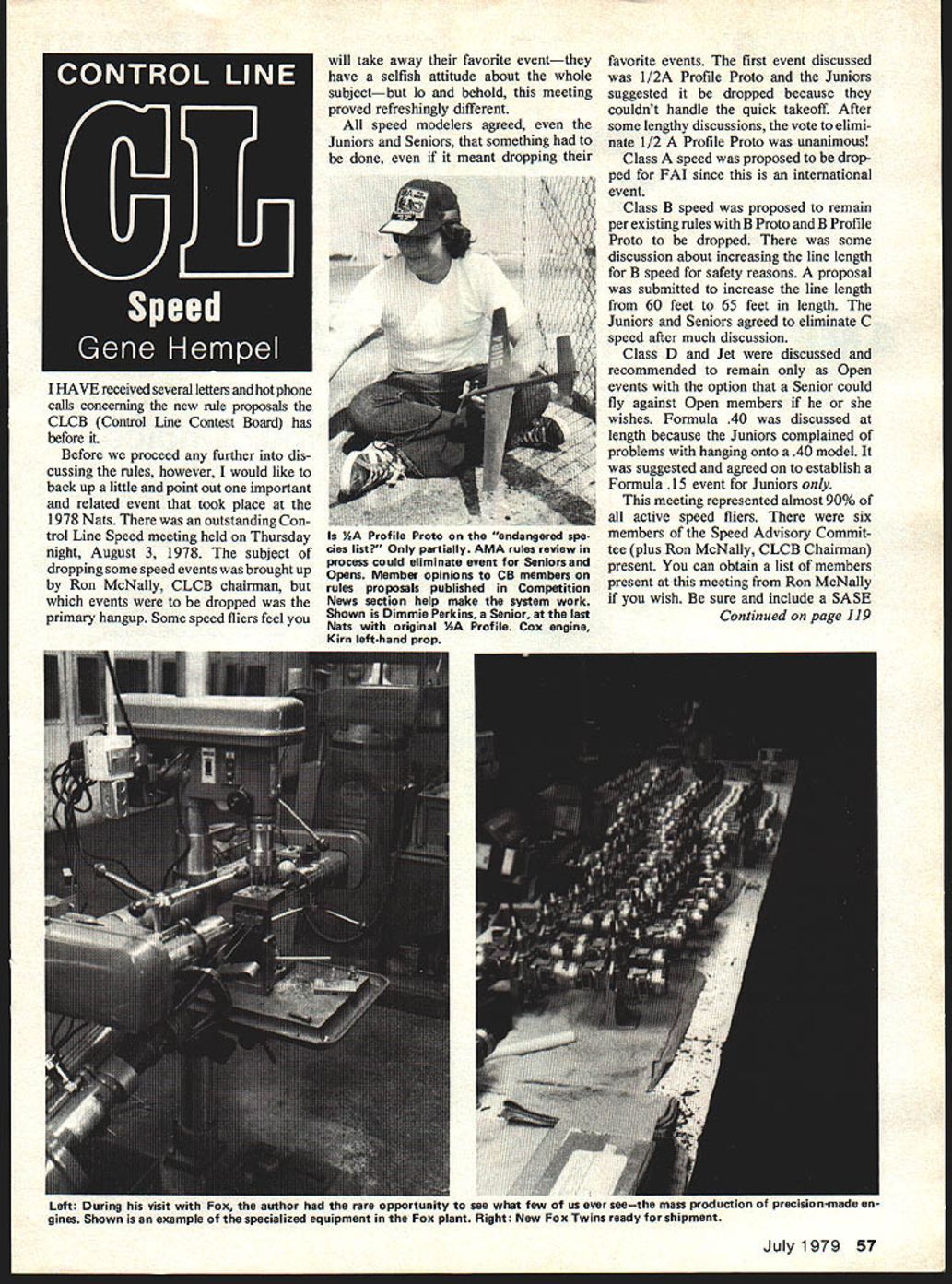
All speed modelers agreed, even the Juniors and Seniors, that something had to be done, even if it meant dropping their favorite events. The first event discussed was 1/2A Profile Proto; the Juniors suggested it be dropped because they couldn't handle the quick takeoff. After some lengthy discussion, the vote to eliminate 1/2A Profile Proto was unanimous.
Other proposals and recommendations from the meeting included:
- Class A speed: Proposed to be dropped for FAI since this is an international event.
- Class B speed: Proposed to remain per existing rules, with B Proto and B Profile Proto to be dropped. There was discussion about increasing the line length for B speed for safety reasons; a proposal was submitted to increase the line length from 60 feet to 65 feet.
- Class C speed: After much discussion, the Juniors and Seniors agreed to eliminate C speed.
- Class D and Jet: Discussed and recommended to remain only as Open events, with the option that a Senior could fly against Open members if he or she wishes.
- Formula .40: Discussed at length because the Juniors complained of difficulty handling a .40 model. It was suggested and agreed to establish a Formula .15 event for Juniors only.
This meeting represented almost 90% of all active speed fliers. Six members of the Speed Advisory Committee (plus Ron McNally, CLCB Chairman) were present. You can obtain a list of members present at this meeting from Ron McNally if you wish — be sure to include a SASE.
All the rule proposals submitted as a result of the speed meeting had a note typed at the top of each page so each member of the CLCB would recognize what the active speed fliers wanted.
- The average speed flier (for the few that are left) realizes that many people try to legislate rules because of some selfish motive. Some modelers feel if they cannot win at their event, they change the rules to fit their need.
The active speed fliers have presented their rule proposals to the members of the CLCB for a favorable vote. Only time will tell whether control-line speed will die—due to rules "legislation" by non-participants.
If you do not express your views on this matter there is no reason to gripe about the results.
The outcome of the CLCB vote
Wake up, guys—speed is becoming less and less popular. Why? Don't assume it is because of RC, which is growing. That's a cop-out. Stunt and other U/C events are healthier. What's wrong in speed? Combat is going great!
One clear problem is we are not involving enough youngsters, except in rare cases like mine, where Tom Upton and I trained and supported Patrick Hempel. He flew for us and we feel he was a very capable pilot. But this took time and a lot of patience. There are a bunch of "oldsters" in RC, but they're doing a better job with their youngsters than we are.
There is no reason why we should not work together.
Outreach and cooperation with RC clubs
UC has contributed a lot to RC. A good example of this is when Tom Upton and I gave a program last year to the Richardson RC Club about UC speed and engine hop-up. The program was so well received that we were asked to give it again six months later. After word got out about our program, we were invited to speak at the North Dallas RC Club.
We should be doing more of this kind of outreach and cooperation.
Visit to Duke Fox and engine manufacturing observations
A fellow modeler and I had the opportunity to visit Duke Fox at his plant in Fort Smith, Arkansas, last month. George Marion and Ken Greene gave us a fantastic tour. This was the first model engine factory I have visited. It was quite interesting to observe the different types of special manufacturing equipment used.
The majority of the machined parts were formed on automatic screw machines. The crankshaft is formed completely on one of these machines. The automatic screw machine produces these parts at a very high rate; it would take me 10 hours or longer to build such a part in my well-equipped machine shop. Other operations were done on a mill or lathe or other special automatic equipment. It is this type of specialized equipment that allows the production of large numbers of precision engines at today's prices.
It was also interesting to observe how glow plug bodies are manufactured (on another automatic screw machine). The entire lower body is produced in one operation, while the top half of the glow plug is made on another. After the platinum element is welded to the top half of the glow plug body, it is inserted into the lower body with an insulator between them. At this point the lip on the lower body is rolled over to form a seal so the unit will not leak.
I also had the opportunity to observe the assembly of Duke's new twin. He is very proud of this engine and rightly so. I believe this is the first Schuerle-ported twin model engine on the market. A required test on the twin during development was to run it at 20,000 rpm on a 10x6 prop for 30 minutes without any damage.
Duke now has the engine in production and it is a beautiful piece of machinery. You have to see it to appreciate what an excellent job of engineering Duke has done on his twin. He also was running some of his .60 racing engines. I have not had the opportunity to really get my hands on one of these but am anxious to do so.
While we were talking about fuel manufacturing, Duke indicated that effective April 1, 1979, nitromethane would become a government commodity and that he was being placed on allocation. He was concerned that since large quantities of nitro would be rationed, he would have difficulty manufacturing fuels that require high nitro content. We may all have to revert back to FAI fuel if the nitro situation worsens.
Racing report
I received a fine letter from Frank Hunt in Merced, California, discussing their recent racing meet. He indicated that Chuck Schuette turned a 157.04 mph for first in FAI, with John Newton and Luke Roy at 153.59 and 148.98 mph respectively. With beautiful weather and a slight overcast, speeds were nothing to brag about. Since this was the first meet of the year, everyone socialized and had a fine time.
Contest support and closing request
With the contest season coming up, I checked how many contests had included speed as part of their schedule. It appears that some contest directors have elected to drop speed for other U/C events. If you don't get out and support your event at these meets, these directors have no choice but to drop them.
Your comments and suggestions on how to correct our growth problem would be most welcome. Also, some of you ex-speed participants might drop me a line on the subject.
Gene Hempel 301 North Yale Dr. Garland, TX 75042
Transcribed from original scans by AI. Minor OCR errors may remain.

