
Control Line Speed
Phill Bussell
WELCOME FORMULA 40 SPEED! The results of the final Control Line Contest Board ballot have been received for the 1976-77 Rules Changes and as expected, Formula 40 Speed is now an official event. Maybe Speed fliers will take the event more serious now—unless they want another Formula 1 pilot to come down and wax them again at the ’76 Nats as was done in 1975. Tuned pipes have been banned in Formula 40, but constant diameter pipes are allowed with a maximum length of 5" measured from the centerline of the engine.
Your best source for a complete review of the rules proposals and cross proposals that have passed will be in past issues of Competition News. Some of the cross proposals stand entirely alone and others refer back to the original proposal or just make one or more alterations to the original proposals. You must get them all together to understand the full intent of the proposals.
It is obvious to me from a cursory review of the vote of the CLCB on the 1976-77 Rules Changes that they relied heavily on input from the various advisory committees. It does appear that the people who are active in the various events are now the ones who are advising what rules changes should pass and which should not. It would appear that our communications between the competitor and the AMA (CLCB in this case) are the best they have ever been. All eleven CLCB Members voted and the results, especially those applicable to Speed, were mostly unanimous.
Tuned pipes are now out in the Junior Age category. Constant diameter pipes are allowed in all Junior Speed events other than Profile Proto. As I understand the Profile Proto rule, no exhaust extension of any kind will be allowed. Also, the engine now has to be side-mounted (no more upright or inverted engines allowed in Profile Proto).
The Fliers of the Model rule has been changed to read that all age entries may set the needle valve or fly the ship. I am enthused with the rules changes and can see where interest can be generated—especially in Junior 1/2A Profile Proto which was introduced as a beginners event in the first place, but quickly changed into one of the hardest of all events to compete in. Also, Formula 40 Speed should be a highly competitive event without the full tuned pipe. The differences between an engine set up for Rat or Formula 1 or Speed are surprisingly minute. The main advantage a Formula 40 Speed ship has over a standard Rat is weight. Most Rats weigh in around 31 to 33 ounces and a Formula 40 ship should weigh in about 24 to 26 ounces; with all other things equal, the 7- to 9-ounce difference is 5 to 7 mph when clocked from a standing start, which is the way Formula 40 is clocked. I will discuss this detail in future columns how to set up a .40 engine for all-out speed and how to partially overcome the weight disadvantage if you choose to use one ship in both Rat and Form. 40.
Speed is definitely in a transitional period. For the first time in many years, I can see good positive changes in our rules for 1976-77. I look for more proposals of the same nature to be presented for the 1978-79 seasons and with the help of the Speed Advisory Committee; hopefully, agreement can be reached among those flying speed and those wanting to fly speed and the CLCB in regards to what is good for Speed.
North American Speed Association
The formation of a National Speed Association took one giant step forward on Saturday night, October 11th, when an organizational meeting was held in Memphis prior to their Sunday contest.
I think the goal of a Speed Society should be to serve as the voice of the competitor and the vehicle by which he communicates with the SAC, CLCB, and those interested in joining in the fun of Speed competition.
The current plight of those interested in the preservation of Speed competition as we now know it was the topic of conversation. We had hoped for a more representative group (more areas represented) and we had but considering the time of the year and lack of communication I was not disappointed in the turn out. Speed in general was discussed, the good, the bad, and the changes in trends. The NFFS, PAMPA and NMPRA and the positive effects these organizations have had on their respective interests were discussed. The time and effort required by a small group of people to make an organization work was discussed. Needless to say, everyone was interested in the formation of a Speed Society—that is until it was time for volunteers to formulate and run the organization.
However, many positive thoughts did surface and it was obvious that many were willing to work although no one present was willing to take the job of organizer and general ramrod which is necessary in getting an organization of this type off the ground. Tom Upton, however, did volunteer to act as Newsletter Editor and his experience as one such in this background was stepped forward and volunteered. By the time the next column is published, I hope to be able to report that NASA is off the ground and flying. I also hope to be able to tell you how to go about joining. We are now open for fresh ideas in regards to what others think of such an association and what goals they think the society should work towards. All those interested please respond to me (Phill Bussell, 4803 Fallon Place, Dallas, Texas 75227). My next column will appear in the March 1976 issue of Model Aviation and hopefully, we will have enough people willing to help get such an organization off the ground. Help — we need volunteers!
Keys to Speed
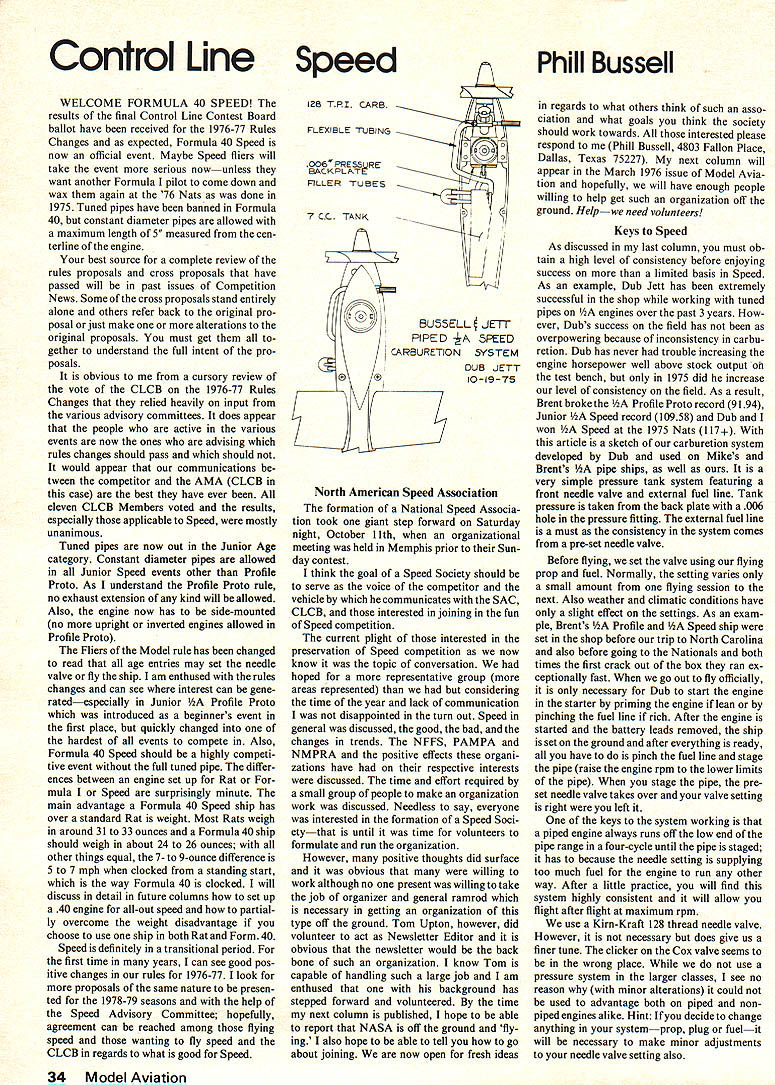
As discussed in my last column, you must obtain a high level of consistency before enjoying success on more than a limited basis in Speed. As an example, Dub Jett has been extremely successful in the short while working with tuned pipes on 1/2A engines over the past 3 years. However, Dub’s success on the field has not been as overpowering because of inconsistency in carburation. Dub has never had trouble increasing the engine horsepower well above stock output on the test bench, but only in 1975 did he increase our level of consistency on the field. As a result, Brent broke the 1/2A Profile Proto record (91.94), Junior 1/2A Speed record (109.58) and Dub and I won 1/2A Speed at the 1975 Nats (117+). With this article is a sketch of our carburetion system developed by Dub and used on Mike’s and Brent’s 1/2A pipe ships, as well as ours. It is a very simple pressure tank system featuring a front needle valve and external fuel line. Tank pressure is taken from the back plate with a .006 hole in the pressure fitting. The external fuel line is a must as the consistency in the system comes from a pressure-fed needle valve.
Before flying, we set the valve using our flying prop and fuel. Normally, the setting varies only a small amount from one flying session to the next. Also weather and climatic conditions have only a slight effect on the settings. As an example, Brent’s 1/2A Profile and the 1/2A Speed ship were set in the shop before our trip to North Carolina and also before going to the Nationals and both times the ship started out of the box they ran exceptionally fast. When we go out to fly officially, it is only necessary for Dub to start the engine in the starter by priming the engine if lean or by pinching the fuel line if rich. After the engine is started and the battery leads removed, the ship is set on the ground and after everything is ready, all you have to do is pinch the fuel line and stage the pipe (raise the engine rpm to the lower limit of the pipe). When you stage the pipe, the present needle valve setting will be right if the pipe and engine combination is right where you left it.
One of the keys to the system working is that a piped engine always runs on the lean side of the pipe range in a four-cycle until the pipe is staged; it has to be because the needle setting is supplying too much fuel for the engine to run any other way. After a little practice, you will find this system highly consistent and it will allow you slight after-flight adjustments to set up to maximum rpm.
We use a Kim-Kraft 128-thread needle valve. However, it is not necessary but does give us a finer tuning. The clicker on the Cox valve seems to be in the wrong place. While we do not use a pressure system in the larger classes, I see no reason why (with minor alterations) it could not be used to advantage both on piped and non-piped engines alike. Hint: If you decide to change anything in your system—prop, plug or fuel—it will be necessary to make minor adjustments to your needle valve setting also.
Transcribed from original scans by AI. Minor OCR errors may remain.

