
CONTROL LINE SPEED
Scott Newkirk 4840 N. Glendale, Bel Aire KS 67220
THE SPRING flying season will be around the corner when this issue goes out in the mail. Hopefully it's been a good year for all so far.
This column includes the second part of the engine work series: break-in procedures for aluminum-brass-chrome (ABC) and aluminum-aluminum-chrome (AAC) engines.
In the future I will cover reducing internal drag, balancing the engine, port timing, adjusting fits, head design, and more. The series will take more than a year to get out in print, and maybe even two years. Be patient—we'll get there.
New Equipment
I received a wonderful package in the mail: Alberto Dona of Hobby Club sent me several engines to review. I love to check out engines, whether I can use them or not.
In the package were:
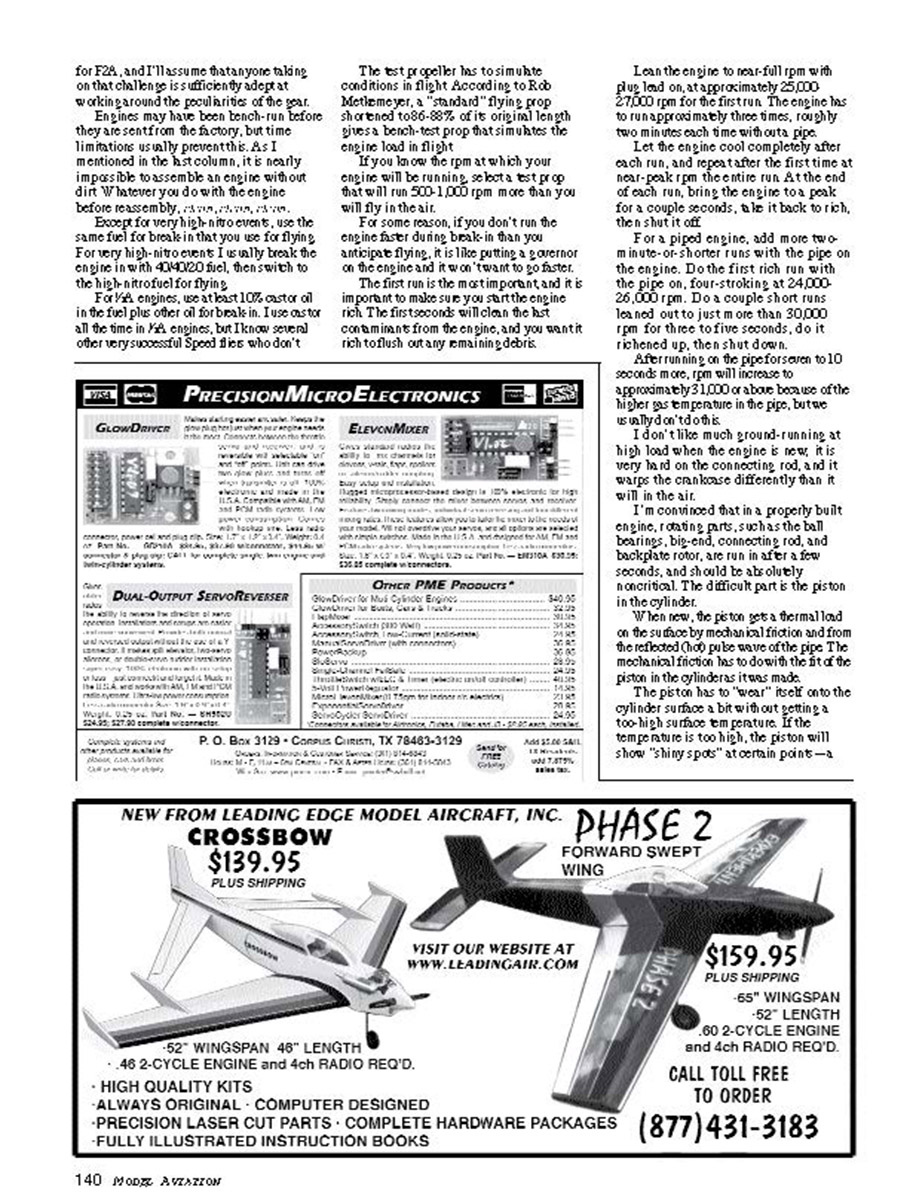
- three PAS .21 engines suitable for .21 Sport Speed and .21 Proto (Alberto sent a car, a buggy, and a marine version).
These resemble NovaRossi engines, with lower exhaust timing and five transfer ports — which I think is preferable to the NovaRossi eight- and nine-port setups. The engines have 13 mm cranks, and the marine version comes stock with a .395 bore. For Speed applications the ideal engine would be a hybrid with the crankcase and piston-cylinder assembly from the car engine mated to the crankshaft from the marine engine.
The majority of my correspondence is from the Free Flight (FF) community. Having started there myself, I understand that group's engine needs. As a result, I will occasionally include info about engines I cross paths with that aren't for Speed, but look particularly useful to others in the aeromodeling community.
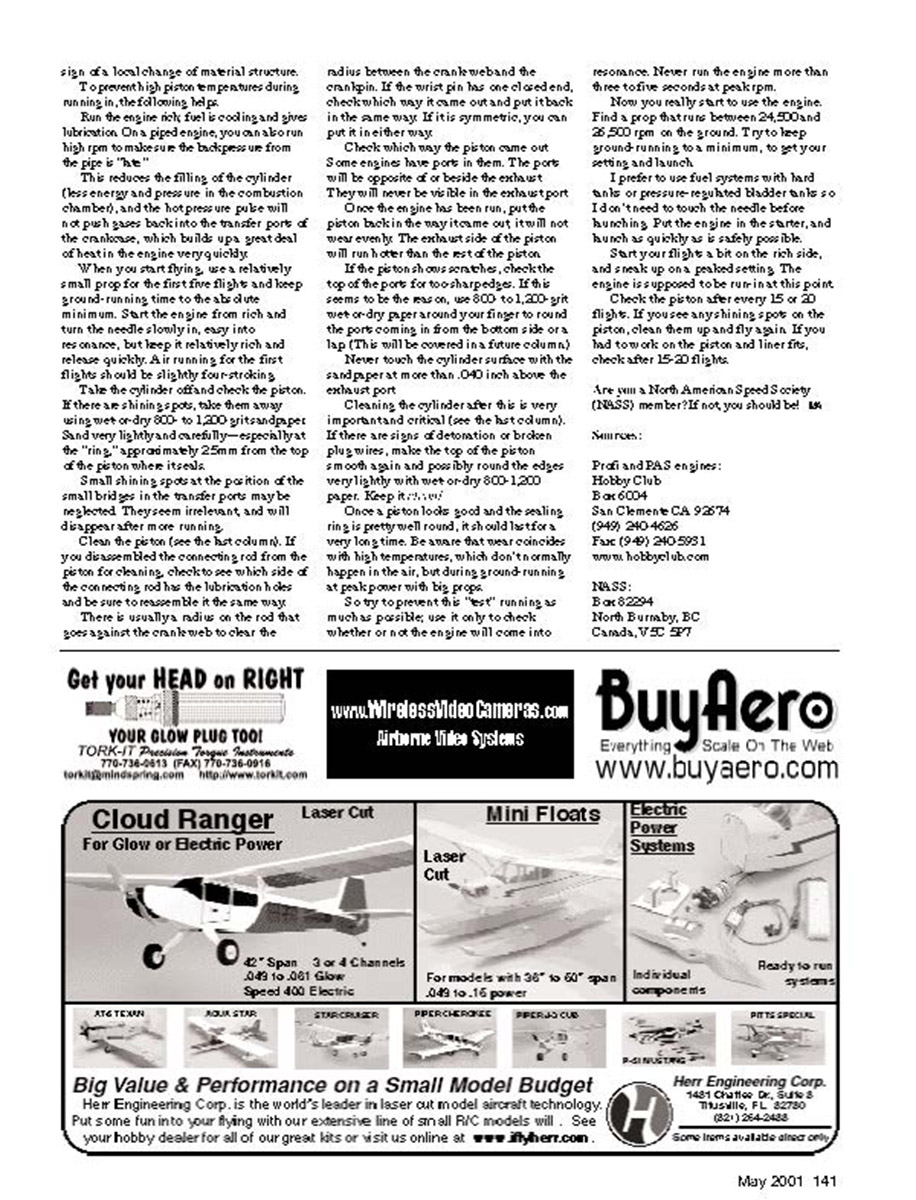
The Profi Combat .15 from Hobby Club has been specially modified with a larger venturi for FF for Alberto. It is beautifully made, as are most Russian competition engines. The Profi has a very compact and light crankcase; it weighs only 126 grams (4 3/8 ounces). The exhaust is offset to clear the leading edge of the wing (or pylon). It looks to be a very good engine for FF and perhaps some Control Line Racing events.
Engine Series, Part 2 — Engine Break-in Procedure
I'm going to assume you are running an ABC or AAC piston-liner assembly, since all current Speed engines are. I'm making no differentiation between nickel and chrome in the liners, because it doesn't affect the break-in procedure.
Read all the text before you start. You won't just run the engine; you will tear it down, inspect it, and adjust it during the break-in.
I'm giving rpm data based on a .40 engine; you will have to alter the numbers to match your specific engine and the application for which you are going to use it.
The running info and flying are different for piped engines with beryllium-copper cylinders; they cool and run completely differently. The only engines manufactured with beryllium-copper liners are for F2A, and I'll assume that anyone taking on that challenge is sufficiently adept at working around the peculiarities of the gear.
Engines may have been bench-run before they are sent from the factory, but time limitations usually prevent this. As I mentioned in the last column, it is nearly impossible to assemble an engine without dirt. Whatever you do with the engine before reassembly, clean, clean, clean.
- Except for very-high-nitro events, use the same fuel for break-in that you use for flying.
- For very-high-nitro events I usually break the engine in with 40/40/20 fuel, then switch to the high-nitro fuel for flying.
- For 1/2A engines, use at least 10% castor oil in the fuel plus other oil for break-in. I use castor all the time in 1/2A engines, but I know several other very successful Speed fliers who don't like castor.
The test propeller has to simulate conditions in flight. According to Rob Metkemeier, a "standard" flying prop shortened to 86%–88% of its original length gives a bench-test prop that simulates the engine load in flight. If you know the rpm at which your engine will be running, select a test prop that will run 500–1,000 rpm more than you will fly in the air. For some reason, if you don't run the engine faster during break-in than you anticipate flying, it is like putting a governor on the engine and it won't want to go faster.
The first run is the most important and it is important to make sure you start the engine rich. The first seconds will clean the last contaminants from the engine, and you want it rich to flush out any remaining debris.
- Lean the engine to near-full rpm with the plug lead on, at approximately 25,000–27,000 rpm for the first run.
- The engine has to run approximately three times, roughly two minutes each time without a pipe.
- Let the engine cool completely after each run, and repeat after the first time at near-peak rpm the entire run.
- At the end of each run, bring the engine to peak for a couple of seconds, take it back to rich, then shut it off.
For a piped engine, add more two-minute-or-shorter runs with the pipe on. Do the first rich run with the pipe on, four-stroking at 24,000–26,000 rpm. Do a couple short runs leaned out just to around 30,000 rpm for three to five seconds, then richen up and shut down. After running on the pipe for seven to 10 seconds more, rpm will increase to approximately 31,000 or above because of the higher temperature in the pipe, but we usually don't do this.
I don't like much ground-running at high load when the engine is new; it is very hard on the connecting rod, and it warps the crankcase differently than it will in the air.
I'm convinced that in a properly built engine, rotating parts — such as the ball bearings, big end, conrod, connecting rod, and backplate/rotor — are run in after a few seconds and should be absolutely noncritical. The difficult part is the piston in the cylinder.
When new, the piston gets a thermal load on the surface by mechanical friction and from the reflected (hot) plume wave of the pipe. The mechanical friction has to do with the fit of the piston in the cylinder it was made for. The piston has to "wear" itself onto the cylinder surface a bit without getting a too-high surface temperature. If the temperature is too high, the piston will show "shiny spots" at certain points — a sign of a local change of material structure.
To prevent high piston temperatures during running-in, the following helps:
- Run the engine rich; fuel cools and gives lubrication.
- On a piped engine, you can also run at high rpm to make sure the backpressure from the pipe "bakes" the exhaust. This reduces the filling of the cylinder (less energy and pressure in the combustion chamber), and the hot pressure plume will not push gases back into the transfer port of the crankcase, which builds up a great deal of heat in the engine very quickly.
When you start flying, use a relatively small prop for the first few flights and keep ground-running time to an absolute minimum. Start the engine from rich and turn the needle slowly in, easy into resonance, but keep it relatively rich and release quickly. Air running for the first flights should be slightly four-stroking.
Take the cylinder off and check the piston. If there are shining spots, remove them using wet-or-dry 800- to 1,200-grit sandpaper and sand very lightly and carefully — especially the "ring" approximately 25 mm from the top of the piston where it seals. Small shining spots at the position of the small bridges in the transfer ports may be neglected; they seem irrelevant and will disappear after more running.
Clean the piston (see the last column). If you disassembled the connecting rod from the piston for cleaning, check which side of the connecting rod has the lubrication holes and be sure to reassemble it the same way. There is usually a radius on the rod that goes against the crankweb to clear the radius between the crankweb and the crankpin. If the wrist pin has one, check which way it came out and put it back in the same way. If it is symmetric, you can put it in either way.
Check which way the piston came out. Some pistons have ports in them; the ports will be opposite or beside the exhaust and will never be visible in the exhaust port. Once the engine has been run, put the piston back in the same orientation; it will not wear evenly, and the same side will mate better to the liner.
If the piston shows scratches, check the top of the ports for too-sharp edges. If this seems to be the reason, use 800- to 1,200-grit wet-or-dry paper around your finger to round the ports coming in from the bottom side, or use a lap (this will be covered in a future column). Never touch the cylinder surface with sandpaper at more than 0.040 inch above the exhaust port.
Cleaning the cylinder after this is very important and critical (see the last column). If there are signs of detonation or broken plug wires, make the top of the piston smooth again and possibly round the edges very lightly with 800–1,200 paper. Keep it very light.
Once the piston looks good and the sealing ring is pretty well round, it should last a very long time. Be aware that wear coincides with high temperatures, which don't normally happen in the air but do occur during ground-running at peak power with the prop. So try to prevent the "test" running as much as possible; use it only to check whether or not the engine will come into resonance. Never run the engine more than three to five seconds at peak rpm.
Now you really start to use the engine. Find a prop that runs between 24,500 and 25,500 rpm on the ground. Try to keep ground-running to a minimum, just enough to get your setting and launch.
I prefer to use fuel systems with hard tanks or pressure-regulated bladder tanks so I don't need to touch the needle before launching. Put the engine in the starter, and hunch as quickly as is safely possible. Start your flight a bit on the rich side, and nearly on a packed setting. The engine is supposed to be running at this point.
Check the piston after every 15–20 flights. If you see any shining spots on the piston, clean them up and fly again. If you have done work on the piston and liner fits, check after 15–20 flights.
Are you in North American Speed Society (NASS)? If not, you should be!
Sources
Profi and PAS engines: Hobby Club Box 6004 San Clemente, CA 92674 (949) 240-0626 Fax (949) 240-0951 www.hobbyclub.com
NASS: Box 82294 North Burnaby, BC Canada V5C 5P7
Transcribed from original scans by AI. Minor OCR errors may remain.

