
CONTROL LINE SPEED
Dave Mark Box 371, Fenton MI 48430 E-mail: Speedtimes@chartermi.net
Getting started
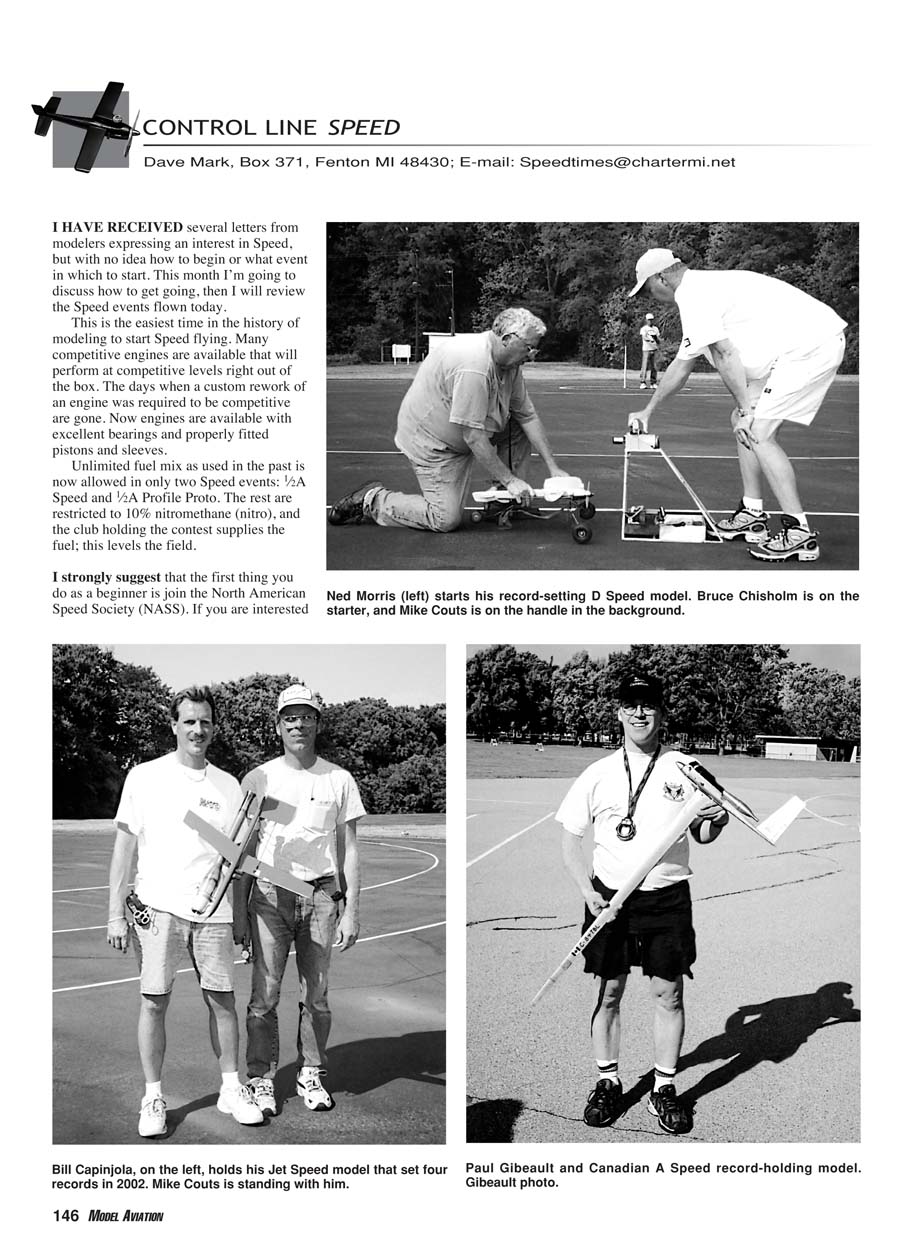
I have received several letters from modelers expressing an interest in Speed, but with no idea how to begin or what event in which to start. This month I'm going to discuss how to get going, then I will review the Speed events flown today.
This is the easiest time in the history of modeling to start Speed flying. Many competitive engines are available that will perform at competitive levels right out of the box. The days when a custom rework of an engine was required to be competitive are gone. Now engines are available with excellent bearings and properly fitted pistons and sleeves.
Unlimited fuel mix as used in the past is now allowed in only two Speed events: 1/2A Speed and 1/2A Profile Proto. The rest are restricted to 10% nitromethane (nitro), and the club holding the contest supplies the fuel; this levels the field.
I strongly suggest that the first thing you do as a beginner is join the North American Speed Society (NASS). If you are interested in doing so, write to Box 371, Fenton MI 48430. NASS's publication Speed Times contains articles, contest reports, and a section called the "Parts Finder" that will help you locate equipment such as control systems, Almost Ready-to-Fly (ARF) models for several events, and sources for engines currently used in Speed. After joining NASS, review the member list and locate a Speed flier near your location. Give that person a call and ask him or her to mentor your start.
Next, build a trainer. For some reason many Speed beginners are in such a hurry to start that they jump right past this step. Profile trainers are easy to build and low in cost. They eliminate the problem of building a dolly. The Texas Quickie Rat event employs models that are perfect for trainers. One excellent design for this event is the Scorpion produced by Dave McDonald and Pat Matson. The kit includes everything you need except the tank, lines, and paint. The Scorpion is a stable-flying model that will allow you to practice flying in the pylon with a model that simulates a full-up Speed model. It can be built to use two-line control, monoline control, or both. The kit sells for $55, which is a modest outlay by today's standards.
The Scorpion could be powered with a state-of-the-art Nelson .40 R/C, but that would defeat the intent of the trainer. Vic Garner sells K&B .40s (Model 8011) that are fully reworked for racing for $104 postpaid. Vic's engines are on the noses of many models that place in Texas Quickie Rat. For approximately $160 a newcomer can end up with an easy-to-build Speed trainer that flies and grooves well. It will be fast enough to give that person a workout in the pylon and a taste of Speed flying at any meet. This combination will allow the beginner to experience Speed flying and contests for a small expense.
Speed events
Below is a review of the Speed events currently flown, with typical pros and cons for each.
1/2A Profile Proto
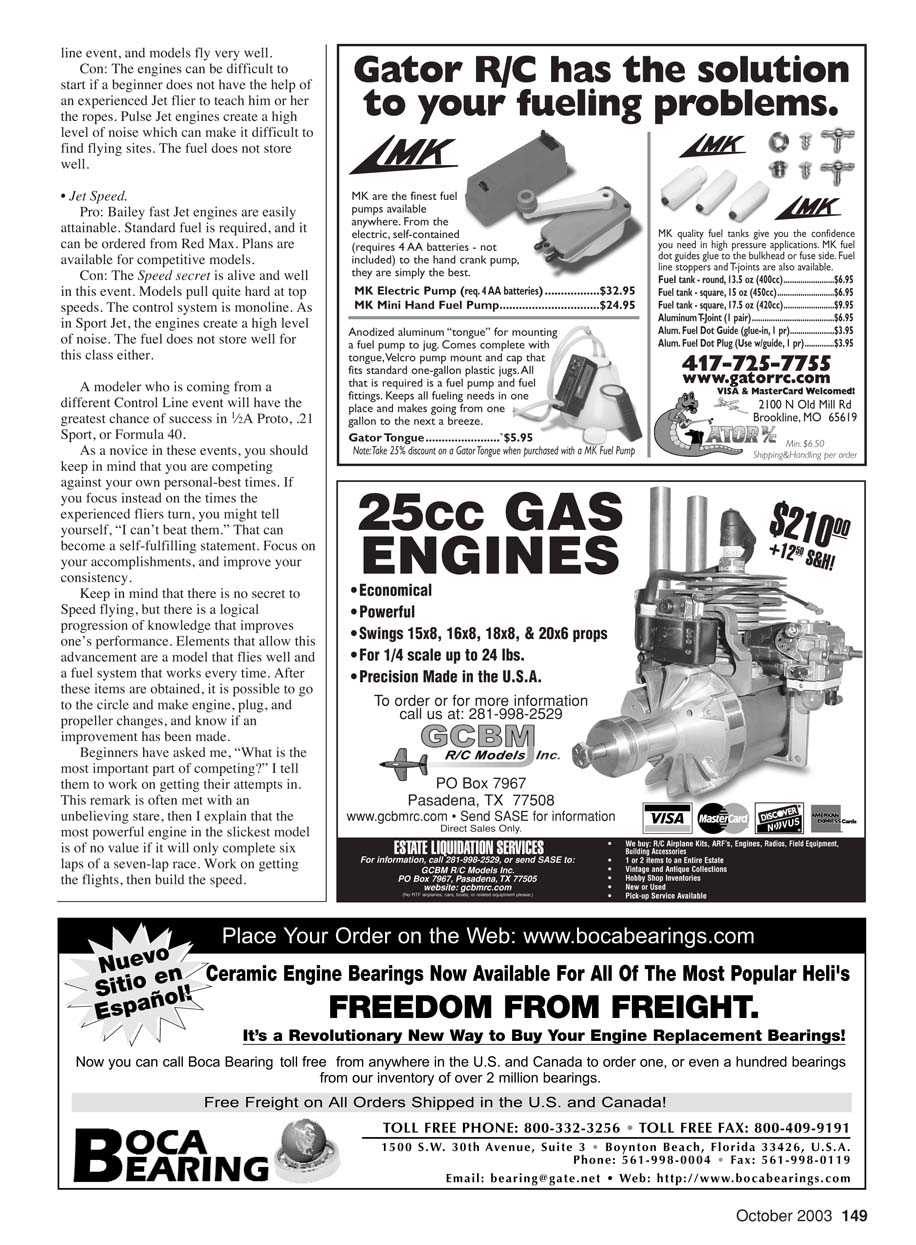
- Pro: The engine primarily used in this event—the GZ .049—is inexpensive and available from Bill Hughes. The favorite propeller for this event is available from Mike Hazel of ZZ Prop. Plans for the Little Tiger, which is a record-setting 1/2A Proto model, are available from AMA.
- Con: High nitro is the rule in this category for now. Many modelers mix their own fuel, but records have been set with off-the-shelf fuel. The short lines in this event make it difficult to fly at sites with large grass doughnuts.
1/2A Speed
- Pro: Engines—the GZ .049—are available and inexpensive. ARF models are available from John Newton. Propellers are available from several suppliers.
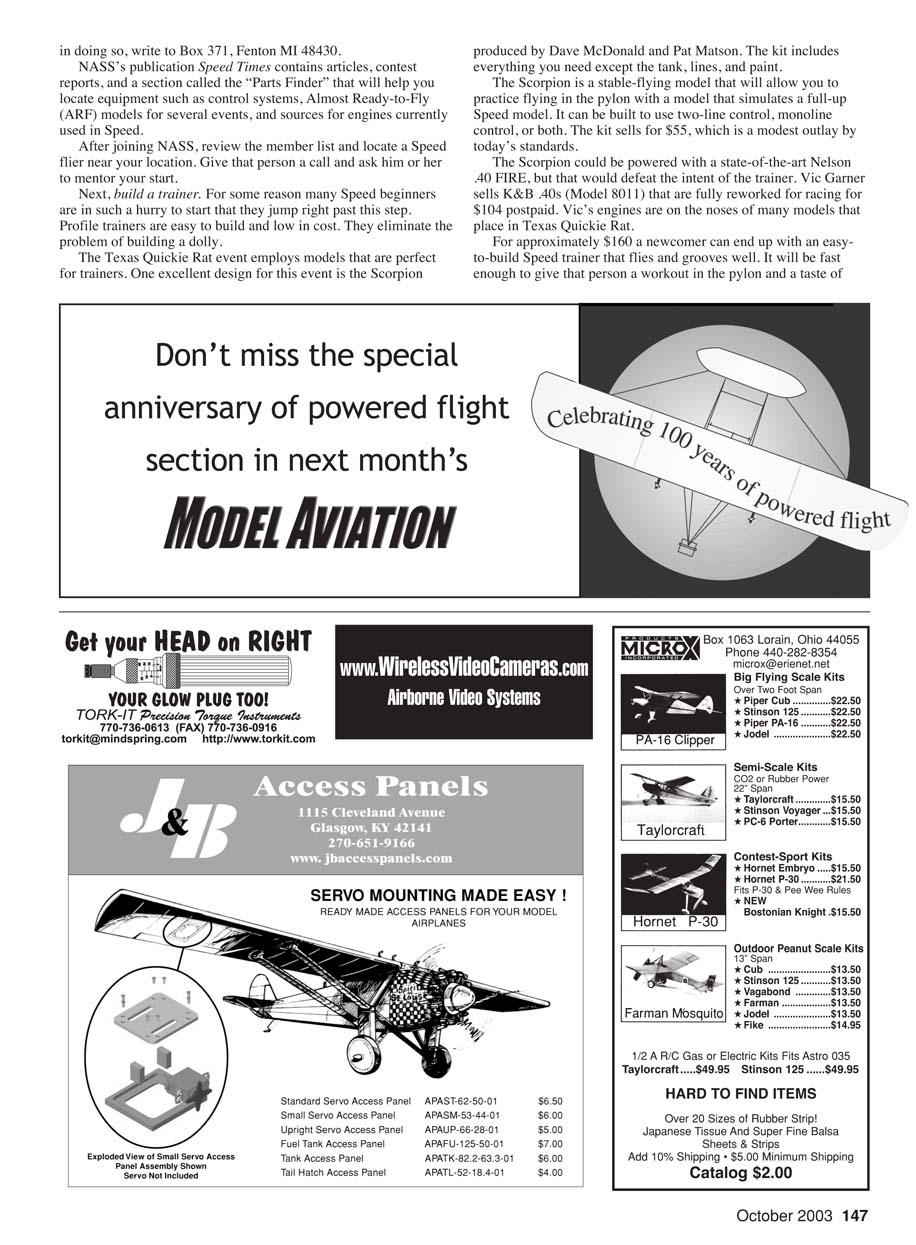
- Con: High nitro is the rule, and many fliers mix their own fuel. The control system of preference is monoline. The models are quite small, and control systems can be difficult to get working correctly. Speeds are in the area of 150 mph, giving this event the quickest rotation speed around the pylon. This can make it a job to keep up with the model, even for the most experienced fliers.
A Speed and F2A
- Pro: ARF kits are readily available for these events. They come with world-class engines equipped with tuned pipes, engine shutoff, and tanks installed. Finished propellers are plentiful and perform at a world-class level. The fuel is regulated to methanol and castor oil for F2A and 10% nitro for A Speed, and this results in long engine life.
- Con: Beginners should attempt these events only if they have mentors to help them over the learning curve produced by the use of the tuned pipe. High rotation speeds at the pylon make it difficult for beginners to keep up with the models. A dolly is needed for takeoff.
B Speed
- Pro: The dominant engine in this event—the Nelson .29 with pipe—is readily available. Speed shells and prebuilt wings are available from John Newton.
- Con: This is a tuned-pipe event, and the winning models have asymmetrical designs; they are somewhat difficult to build. Monoline is the dominant control system. A dolly is needed for takeoff. Propellers can be difficult to find, and fuel systems in this category tend to be the most complicated of all Speed classes.
D Speed
- Pro: The O.S. .65 engine can still be obtained, and the Nelson .65 is now available. Speed shells and wings for asymmetrical models are available from John Newton. Models for this event fly well.
- Con: Models for this event pull hard, and many pilots find it difficult to handle the pull. It can be hard to locate propellers that can stay together under the high power output of this class. Monoline is the control of choice. The O.S. .65 engine requires rework to turn fast times.
.21 Sport Speed
- Pro: ARF models are available. This event is flown on two lines, and the engine of choice—the NovaRossi .21—is easy to obtain. Propellers can be purchased from several sources. Models in this class do not pull excessively and fly very well. This class is easy to get started in.
- Con: It is difficult to break the 150 mph barrier. The models require dollies for takeoff.
.21 Proto
- Pro: This is a two-line event. The NovaRossi .21, which is the favored engine, is easy to get, and propellers are available from several sources. Models in this class are equipped with landing gear and do not pull excessively.
- Con: Takeoff can be difficult if the pilot is inexperienced.
Formula 40
- Pro: The preferred engine—the Nelson FIRE .40—is easy to acquire. Many used engines are available at swap meets because of discontinued Pylon Racing events. Model plans are available from AMA or NASS. Propellers are easy to find. Models that are designed correctly take off and fly very well.
- Con: There are few disadvantages to this event.
Sport Jet
- Pro: Stock Dynajet or Bailey Sport Jet engines are required. Dynajets are occasionally available on eBay, and you can order Bailey Sport Jets for $180 plus shipping. Standard fuel is required and can be ordered from Red Max. This is a two-line event, and models fly very well.
- Con: The engines can be difficult to start if a beginner does not have the help of an experienced Jet flier to teach the ropes. Pulse Jet engines create a high level of noise which can make it difficult to find flying sites. The fuel does not store well.
Jet Speed
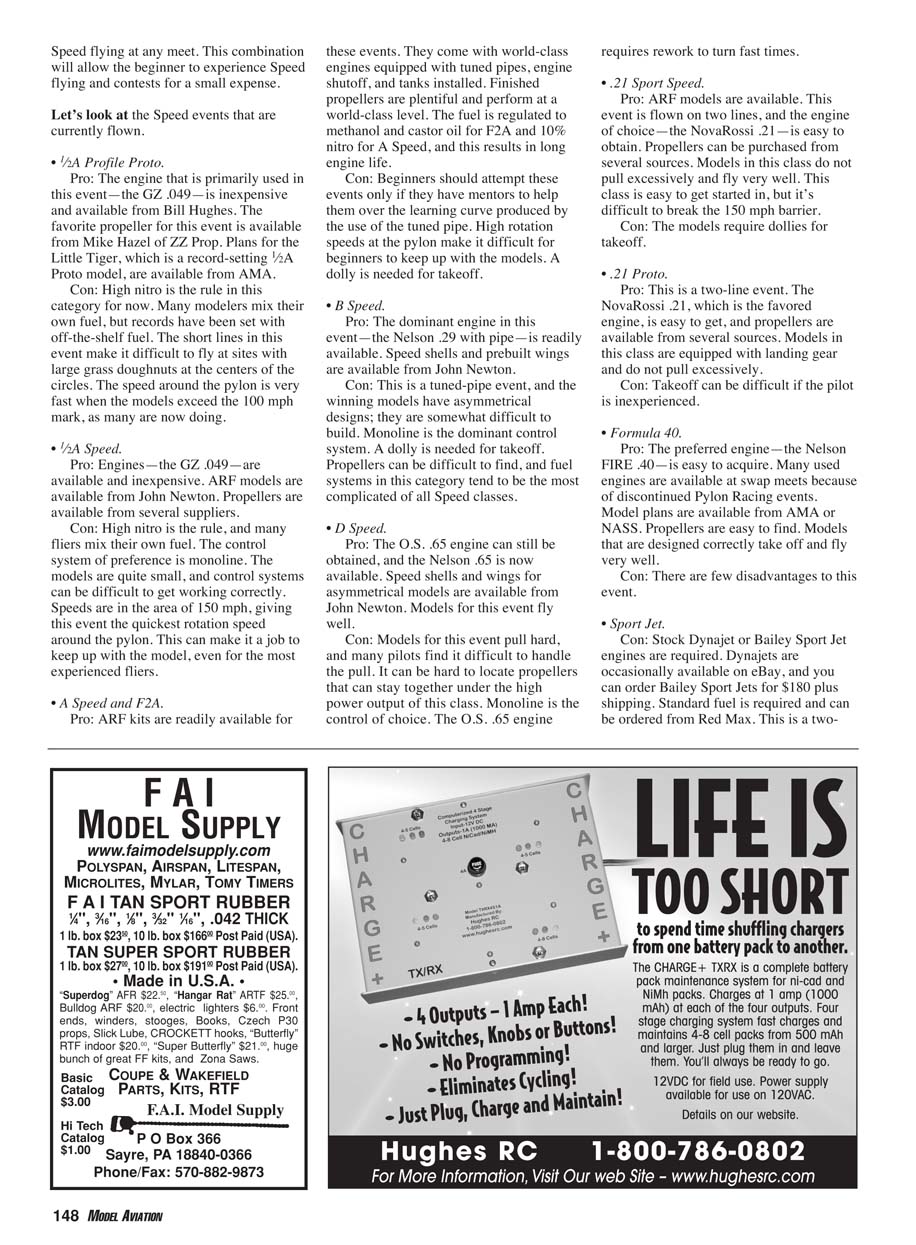
- Pro: Bailey fast Jet engines are easily attainable. Standard fuel is required, and it can be ordered from Red Max. Plans are available for competitive models.
- Con: The Speed secret is alive and well in this event. Models pull quite hard at top speeds. The control system is monoline. As in Sport Jet, the engines create a high level of noise. The fuel does not store well for this class either.
A modeler who is coming from a different Control Line event will have the greatest chance of success in 1/2A Proto, .21 Sport, or Formula 40.
As a novice in these events, you should keep in mind that you are competing against your own personal-best times. If you focus instead on the times the experienced fliers turn, you might tell yourself, "I can't beat them." That can become a self-fulfilling statement. Focus on your accomplishments, and improve your consistency.
Keep in mind that there is no secret to Speed flying, but there is a logical progression of knowledge that improves one's performance. Elements that allow this advancement are a model that flies well and a fuel system that works every time. After these items are obtained, it is possible to go to the circle and make engine, plug, and propeller changes, and know if an improvement has been made.
Beginners have asked me, "What is the most important part of competing?" I tell them to work on getting their attempts in. This remark is often met with an unbelieving stare, then I explain that the most powerful engine in the slickest model is of no value if it will only complete six laps of a seven-lap race. Work on getting the flights, then build the speed.
That's it for now. I'll be back in three months. MA
Sources
- Scorpion TQR kit:
McDonald Racing Box 384 Daleville IN 47334
- K&B engines:
Vic Garner (925) 447-3786
- Models and GZ engines:
Bill Hughes (630) 736-6036
- ARF .21 Sport kits, etc.:
John Newton (626) 964-5363
- F2A and A Speed Ready to Flys:
Jim Booker (360) 652-4136
- Propellers:
Mike Hazel (503) 364-8593
- Nelson engines:
Henry Nelson (724) 538-5282
- Bailey Jet engines:
Earl Bailey (713) 694-7017
Transcribed from original scans by AI. Minor OCR errors may remain.

