
CONTROL LINE SPEED
Dave Mark, Box 371, Fenton MI 48430; E-mail: Speedtimes@chartermi.net
THIS MONTH I will write about the inaugural Hamster Dash at the 2004 Nats, the effect of model weight, and a few methods of building a lightweight Speedster.
Following the demise of .40-powered Rat Racers, the racing community has been looking for an event to replace it. In 2002, the participants tried a .21-powered racer. This size of power plant is not a displacement that CL racers have in their engine sheds. Not many models powered with .21s were built.
The next size tried was a .15-powered Rat Racer. This size caught on because it is a displacement used in other racing events. Racers affectionately refer to the models used in .15 Rat as "Hamsters."
Hamster Dash at the Nats
The North American Speed Society (NASS) will hold the first Hamster Dash on Tuesday, July 13, 2004, during the Nats. It will be at the Speed site at the International Aeromodeling Center in Muncie, Indiana, and will begin following the completion of the day's scheduled events.
This unofficial event is the result of much discussion on the Delphi Speed Forum. Racers were asking if it would be possible to use the Speed circles and pylons to test their models. NASS then made an offer to host the festivities and supply awards for the fastest airplanes. All models will be timed from a standing start and for seven laps on the fly. Awards suitable for framing will be presented for both methods. The survey on the Speed forum showed 18 for Proto time and 15 for standard, so we will do both. NASS will supply watches, contest equipment, and awards. The contestants will supply timers. The regulations are as follows:
- Models with .15 size engines max (.1525).
- Models must use two (2) lines sized .014-inch x 60 feet plus all you want, minus 6 inches.
- Times of models flown on 59-foot 6-inch lines will be adjusted to 60 feet with a correction factor.
- All models must have at least one (1) wheel.
- No asymmetric models allowed.
- Models may be whipped for takeoff only. When the wheel leaves the ground the arm stops!
- Hamsters, Goodyear racers, and any model with a .15 on the nose including purpose-built are welcome to compete as long as they meet the above criteria.
- One-and-a-half laps are allowed to enter the pylon.
- Open-face exhaust or mini pipe allowed. No tuned pipes.
- Fuel of 10% nitro will be supplied by contest management.
- No one-blade propellers allowed.
The rules are subject to change until the day of the contest with the intent of obtaining maximum participation.
Discussion of the Rules
A few of the rules created a high level of discussion. Rule 2 reflects the practice of making lines 6 inches shorter than 60 feet, as is allowed by the rules for racing and is used by all of the racers. They time the flight based on 60-foot lines and ignore the fact that the lines are shorter than that. I don't know how or why this practice developed in the racing community. This practice of using short lines is the reason for Rule 3: the correction factor to bring the times back to a full 60-foot length. This did generate a few offers by Speed fliers to hold classes on the use of measuring tapes and line construction!
The next item to cause discussion was Rule 7, which specifically allows the use of purpose-built models. This was included in an attempt to invite Speed fliers to put together a model for the Hamster Dash. The rule caused a few of the racers to state that they would not stand a chance against models designed for the event. They felt that the 2-ounce tanks and shutoff units would add weight that would hold their speeds down. Some felt that the larger wing and stabilizer area would work against them.
Wing Area and Handling
Let's look at these concerns beginning with the wing-area issue. The average Hamster has a wingspan between 22 and 24 inches and has a working elevator across the full length of the stabilizer. The large elevator is used to shake off speed to make landings happen quicker in the racing environment.
This should not present a problem in a Speed run. Racing pilots are able to groove these models in the traffic of a race, so they will surely not find it difficult to groove during a Speed run of 14 laps.
The wingspan is comparable to that used in the Formula 40 event. Many Speed models flown today use wing areas much larger than those used in the past. The increased wing area produces a model that flies more smoothly, and it is much easier to land than the small models of the past which simply dropped out of the air when the engine quit.
Model Weight
The issue of model weight caused the highest level of concern among the racers. It was often stated that the lighter weight of purpose-built models would give them such a significant edge that it would make the Rat Racers noncompetitive. After reviewing last year's Nats results, I disagree.
The Hamster Dash will have two timing components: the standing-start mile and the on-the-fly 1/2 mile; in effect, we have two separate events in one.
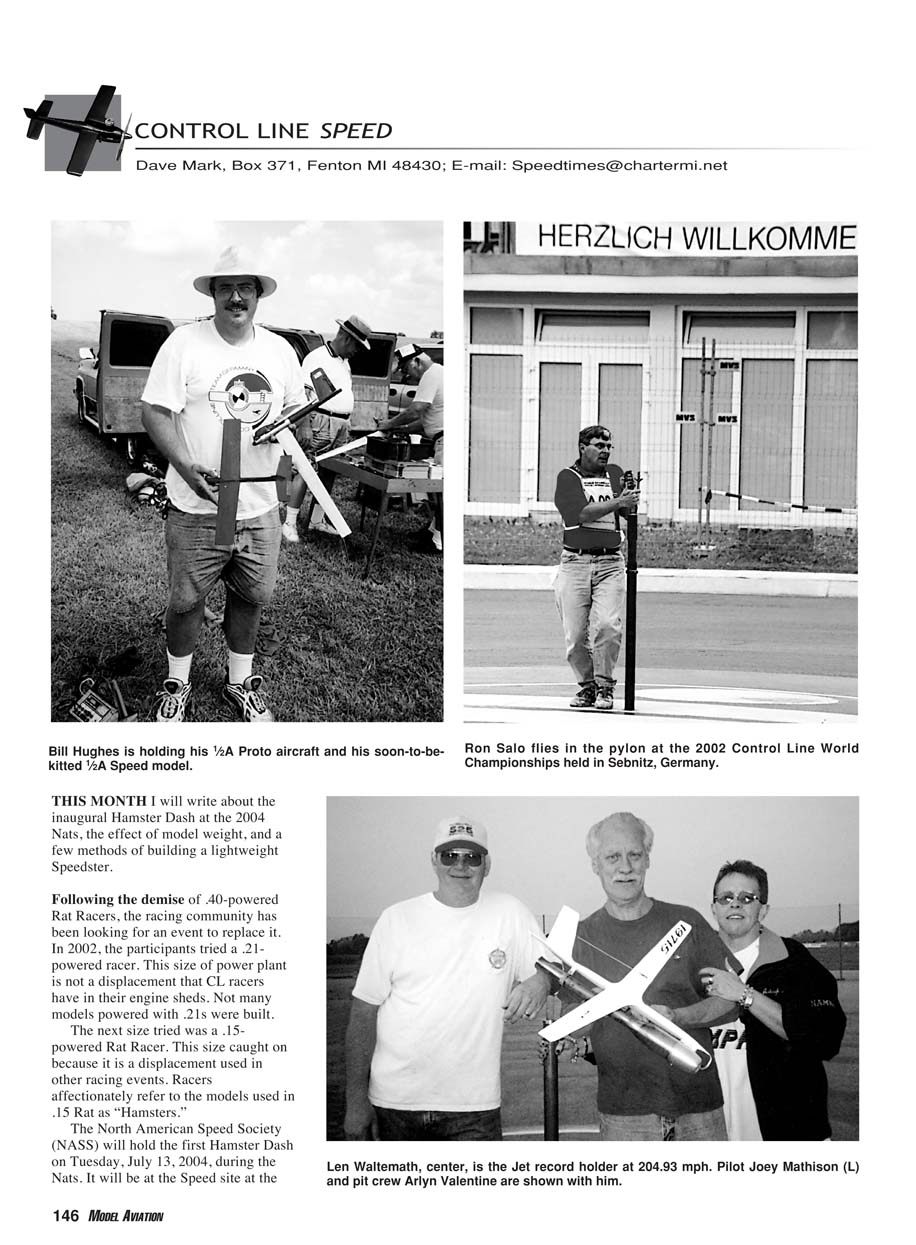
The standing-start one-mile timing will probably go to a purpose-built model, or as we will call it, a Formula 15. This statement is based on reviewing the model weights of the first three places in Formula 40 and 1/2A Proto.
In Formula 40, first, second, and third places went to models that weighed 23–28 ounces including fuel. One other model fell within this range but didn't place. The rest entered in the event were heavier.
In 1/2A Proto, the first five places went to models that ranged from 4.9 to 6.3 ounces including fuel. There are two anomalies in this group. The 6.3-ounce model came in second and the 4.9-ounce model came in fifth. The other three placing models weighed 5.5, 5.1, and 5.6 ounces. I conclude that lighter is much better in an event where acceleration is a component.
Weight does not appear to be as important in the events timed on-the-fly that are not piped. In .21, sport models ranged from 18.5 to 25 ounces. First place went to a 22-ounce unit and second through fifth places went to models ranging between 22 and 25 ounces.
In D Speed, first- through fifth-place entries weighed 43, 46, 40, 38, and 42 ounces respectively. I see no clear-cut pattern here indicating that lighter is totally necessary to place in a Speed event, but Paul Gibeault, a NASS member from Alberta, Canada, summed the issue up with the statement, "A heavy-flying Speed model is far superior to the lightest Speed model that never sees a contest!"
Lighter is better in Speed models, but this can be carried to extremes. I have seen a few airplanes that were constructed so light that they did not last one flight.
Methods to Reduce Weight
One thing that helps reduce weight is to use a little magnesium Speed pan. It is common on Formula 40 models to use a DARP (734) 266-7290 B Pan cut to 10-1/2 inches. This should be replaced with a DARP Proto Pan cut to 5-1/4 inches long. The width is narrowed to the same as the B Pan. The Proto Pan allows the use of all six hold-down screws on the Nelson .40.
The area that was pan is replaced with a piece of 1/16 basswood that has been soaked in water and wrapped over the end of the pan that was cut off and left to dry. This item is much lighter than a hollowed-out balsa block and much stronger.
The pan is hollowed out and thinned to a thickness of .080 to .100 inch. It can be difficult to measure the thickness of the pan. If you have a drill press, set a small drill so that it stops at roughly .080 to .100 inch above the table. Drill the pan in the areas that you plan to thin. Install a rotary file in the chuck, and work the pan down to the drill points and stop.
This method gives you a target area of how far to take the thinning. The fins on the Nelson should be milled down to 1-1/2 inches diameter. The propeller nut is replaced with a nut made from 7075 aluminum.
The landing-gear strut should be titanium, which can be obtained from Glenn Lee (630) 879-2558. Order a set of Glenn's 1-inch-diameter wheels. The wheels come with brass hubs which should be replaced with ones made from aluminum.
This attention to detail should be applied to every item in the model. The result is a Formula 40 with a weight — including fuel — of 21.5 ounces. The results of the test flights will be in the next column.
I am out of space for this time. I'll be back in three months. —DM
Transcribed from original scans by AI. Minor OCR errors may remain.

