
Control Line: Speed
Gene Hempel
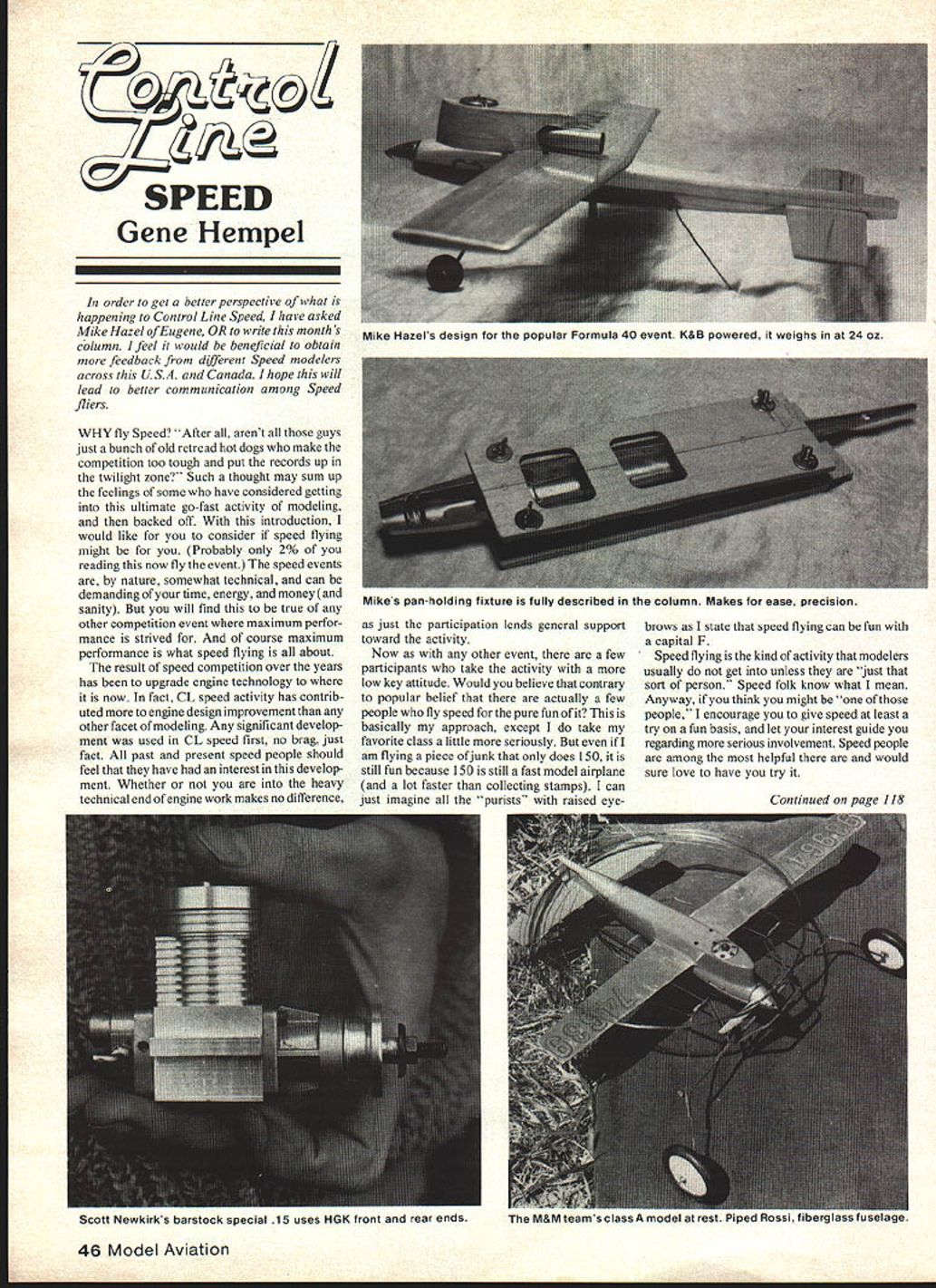
In order to get a better perspective of what is happening to Control Line Speed, I have asked Mike Hazel of Eugene, OR to write this month's column. I feel it would be beneficial to obtain more feedback from different Speed modelers across the U.S.A. and Canada. I hope this will lead to better communication among Speed fliers.
Why fly Speed?
WHY fly Speed? "After all, aren't all those guys just a bunch of old retread hot dogs who make the competition too tough and put the records up in the twilight zone?" Such a thought may sum up the feelings of some who have considered getting into this ultimate go-fast activity of modeling, and then backed off. With this introduction, I would like for you to consider if speed flying might be for you. (Probably only 2% of you reading this now fly the event.)
The speed events are, by nature, somewhat technical, and can be demanding of your time, energy, and money (and sanity). But you will find this to be true of any other competition event where maximum performance is strived for. And of course maximum performance is what speed flying is all about.
The result of speed competition over the years has been to upgrade engine technology to where it is now. In fact, CL speed activity has contributed more to engine design improvement than any other facet of modeling. Any significant development was used in CL speed first — no brag, just fact. All past and present speed people should feel that they have had an interest in this development. Whether or not you are into the heavy technical end of engine work makes no difference, as just the participation lends general support toward the activity.
Now, as with any other event, there are a few participants who take the activity with a more low-key attitude. Would you believe that contrary to popular belief there are actually a few people who fly speed for the pure fun of it? This is basically my approach, except I do take my favorite class a little more seriously. But even if I am flying a piece of junk that only does 150, it is still fun because 150 is still a fast model airplane (and a lot faster than collecting stamps). Speed flying can be fun with a capital F.
Speed flying is the kind of activity that modelers usually do not get into unless they are "just that sort of person." Speed folk know what I mean. Anyway, if you think you might be "one of those people," I encourage you to give speed at least a try on a fun basis, and let your interest guide you regarding more serious involvement. Speed people are among the most helpful there are and would sure love to have you try it.
A favorite design
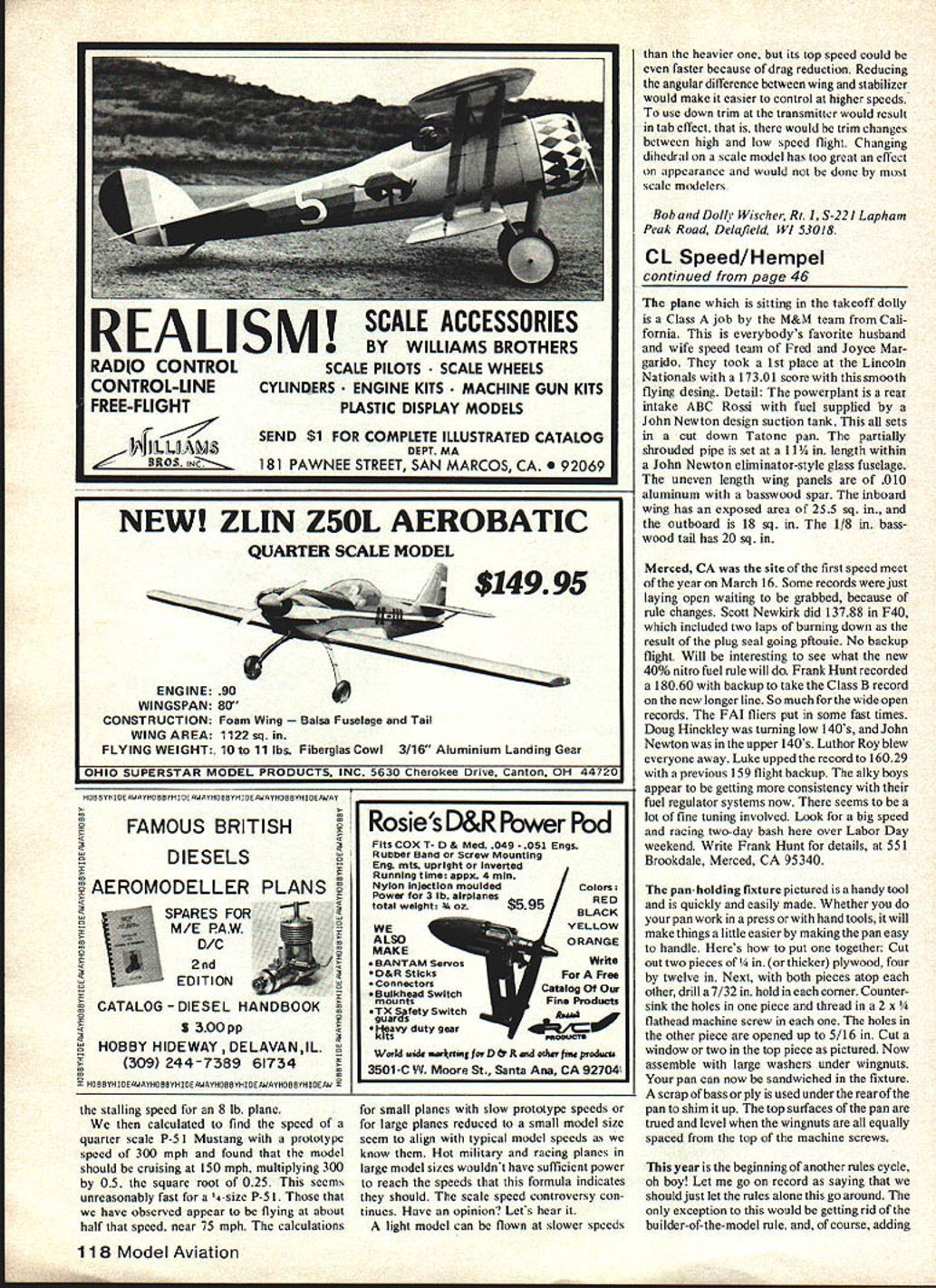
The plane which is sitting in the takeoff dolly is a Class A job by the M&M team from California. This is everybody's favorite husband-and-wife speed team of Fred and Joyce Margarido. They took 1st place at the Lincoln Nationals with a 173.01 score with this smooth-flying design.
Details: The powerplant is a rear-intake ABC Rossi with fuel supplied by a John Newton design suction tank. This all sits in a cut-down Tatone pan. The partially shrouded pipe is set at an 11½ in. length within a John Newton eliminator-style glass fuselage. The uneven-length wing panels are of .010 aluminum with a basswood spar. The inboard wing has an exposed area of 25.5 sq. in., and the outboard is 18 sq. in. The 1/8 in. basswood tail has 20 sq. in.
Merced meet report
Merced, CA was the site of the first speed meet of the year on March 16. Some records were just laying open waiting to be grabbed because of rule changes. Scott Newkirk did 137.88 in F40, which included two laps of burning down as the result of the plug seal going "pfft." No backup flight. It will be interesting to see what the new 40% nitro fuel rule will do.
Frank Hunt recorded a 180.60 with backup to take the Class B record on the new longer line. So much for the wide-open records. The FAI fliers put in some fast times. Doug Hinckley was turning low 140s, and John Newton was in the upper 140s. Luthor Roy blew everyone away — he upped the record to 160.29 with a previous 159 flight backup. The alky boys appear to be getting more consistency with their fuel regulator systems now. There seems to be a lot of fine tuning involved.
Look for a big speed and racing two-day bash here over Labor Day weekend. Write Frank Hunt for details at: 551 Brookdale, Merced, CA 95340.
Pan-holding fixture
The pan-holding fixture pictured is a handy tool and is quickly and easily made. Whether you do your pan work in a press or with hand tools, it will make the job easier by making the pan easy to handle. Here's how to put one together:
- Cut two pieces of 1/8 in. (or thicker) plywood, 4 by 12 in.
- With both pieces atop each other, drill a 7/32 in. hole in the center.
- Countersink the hole in one piece and thread in a 2 x 1/4 flathead machine screw in each one.
- Enlarge the holes in the other piece to 5/16 in.
- Cut a window or two in the top piece as pictured.
- Assemble with large washers under wingnuts. Your pan can now be sandwiched in the fixture.
- Use a scrap of basswood or ply under the rear of the pan to shim it up. The top surfaces of the pan are trued and leveled when the wingnuts are all equally spaced from the top of the machine screws.
Rules and event changes
This year is the beginning of another rules cycle. Let me go on record as saying that we should just let the rules alone this go-around. The only exception to this would be getting rid of the builder-of-the-model rule and, of course, adding any safety regulation which may appear to be necessary in the future. The last rule cycle should have taken care of any questions on safety, however. Much of the effort of the Speed Advisory Committee went into safety regulation last time. Speed fliers are probably the most safety-conscious segment of modelers there are, and this is reflected by the thought and concern involved in the last and previous rules cycles.
Again, I feel that regulations should remain status quo, but anyone feeling the opposite should certainly speak up. Any proposals should be carefully thought out with regard to the following criteria:
- Will it benefit our activity and help increase participation?
- Will it be easy to officiate with rules that are clearly enforceable?
- Will it not obsolete present equipment?
- Are safety considerations adequate?
My opinion is that unless these questions can be answered positively, the proposal should be destined for the round file.
Now that some of the events have been dropped, it will be interesting to see if the effect will be the positive one as originally hoped. It was thought that with so many classes, and a limited number of entrants, participation was spread thin in specific classes. With some of the low-participation classes gone, will activity in other classes increase? I certainly hope so, but I won't hold my breath, because it probably will not make much difference. I was in favor of dropping the events that we did because of their minimal value. There is still a slight problem about dropping an event, however, because no matter how unpopular the class may be, it will be somebody's favorite, and they may drop out. Hmmm — maybe it was their favorite class because they were the only one flying it. Different ways to look at it.
Newsletter plug
I'm going to give a plug for a newsletter that I am involved with. Flying Lines emanates forth from the northwest region and covers area news and happenings. For those not in our area, though, we have monthly columns on all control line activity, including speed, much in the same format as in this magazine. Seven dollars gets you a full year (12 issues).
Address: Flying Lines, 1411 Bryant Ave., Cottage Grove, OR 97424.
Keep the faith and keep flying Speed!
Thanks to Mike Hazel for his thoughts and insights this month. Once again, I invite other interested Speed fliers to write to me about our favorite event.
Gene Hempel 301 N. Yale Dr., Garland, TX 75042.
Transcribed from original scans by AI. Minor OCR errors may remain.

