
Control Line SPEED
Gene Hempel
The U.S. Control Line Championships, held June 21–22 at Winston-Salem, NC, was attended by 140 contestants, and it was by far the best Speed contest I have attended this year.
At the last moment I decided to fly by commercial airline to Winston-Salem. This was quite an experience. It is approximately 1,200 miles from Garland, TX to Winston-Salem, and it was very refreshing to cover the distance in only 2 1/2 hours by air, compared to the usual two-day trip by automobile.
The only problem with traveling by air is transporting models. Since I was unprepared to do this, I left all my equipment at home. This offered an opportunity for me to socialize with all of the control line modelers.
There were approximately 21 Speed contestants, of which only 18 made official flights. The weather was beautiful, with a high of 80° on Saturday and 89° on Sunday. The best feature was being able to spread out the attempts over two days. This gave fliers the opportunity to rebuild their equipment Saturday night while BS-ing with fellow Speed fliers.
Open 1/2A Profile Proto
Open 1/2A Profile Proto was rough. Al Stegens of Cleveland, OH, pushed his open-faced TD up to 99.68 mph. On his third attempt to push it over the record, the ground jumped up. In fact, Al has a very unique way with the TD. He treats them like small watches, and thus he obtains maximum rpm. Jerry Kasmer placed second with 70.15 mph. This was held as a provisional event.
D Speed
It was interesting to hear the D Speed fliers fussing about fuel, prop, and head combinations now that they are running mini-pipes and not having to worry about building a complete engine for each flight. When the rule change was made to eliminate tuned pipes in D Speed, almost everyone thought the speeds would drop dramatically. With the new 6-inch mini-pipe rule, the speeds attained are faster than with the tuned pipes! Frank Garzon of New York proved this by turning 201.26 mph for 1st, with Les Baer, Sr., Allentown, PA, at 197.07 for 2nd. Also, the team of Huff, Hurlocker, and Langlois of Winston-Salem were humping it with 194.31 mph. The engine used to power many of the D Speed models was the OPS .65 or the OPS .60 modified to bring it up to .65 cu in. In the new 5-port OPS .65, it is a real workhorse for D Speed.
Class B Speed
The speeds for Class B have slowed down slightly with the new line length of 65 ft. This is one of the new rule changes implemented for the 1980–81 season. Everyone agrees they are able to control the model much better, and the fear of losing the model is not as great.
Open B Speed roared off with Les Baer, Sr., reaching a record speed of 185.79 mph, but he was unable to make the necessary supporting flight required for an AMA record. Les was using a Supertigre X-29 with a 7 x 10 Rev-Up prop. James Van Sant turned 177.16 mph, and Glen Van Sant flew 163.20 mph.
Bill Hughes captured the Senior B Speed record by turning a 160.54 mph flight, while another Senior, Dray Hooke, was trying for an official flight. The only Junior entry in B Speed was David Hooke. Even though he only made official attempts, he handled his model very well. It is very encouraging to see more Juniors and Seniors flying Speed.
One thing I would like to note is that every B Speed flier used a system similar to the one described in my X-29 article that appeared in the CL Speed column of the April and June issues of Model Aviation. This proves that, with a little work and patience, any modeler can fly Speed.
Some of the Speed fliers encountered problems with their tank systems which caused the model to go rich in the air. To solve this problem, pinch the ram tube with a pair of pliers until only half of the intake area is open. Another solution is to solder a piece of 3/32" tubing inside the 1/8" tube to restrict the amount of air into the ram tube.
Jet Speed
Jet Speed was suffering from a lack of entries. There were just two entries, with Don Beneck of Copiague, NY, making the only official flight with a thundering 195.57 mph. Don's jet model was formed entirely of aluminum material like his D Speed entry. You have to see these models to appreciate the amount of work and time required to build them.
Don has been experimenting with different head configurations. He discussed using a smaller ID and a longer head dimension than the present 3-in. head length. I hope Don will share some of his valuable information on head design.
CL Speed / Hempel — Continued
Class A Speed
The Class A fellows were off to their usual fast pace with Les Baer, Sr., turning 174.69 mph in Open A Speed. Close behind was the team of Huff, Hurlocker, and Langlois with 167.53 mph. Glen Van Sant and James Van Sant turned 148.58 mph and 135.69 mph, respectively. Bill Hughes turned 122.90 mph to capture first in Senior A Speed.
FAI Speed
FAI Speed had Sam Burke of Cambridge, Ont., Canada, a member of the Canadian FAI team, taking first at 148.15 mph, and E. Gifford second with 93.28 mph. The FAI fliers certainly had their problems in making official flights. Lots of test flying was going on.
Open Formula 40 (F-40)
Open Formula 40 had Glenn Lee of Batavia, IL, at 153.00 mph. Tom Lauermann of Chicago and Glen Van Sant turned 146.16 mph and 143.14 mph, respectively.
Bill Hughes set a new Senior F-40 record with 148.46 mph and had a supporting flight at 147.85 mph.
A new fuel restriction for F-40, which specifies a mixture of 40% nitro, 40% alcohol and 20% oil, has slowed the speeds down somewhat. Many Speed fliers indicated that the head configuration was very important to making the engine perform. If you have the proper head, maybe we should try a diesel engine for this event and see how it performs speed-wise—it's something to think about.
The engines used in F-40 were split between the K&B X-40 and the K&B 6.5. Glenn Lee used a K&B 6.5, while Tom Lauermann used an X-40.
The use of the glass prop on F-40 has really increased. My experience has been that there is a small increase in speed when using glass props over wood props. The team Race fliers proved this by using only glass or carbon-fiber props.
Junior A Speed
Junior A Speed had Sheldon Ybanez of Roanoke, VA, turning 85.44 mph for 1st place. There were several other attempts to make official flights in this event, but the Ground Monster caught them.
Personal Notes and Miscellany
I really enjoyed this meet, maybe because the pressure of competing was not heavy on me. I had the opportunity to converse with the Team Race fliers and many contestants who flew in other events. This contest represents, to me, a kind of homecoming week where everyone meets once a year. Modeling has always presented the opportunity to meet different people.
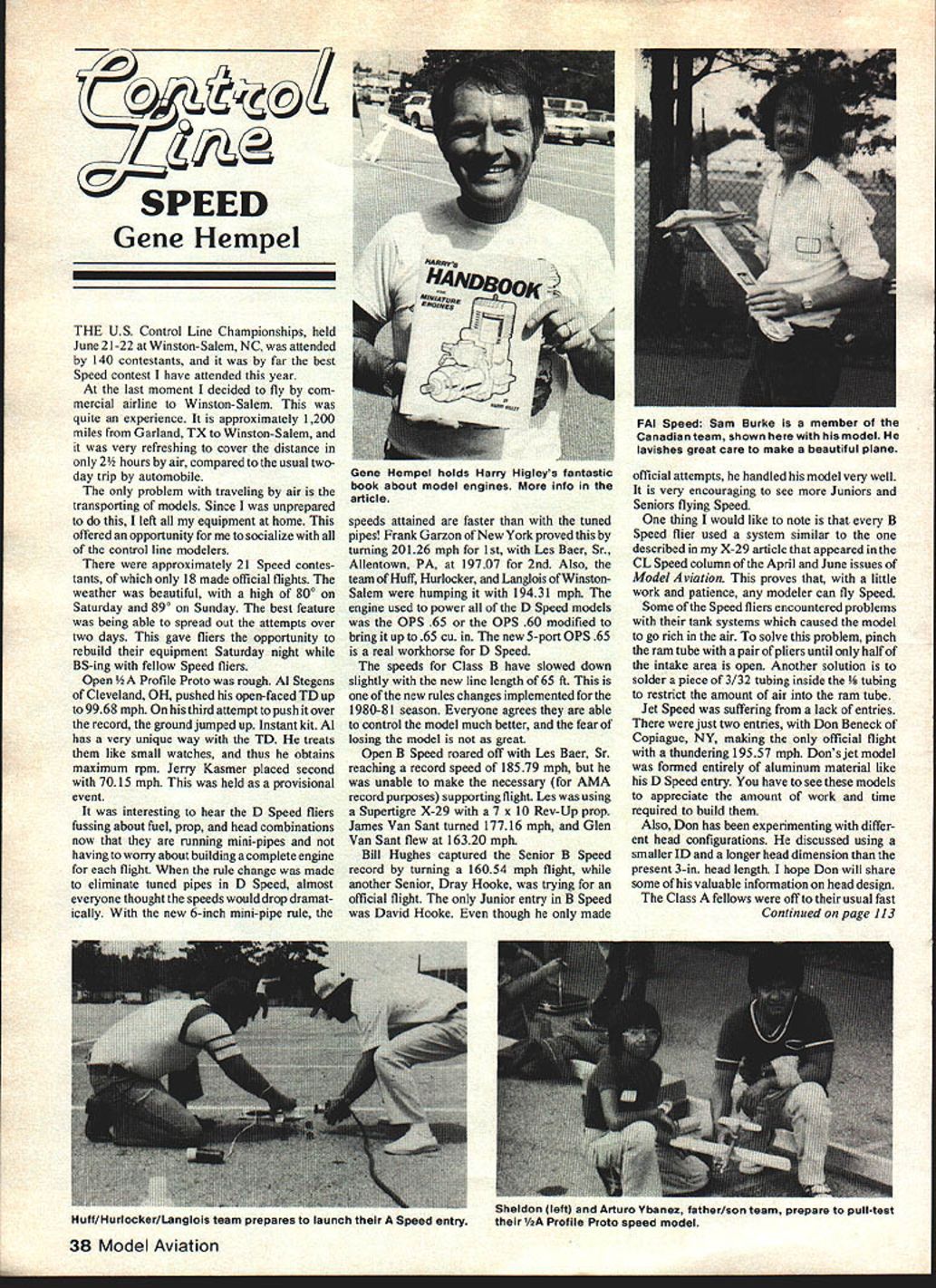
There have been several requests for a photograph of me. Well, I finally had one made by Harry Higley, who writes the "Control Line News" column for Model Airplane News.
I want you to note the book I am holding. This is one of the best handbooks that I have read concerning basic theory and advanced repairs for model engines. The book is entitled [title not available]. It retails for $9.95 and may be ordered from Harry Higley, 433 Arquilla Dr., Glenwood, IL 60425.
Now, you guys can hang this beautiful poster somewhere in your shop. The only rule I have is do not throw the poster away. Gosh! You might hurt yourself.
I received a letter from Jim Harris stating that he has the special rear bearing that fits the Supertigre X-15, X-21 and the Taipan .21. The bearings are manufactured by GMN of Germany. The dimensions are as follows:
- Bore: 10 mm
- Outer diameter: 24 mm
- Width: 7 mm
These can be obtained from Jim's Hobby Shop, 4228 Ridgedale, Mesquite, TX 75150. Phone: (214) 270-3191. Jim also stocks a complete line of OPS engine parts.
Gene Hempel 301 N. Yale Dr. Garland, TX 75042
Transcribed from original scans by AI. Minor OCR errors may remain.

