
Speed
Phill Bussell
DID I HEAR someone say they wanted to fly Speed, but they never learned to fly monoline. You say you want to fly Speed, but you are not too sure about dollies—they look complicated and hard to build. You say you want to fly Speed but you know nothing about tuned pipes (who does?). You say you would love to fly Speed but competitive engines are hard to come by and you never built a speed ship before. You say you really would like to try Speed but are concerned about your chances without first buying a machine shop and then spending the rest of your life trying to learn how to run all that complicated looking machinery you spent your life savings on.
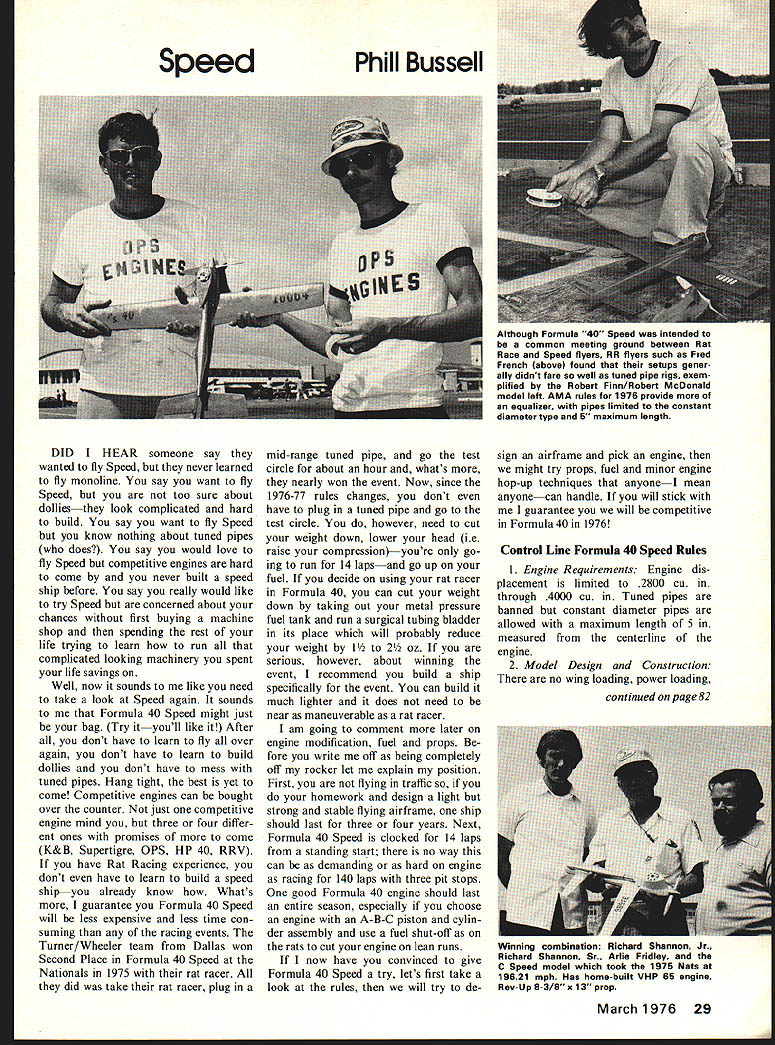
Well, now it sounds to me like you need to take a look at Speed again. It sounds to me that Formula 40 Speed might just be your bag. (Try it—you'll like it!) After all, you don't have to learn to fly all over again, you don't have to learn to build dollies and you don't have to mess with tuned pipes. Hang tight, the best is yet to come! Competitive engines can be bought over the counter. Not just one competitive engine mind you, but three or four different ones with promises of more to come (K&B, Supertigre, OPS, HP 40, RRV). If you have Rat Racing experience, you don't even have to learn to build a speed ship—you already know how. What's more, I guarantee you Formula 40 Speed will be less expensive and less time consuming than any of the racing events. The Turner/Wheeler team from Dallas won Second Place in Formula 40 Speed at the Nationals in 1975 with their rat racer. All they did was take their rat racer, plug in a mid-range tuned pipe, and go the test circle for about an hour and, what's more, they nearly won the event. Now, since the 1976-77 rules changes, you don't even have to plug in a tuned pipe and go to the test circle. You do, however, need to cut your weight down, lower your head (i.e. raise your compression)—you're only going to run for 14 laps—and go up on your fuel. If you decide on using your rat racer in Formula 40, you can cut your weight down by taking out your metal pressure fuel tank and run a surgical tubing bladder in its place which will probably reduce your weight by 1½ to 2½ oz. If you are serious, however, about winning the event, I recommend you build a ship specifically for the event. You can build it much lighter and it does not need to be near as maneuverable as a rat racer.
I am going to comment more later on engine modification, fuel and props. Before you write me off as being completely off my rocker let me explain my position. First, you are not flying in traffic so, if you do your homework and design a light but strong and stable flying airframe, one ship should last three or four years. Next, Formula 40 Speed is clocked for 14 laps from a standing start; there is no way that can be as demanding or as hard on engine as racing for 140 laps with three pit stops. One good Formula 40 engine should last an entire season, especially if you choose an engine with an A-B-C piston and cylinder assembly and use a fuel shut-off as on the rats to cut your engine on lean runs.
If I now have you convinced to give Formula 40 Speed a try, let's first take a look at the rules, then we will try to design an airframe and pick an engine, then we might try props, fuel and minor engine hop-up techniques that anyone—I mean anyone—can handle. If you will stick with me I guarantee you we will be competitive in Formula 40 in 1976!
Control Line Formula 40 Speed Rules
- Engine Requirements: Engine displacement is limited to .2800 cu. through .4000 cu. in. Tuned pipes are banned. Constant diameter pipes are allowed with a maximum length of 5" measured from the centerline of the engine.
- Model Design and Construction: There are no wing loading, power loading
or cross sectional requirements. The method of "hold down" construction for holding the parts of the model together should be considered, in the Event Director's opinion, to be at least as strong as the methods illustrated in the Control Line Speed Section of your AMA Rule Book. Models shall have a fixed landing gear with a minimum of one wheel.
3. Launch:
Models shall take off from the ground or runway under their own power unassisted (no hand launching or dollies).
4. Size and Length of Control Lines:
Minimum line length is 60' and minimum diameter is .018 single-strand wire. Lines of braided or multi-strand construction will not be allowed and no single-line control systems are allowed.
5. Timing of flights:
Fourteen laps (one mile) from a standing start (which is the same as for B Proto Speed).
The 1976-77 Rule Book is not out yet, but the above mentioned rules will be applicable (but not in the format I used to present them in). In my next column, we will design a couple of airframes, pick an engine or two to work with, and, if space permits, discuss some of the smaller but important items to think about.
End of the Trail 1975
The Southwest Model Airplane Championships held in Dallas over the Labor Day Weekend were very successful and, in Speed, if Speed is suffering from an interest standpoint, you can't tell it in the Southwest part of the USA. Junior interest in particular is high in our area and competition in general at the Southwest was in many classes stronger than at the Nationals.
Mark Seigler of Houston broke the Junior C Record when he turned 169.26 with his mini-piped (4-wave length) Supertigre X-40. The team of Bob Finn and Robert McDonald of Arlington, Tex. broke the Open A Record with a sizzling flight of 170.71. Robert McDonald does the flying for this team and has really come on strong the past couple of years. This team runs a Rossi .15 using a suction fuel system with a .230 carburetion venturi hole and they were using a new Rev-Up 6-8-1/2 N and 78% Nitro fuel. Brent Bussell broke the Junior A Record and Charlie Davis broke 190 in Open Jet. Tom Upton turned 166+ in B Proto and John Shannon turned 188+ in B Speed. All in all, speeds were out of sight. This is a good contest to pencil in for 1976 if competition is your bag.
The Memphis, Tennessee Contest was held Sunday, October 12th, and saw a good turn out with a very innovative format. The meet was hosted by Bill McGraw (Bill's Miniature Engines) and featured a $5 per event entry fee with a $10 maximum charge regardless of number of events flown. There was a Junior, Senior and Open High-point Champion crowned and the entry fees were divided up and flown for on a record/ratio basis. In addition, Bill had solicited gifts from several manufacturers and small speed oriented businesses and held drawings for these and awarded them throughout the day.
Brent Bussell won 1st Place and $50 with 104% when he turned 163.57 in Junior A Speed. His Supertigre X-15 just keeps on running. Brent has to be an inspiration to those carping about the high cost of speed. Brent has used the same engine all season long and broke the Junior A Record his first time out and it has continued to perform in the high 160's to the mid 170's for the entire season and all of this with one piston and sleeve.
Fridley and Shannon of Tennessee turned 200+ in Open C for 99.99% and Second Place and $35. Patrick Hempel won 3rd with 98.9% in Junior Jet. Finn/McDonald claimed fourth with 98.66% in Open A Speed and Tom Upton took fifth place with 93.77% in B Proto. If the Bussell/Jett team would ever stop trying to turn 200+ with their .29, they might get an official flight again — the Southwest and Memphis contests were not too kind to us.
NASA: We have had volunteers (but not near enough) to help formulate our organization and contribute to the newsletter. Tom Upton, newsletter Editor, is in the process of soliciting help from all districts in the AMA to contribute to the newsletter on a regular basis. It will not be easy and will take a long time to organize, once it is certain there is enough volunteer help for the organization to function properly. If we can't do it right, there is nothing to be gained by going half-cocked. Hopefully, we will be ready to solicit members by my next column.
(My address is: 4803 Fallon Pl., Dallas, Tex. 75227.)
Transcribed from original scans by AI. Minor OCR errors may remain.

