
Control Line: Speed
Gene Hempel
The U.S. Control Line Championships, held June 13–14 at Winston-Salem, NC, were attended by 132 contestants. It was by far the best Speed contest I have attended this year.
Travel
Again this year I decided to fly commercially to Winston-Salem. It is approximately 1,200 miles from Garland, TX to Winston-Salem, and it was very refreshing to cover the distance in only 2½ hours by air, compared to the usual two-day trip by automobile.
The only problem with traveling by air is transporting models. Since I was unprepared, I packed a model in a suitcase but discovered when unpacking that I had left the flying lines at home. After kicking myself numerous times, I decided to make the best of it — after all, the event offered an opportunity to socialize with lots of control line modelers.
Weather and format
There were approximately 24 Speed contestants, of which 22 made official flights — an increase from last year. The weather was beautiful except for a thunder shower that started about 4:00 p.m. Saturday. Saturday’s high was 85°F, with Sunday reaching 91°F. The best feature was being able to spread attempts over two days, giving fliers the opportunity to rebuild equipment Saturday night while chatting with fellow Speed fliers.
Results
Open D Speed
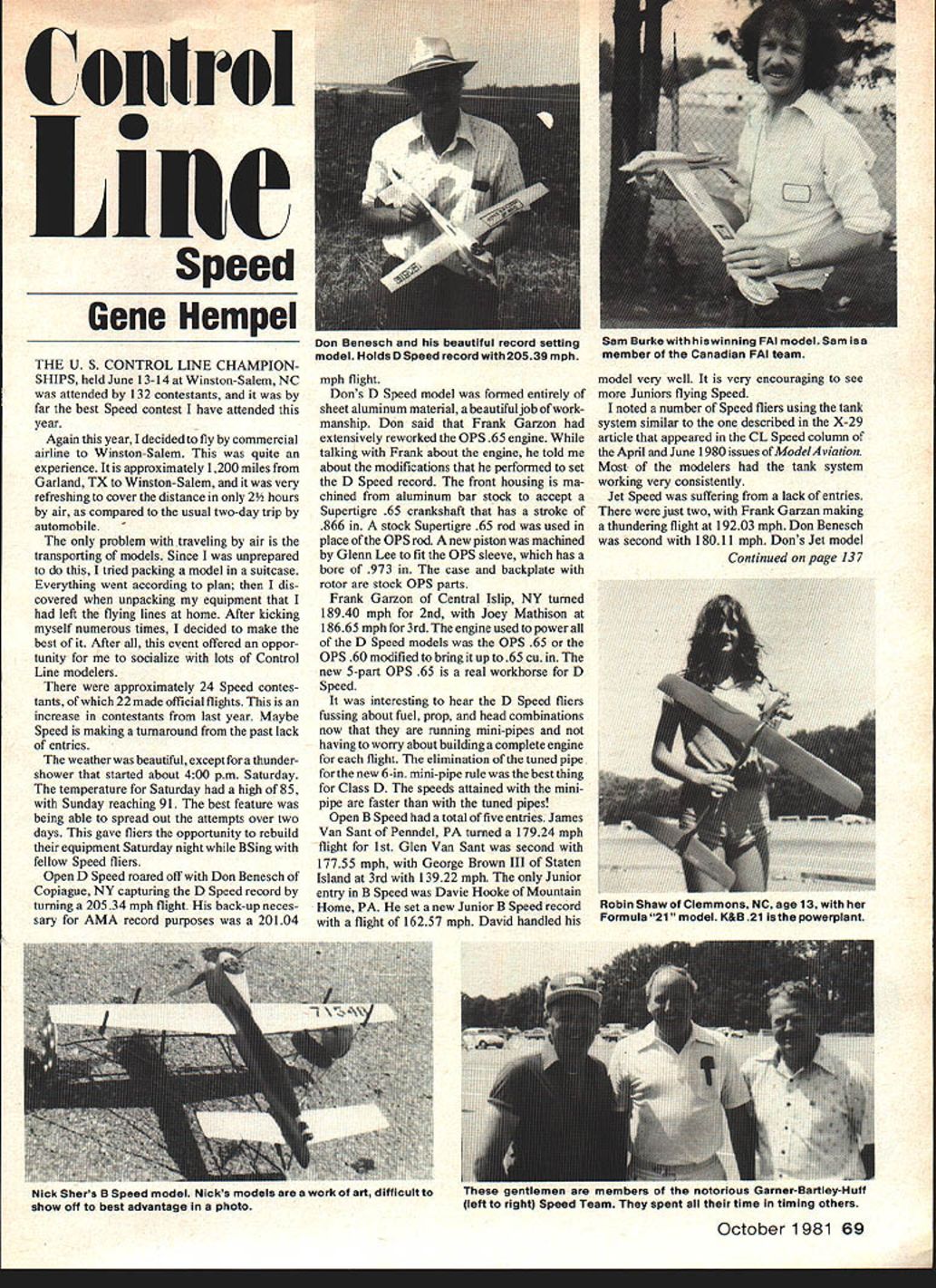
Don Benesch of Copiague, NY captured the D Speed record with a 205.34 mph flight. His backup, necessary for AMA record purposes, was 201.04 mph.
- Don Benesch — 205.34 mph (record), backup 201.04 mph
- Frank Garzon (Central Islip, NY) — 189.40 mph
- Joey Mathison — 186.65 mph
Don’s D Speed model was formed entirely of sheet aluminum and showed beautiful workmanship. He said Frank Garzon had extensively reworked the OPS .65 engine. Frank described the modifications he performed to set the D Speed record: the front housing is machined from aluminum bar stock to accept a Supertigre .65 crankshaft with a stroke of .866 in. A stock Supertigre .65 rod was used in place of the OPS rod. A new piston was machined by Glenn Lee to fit the OPS sleeve, which has a bore of .973 in. The case and backplate with rotor are stock OPS parts.
The engines used to power all of the D Speed models were the OPS .65 or the OPS .60 modified to bring it up to .65 cu. in. The new 5-part OPS .65 is a real workhorse for D Speed. It was interesting to hear the D Speed fliers fussing about fuel, prop, and head combinations now that they are running mini-pipes and are not having to build a complete engine for each flight. The elimination of the tuned pipe in favor of the new 6-inch mini-pipe rule was the best thing for Class D. The speeds attained with the mini-pipe are faster than with the tuned pipes!
Open B Speed
Open B Speed had a total of five entries.
- James Van Sant (Penndel, PA) — 179.24 mph
- Glen Van Sant — 177.55 mph
- George Brown III (Staten Island) — 139.22 mph
The only Junior entry in B Speed was Davie Hooke (Mountain Home, PA). He set a new Junior B Speed record with a flight of 162.57 mph. David handled his model very well; it is encouraging to see more juniors flying Speed.
I noted a number of Speed fliers using the tank system similar to the one described in the X-29 article that appeared in the CL Speed column of the April and June 1980 issues of Model Aviation. Most of the modelers had the tank system working very consistently.
Jet Speed
Jet Speed suffered from a lack of entries — only two.
- Frank Garzon — 192.03 mph
- Don Benesch — 180.11 mph
Don’s Jet model was also formed entirely of sheet aluminum like his D Speed entry. You have to see these models to appreciate the amount of work and time required to build them. Don has been experimenting with different head configurations; he discussed using a smaller I.D. and a longer head dimension than the present 3-inch head length.
Open A Speed
The Class A fellows were off to their usual fast pace in Open A Speed.
- Nick Sher (Langhorne, PA) — 175.88 mph (Open A)
- G. D. Hooke — 145.93 mph
- James Van Sant — 125.39 mph
Junior A Speed:
- David Hooke — 125.47 mph
Open A Speed was rough overall. Al Stegens (Cleveland, OH) pushed his open-faced TD up to 124.17 mph. Nick Sher’s tuned-pipe TD made 122.97 mph. Sam Burke placed 3rd with a beautiful 3/4 A asymmetrical model at 107.23 mph.
FAI Speed
FAI Speed results:
- Sam Burke (Cambridge, Ont., Canada) — 146.21 mph (member of the Canadian FAI Team)
- Ed Gifford (Newfield, NJ) — 133.15 mph
- Stewart Henderson (Mississauga, Ont.) — 130.81 mph
FAI Speed appears to be attracting more fliers; I hope this trend continues, as we need more modelers to participate in FAI Speed.
Open Formula "40"
Open Formula "40" had a record number of entries — a total of 10.
- Glenn Lee (Batavia, IL) — 154.58 mph
- Carl Shaefer — 148.46 mph
- Glen Van Sant — 147.12 mph
The Formula "40" fuel restriction specifies a mixture of 40% nitro, 40% alcohol, and 20% oil, and it has slowed speeds down somewhat. Many Speed fliers indicated that head configuration is very important to make the engine perform on the low-nitro fuel. Formula "40" is really a fun event to fly.
The engines that powered the F-40 models were split between the Super Tigre X-40 and the K&B 6.5. Glenn Lee used a K&B 6.5, while Carl Shaefer used an X-40.
Formula "21"
Formula "21," a junior provisional event, had two entries.
- Robin Shaw (Clemmons, NC) — 104.13 mph
- Sheldon Ybanez (Roanoke, VA) — 87.86 mph
Notes and observations
- The use of glass props in F-40 and D Speed has really increased. My experience is that there is about a 3 mph advantage in glass props over wood. Team Race fliers tend to use only glass or carbon-fiber props.
- Many D Speed and F-40 competitors are adapting to mini-pipes and experimenting with head and prop combinations to optimize performance on various fuels.
- There have been several requests for blank Cox cylinders and chromed crankshafts. For more information, mail a SASE to:
P&C Metal Shop 301 North Yale Dr. Garland, TX 75042
Gene Hempel 301 N. Yale Dr. Garland, TX 75042
Transcribed from original scans by AI. Minor OCR errors may remain.

