
Control Line: SPEED
Gene Hempel
As the first order of business this month, I would like to express my thanks and appreciation to all Speed modelers and readers around the world who have taken time to write. There are times when I do not know what would be of interest to the modeling fraternity. If you have any questions, suggestions, or ideas, drop me a line and I will attempt to accommodate your request.
Reader letters and meet reports
- James Van Sant (Penndel, PA) reported on the Big-Little Speed Meet held October 3, 1982, at Jonesville, PA:
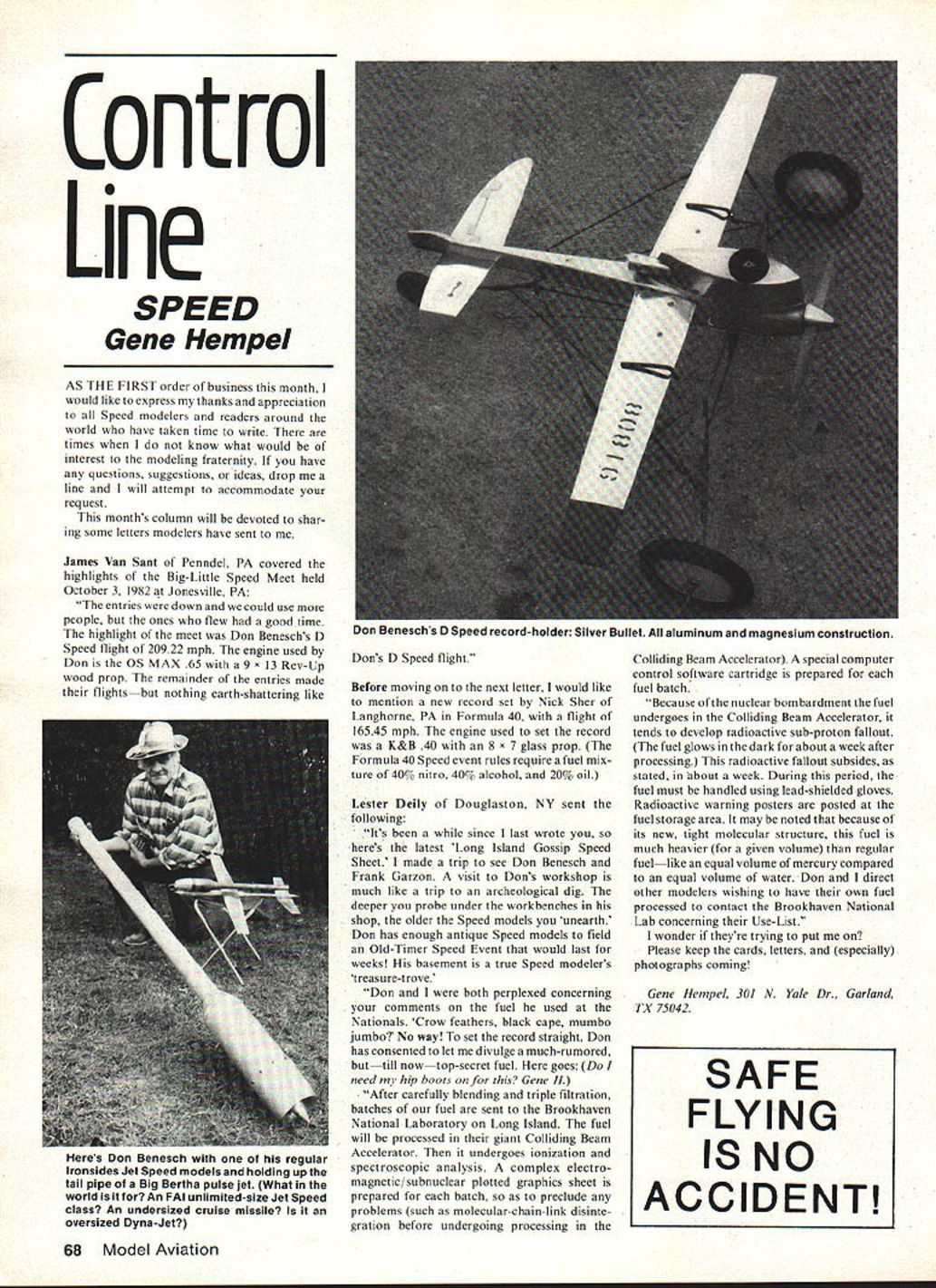
"The entries were down and we could use more people, but the ones who flew had a good time. The highlight of the meet was Don Benesch's D Speed flight of 209.22 mph. The engine used by Don is the OS MAX .65 with a 9 x 13 Rev-Up wood prop. The remainder of the entries made their flights — but nothing earth-shattering like Don's D Speed flight."
Before moving on to the next letter, I would like to mention a new record set by Nick Sher (Langhorne, PA) in Formula 40, with a flight of 165.45 mph. The engine used to set the record was a K&B .40 with an 8 x 7 glass prop. (The Formula 40 Speed event rules require a fuel mixture of 40% nitro, 40% alcohol, and 20% oil.)
- Lester Deily (Douglaston, NY) sent the following:
"It's been a while since I last wrote you, so here's the latest 'Long Island Gossip Speed Sheet.' I made a trip to see Don Benesch and Frank Garzon. A visit to Don's workshop is much like a trip to an archeological dig. The deeper you probe under the workbenches in his shop, the older the Speed models you unearth. Don has enough antique Speed models to field an Old-Timer Speed Event that would last for weeks! His basement is a true Speed modeler's treasure-trove.
"Don and I were both perplexed concerning your comments on the fuel he used at the Nationals. 'Crow feathers, black cape, mumbo jumbo? No way! To set the record straight, Don has consented to let me divulge a much-rumored, but — till now — top-secret fuel. Here goes: (Do I need my hip boots on for this? Gene H.)
"After carefully blending and triple filtration, batches of our fuel are sent to the Brookhaven National Laboratory on Long Island. The fuel will be processed in their giant Colliding Beam Accelerator. Then it undergoes ionization and spectroscopic analysis. A complex electromagnetic/subnuclear plotted graphics sheet is prepared for each batch, so as to preclude any problems (such as molecular-chain-link disintegration) before undergoing processing in the Colliding Beam Accelerator. A special computer control software cartridge is prepared for each fuel batch.
"Because of the nuclear bombardment the fuel undergoes in the Colliding Beam Accelerator, it tends to develop radioactive sub-proton fallout. (The fuel glows in the dark for about a week after processing.) This radioactive fallout subsides, as stated, in about a week. During this period, the fuel must be handled using lead-shielded gloves. Radioactive warning posters are posted at the fuel storage area. It may be noted that because of its new, tight molecular structure, this fuel is much heavier (for a given volume) than regular fuel — like an equal volume of mercury compared to an equal volume of water. Don and I direct other modelers wishing to have their own fuel processed to contact the Brookhaven National Lab concerning their Use-List.
"I wonder if they're trying to put me on? Please keep the cards, letters, and (especially) photographs coming!"
Gene Hempel 301 N. Yale Dr. Garland, TX 75042
Transcribed from original scans by AI. Minor OCR errors may remain.

