
Control Line: Speed
Gene Hempel
My first order of business this month is to mention several organizations pertaining to Control Line speed. The monthly newsletter Gazette, edited by Laird Jackson, will be incorporated into a new organization called the National Control Line Coalition.
This developing organization is intended to provide a representative body for all Control Line modelers. The intent is to provide a means for modelers to have an ability to speak with one voice of authority to the AMA or to any other group concerning Control Line matters of interest.
The Gazette has an international audience but needs new subscribers to cover printing costs. Write in and support the Coalition concept if you refuse to accept that Control Line is dead. To join, mail $10 for one year to Laird Jackson, 2322 Wilson Ave., Bristol, PA 19007. (Outside of the U.S., the subscription rate is $15/year.)
North American Speed Society (NASS)
Another new organization is the North American Speed Society. Their newsletter, Speed Times, contains lots of information concerning speed-related items.
Membership dues:
- Open: $15
- Senior: $10
- Junior: $7
All NASS members will receive a membership card, three NASS decals, a name tag, and the quarterly newsletter. For more information mail a SASE to Chris Sackett, Box 82294, British Columbia, Canada V5C 5P7.
Letter from Tom Pearson
Dear Gene,
Got the camera loaded with B&W to take some photos of rare engines and models for you last week.
One photo is of a rather rare Fox .29R of the 1956–57 era. This engine is the second version with a finned, single-plug head. The first version had a twin-plug, non-finned head — the fastest .29 in its time until the Fox .29X came onto the scene. It spelled the end of the Dooling and McCoy .29 B Speed engines.
The next series of photos is of a McCoy .49 Speed model dating to about 1947. Note the ignition .49 complete with Burgess battery pack, and the adjustable-pitch Air-O single-blade prop. This was a commercial development of the prop used by two Californians in their Hornet .60 Speed model in 1946 to set the Open D speed record.
The airplane itself is rather unique, as it is molded from some sort of bakelite-impregnated paper. It was not a good flying model. I do not know who built it; perhaps your readers can identify it.
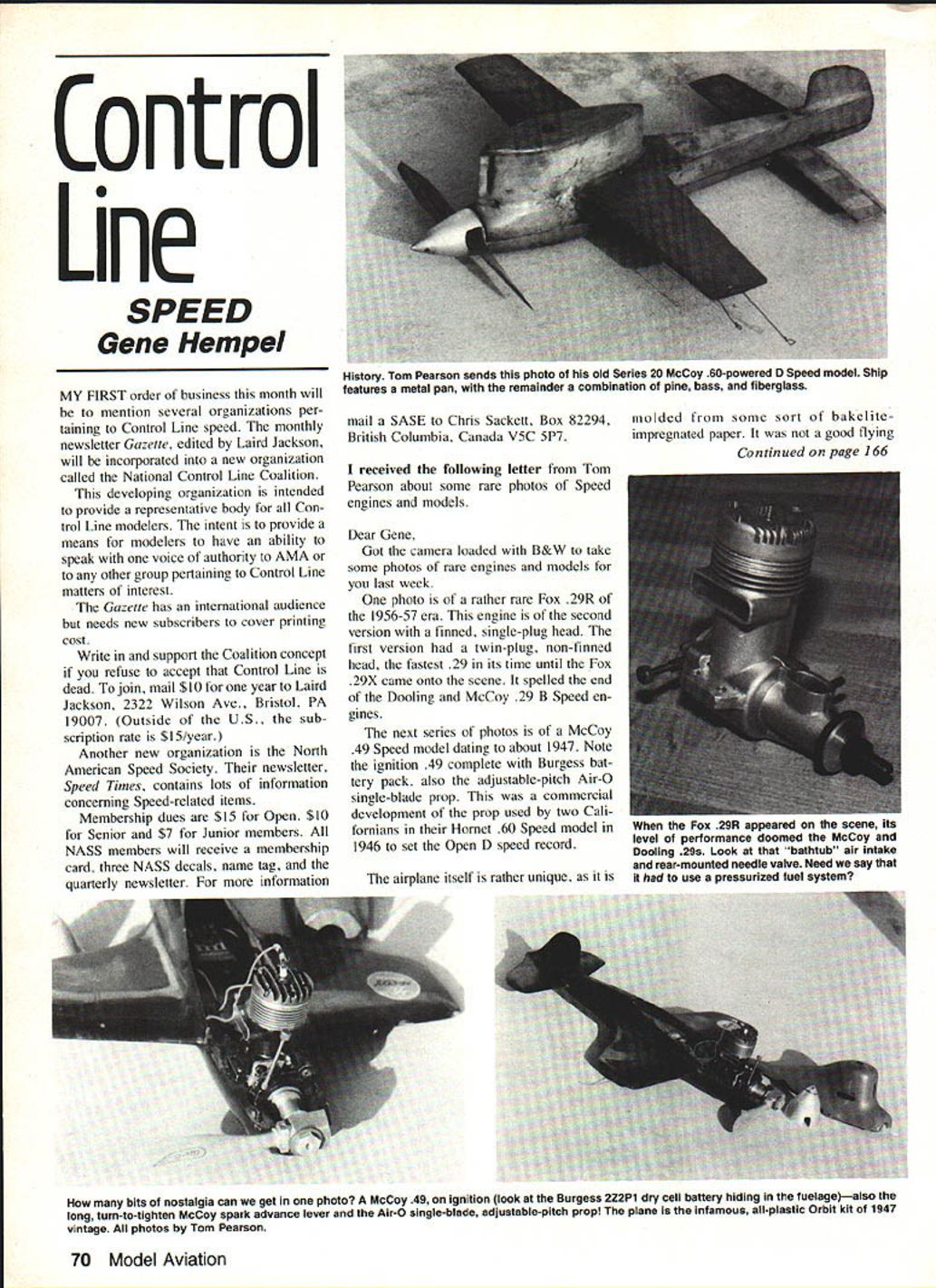
Another photo is of a Series 20 McCoy .60 mounted in a model constructed of pine, basswood, and fiberglass resin. The horizontal stab was not mounted at the extreme end of the pan. I found that when flying on a grass surface the model would tumble on landing and the stab was less likely to break.
Monoline came on the scene in 1958. By 1959, Monoline was beginning to dominate the Speed events. It appears many contests dropped Speed due to declining participation. I quit flying Speed at the end of the 1960 season, as contests were few and far between.
Regards, (s) Tom Pearson
Editor’s note
The model described above is an Orbit, kitted by Formacraft Corp., Barberton, OH. — RMMcM
I would be interested to hear any comments on how Speed can be improved to attract modelers to start flying again.
Gene Hempel 301 N. Yale Dr., Garland, TX 75042.
Transcribed from original scans by AI. Minor OCR errors may remain.

