
Control Line: Speed
Gene Hempel
REVIVAL TIME! This month, I'm printing two letters which have recently arrived in my mailbox and which have ideas on how to revive CL Speed flying. One letter is from Bob Heywood (Dayton, OH), while the other is from Joe Sullivan (Richardson, TX). I hope that other interested modelers will take the time to write and express themselves on this subject. (Of course, comments and questions on any Speed-related topic are also welcome.)
First, let's read Bob Heywood's letter, dated November 4, 1983:
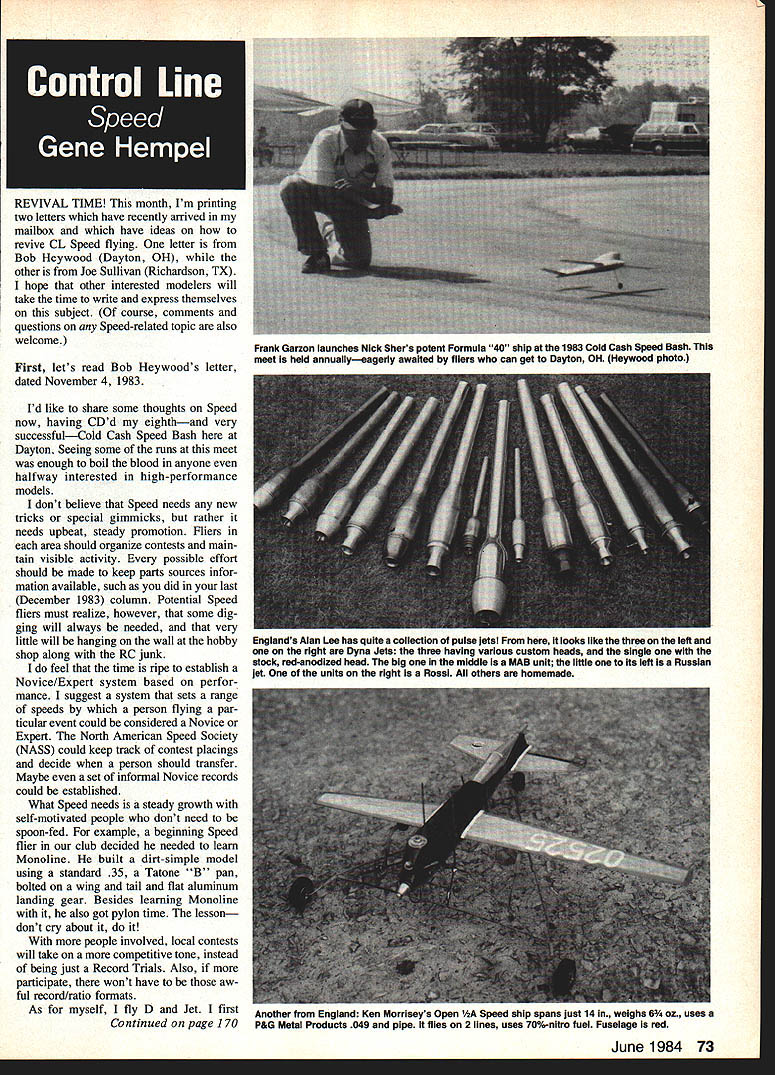
I'd like to share some thoughts on Speed now, having CD'd my eighth—and very successful—Cold Cash Speed Bash here at Dayton. Seeing some of the runs at this meet was enough to boil the blood in anyone even halfway interested in high-performance models.
I don't believe that Speed needs any new tricks or special gimmicks, but rather it needs upbeat, steady promotion. Fliers in each area should organize contests and maintain visible activity. Every possible effort should be made to keep parts sources information available, such as you did in your last (December 1983) column. Potential Speed fliers must realize, however, that some digging will always be needed, and that very little will be hanging on the wall at the hobby shop along with the RC junk.
I do feel that the time is ripe to establish a Novice/Expert system based on performance. I suggest a system that sets a range of speeds by which a person flying a particular event could be considered a Novice or Expert. The North American Speed Society (NASS) could keep track of contest placings and decide when a person should transfer. Maybe even a set of informal Novice records could be established.
What Speed needs is steady growth with self-motivated people who don't need to be spoon-fed. For example, a beginning Speed flier in our club decided he needed to learn Monoline. He built a dirt-simple model using a standard .35, a Tatone "B" pan, bolted on a wing and tail and flat aluminum landing gear. Besides learning Monoline, he also got pylon time. The lesson—don't cry about it, do it!
With more people involved, local contests will take on a more competitive tone, instead of being just a Record Trials. Also, if more participate, we don't have to be those awful record/ratio formats.
As for myself, I fly D and B. I first...
Continued on page 170.
CL Speed/Hempel
Continued from page 73
I started Speed in 1967 with an ex-Roselle McCoy .60 ship. Harry Roe, Jerry Roselle, Jack Frye, and Warren Gregory all helped me to learn. I never really have been a threat in national competition, but flying fast planes, being on the handle-end of a thundering .65, is perhaps my biggest modeling thrill.
The other letter, from Joe Sullivan, is dated September 10, 1983.
I just read your column in the September 1983 MA, where you asked for ideas to rekindle interest in Speed.
My feeling is that the decline in Speed came when interest in other fast (and large) exotic flying items, such as the tuned pipes, the mini-40s, etc., drew attention away from flying U-Control in 1949. I flew actively until 1962. I had dabbled a bit with R/C along the way, to stay current on what was going on.
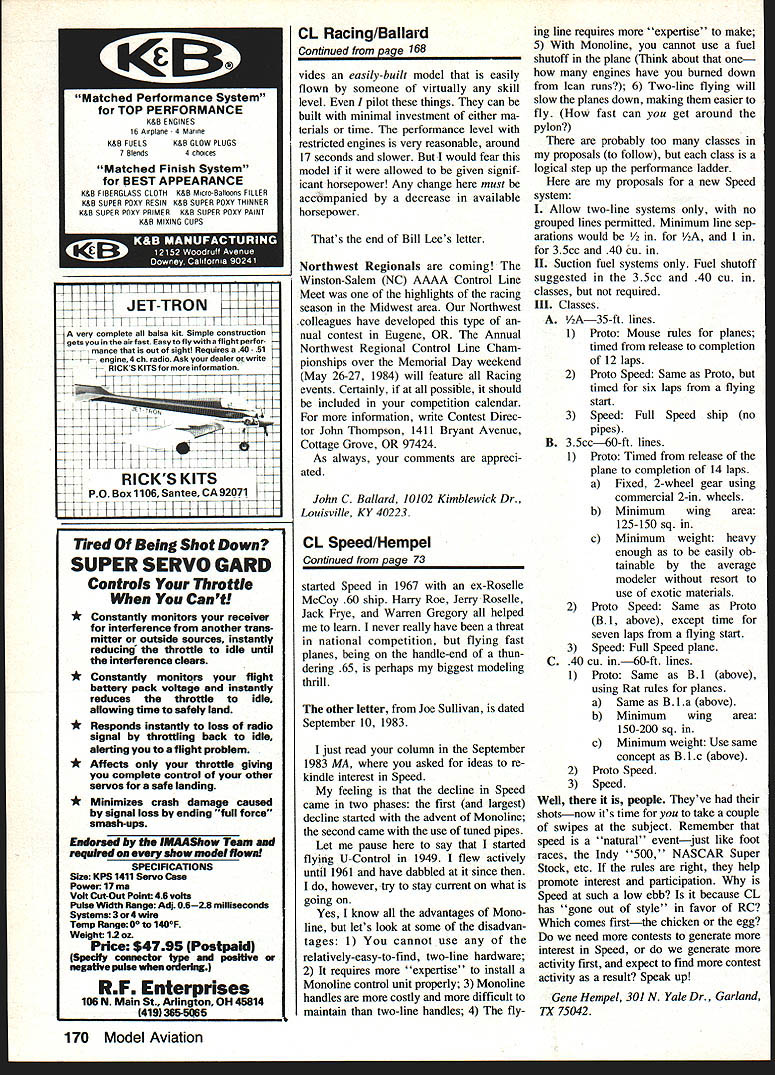
Yes, I know all the advantages of Monoline, but let's look at some of the disadvantages: 1) You cannot use any of the relatively-easy-to-find, two-line hardware; 2) It requires more “expertise” to install a Monoline control unit properly; 3) Monoline handles are more costly and more difficult to maintain than two-line handles; 4) The flying line requires more “expertise” to make; 5) With Monoline, you cannot use a fuel shutoff in the plane (Think about that... how many engines have you burned down from lean runs?); 6) Two-line flying can slow the planes down, making them easier to fly. (How fast can you get around the pylon?)
There are probably too many classes in many proposals (to follow), but each class is logical step up the performance ladder.
Here are my proposals for a new Speed League:
I. Allow two-line systems only, with no shutoffs in the plane. Minimum line separations allowed be 1/2 in. for 1/2A, and 1 in. for .35cc and .40 cu. in.
II. Suction fuel systems only. Fuel shutoff suggested in the .35cc and .40 cu. in. classes, but not required.
III. Classes
A. 1/2A—35-.1 in.
1) Proto: Mouse rules for planes; timed from release to completion of 12 laps.
2) Proto Speed: Same as Proto, but timed for six laps from a flying start.
3) Speed: Full Speed ship (no tires).
B. 3.5cc—60-ft. lines.
1) Proto: Timed from release of the plane to completion of 14 laps.
a) Fixed, 2-wheel gear using commercial 2-in. wheels.
b) Minimum wing area: 155-150 sq. in.
c) Minimum weight: heavy enough to be easily obtainable by the average modeler without resort to exotic materials.
2) Proto Speed: Same as Proto (B.1. above), except timed for seven laps from a flying start.
3) Speed: Full Speed plane.
C. .40 cu. in.—60-ft. lines.
1) Proto: Same as B.1 (above), using Rat rules for planes.
a) Same as B.1(a) above.
b) Minimum wing area: 150-200 sq. in.
c) Minimum weight: Use same concept as B.1.c (above).
2) Proto Speed.
3) Speed.
Well, there it is, people. They've had their shot—now it's time for you to take a couple of swipes at the subject. Remember that Speed is a “natural” event—just like foot races, the Indy “500,” NASCAR Supers, Stock, etc. If the rules are right, they help promote interest and participation. Why is Speed at such a low ebb? Is it because CL is “gone out of style” in favor of R/C? Which comes first—the chicken or the egg? Do we need more contests to generate more interest in Speed, or do we need more activity first, and get more contest activity as a result? Speak up!
Gene Hempel, 301 N. Yale Dr., Garland, TX 75042.
Transcribed from original scans by OpenAI. Minor OCR errors may remain.
Transcribed from original scans by AI. Minor OCR errors may remain.

