
Control Line
Speed
Gene Hempel
I'm elated. The Control Line World Championships ended a few weeks ago, and I am still filled with a great sense of pride—proud because I felt a real friendship for the personnel who pulled together, worked so hard, and made this a momentous event.
It was an honor to be F2A (Speed) Event Director for the Control Line World Championships held at Westover AFB, Chicopee, MA. I would like to thank the members of my staff:
- Frank Garzon
- Glenn Lee
- Bob Lieber
- Cliff Norman
- Al Stegens
- Bill Wisniewski
- Walter Beilmer
- Charlie Davis
The running of F2A involved long hours and hard work—but it really paid off. We were the U.S.A., and we looked very good. More than that, all the guys became friends, and we did something very special. A job well done.
There were approximately 29 nations and 230 competitors registered for the World Champs. On Monday, September 17, there was a special reception given by the Westover Base Commander for the official working personnel and team managers. This allowed each team manager to acquaint himself with each Event Director and have a general bull session.
Tuesday, September 18, was set aside for official practice for all events. The weather was a cool 60°F in the morning, rising to 70°F in the afternoon. I was surprised to see the Speed modelers not utilizing this day to adjust their equipment for the varying weather conditions. I guess this proves that if you have your equipment set up right, there's no need to waste time practicing! A comment made by many competitors was their pleasure at the availability of so much space to practice. This really was an asset to the Team Race and Stunt fliers. There was enough space to accommodate 15 to 20 practice circles. This free time allowed me to discuss different ideas with Speed fliers from different nations. I really enjoyed this.
After the practice flying session ended, we packed all the gear and headed back to the hotel. After a quick bite to eat, we had our first team managers' meeting at 6:00 p.m. This meeting was intended to cover any rules or questions that might arise the next day. After the team managers' meeting, we proceeded to start processing the F2A Speed models. This took longer than anticipated because we had to calculate the wing loading and mark the engine on each model submitted for official flying.
Wednesday, September 19, was the first day of official flying. The day started with fog so thick we had to cancel the 8:00 a.m. start. After the fog lifted at 9:00 a.m., the official flying commenced. Each individual was scheduled 10 minutes to make an official flight. If no official flight was made, a second attempt was scheduled after everyone had completed his first attempt.
There were only 17 official flights out of 37 attempts on the first day of official flying. Gao Guojun of the People's Republic of China had the fastest time of the day with a speed of 166.5 mph (268.0 kph). He was using one of the Chinese-built CSG 2.5 cc engines, which appeared to be a Rossi copy based on outward appearance. The engine utilized a sand-cast case with an ABC cylinder assembly. It was a beautiful job of workmanship. His model utilized the upright engine configuration instead of the side mount which so many other modelers used. The wing had a span of 1,100 mm and weighed 525 g. The prop was a single-blade design with a diameter of 160 mm and a pitch of 145 mm.
The second- and third-best flights of the day were made by Sandor Szegedi of Hungary with a speed of 165.8 mph (266.8 kph) and Ding Yibo of China at 165.3 mph (266.0 kph).
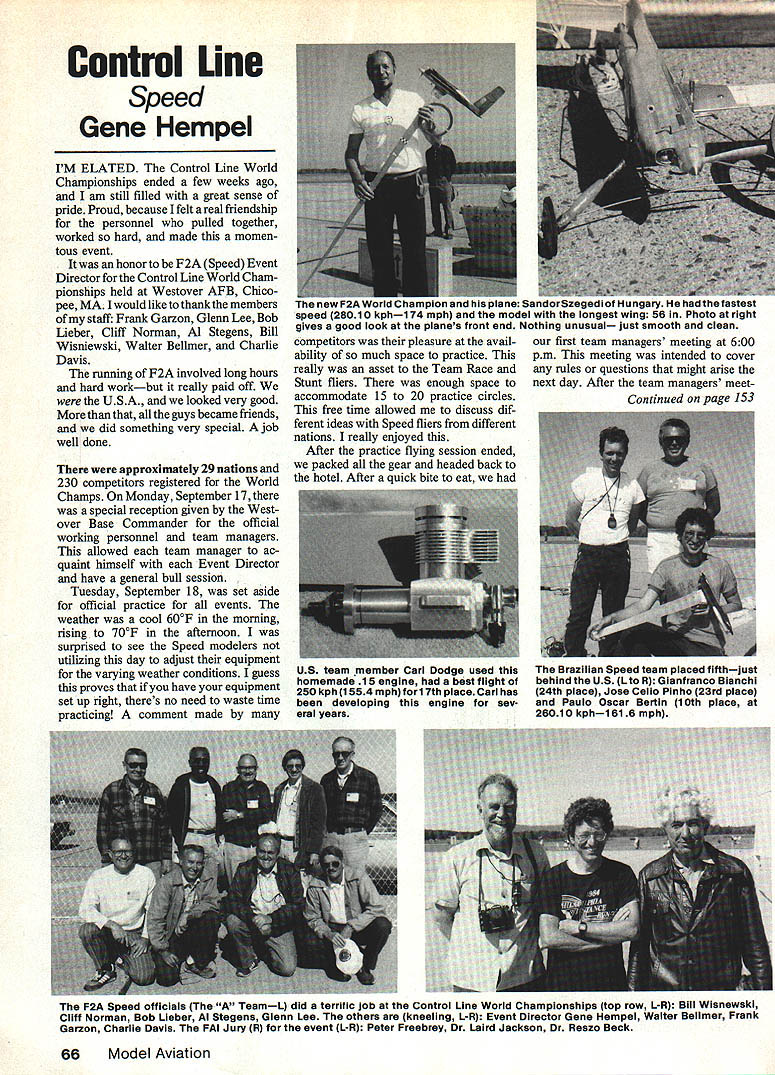
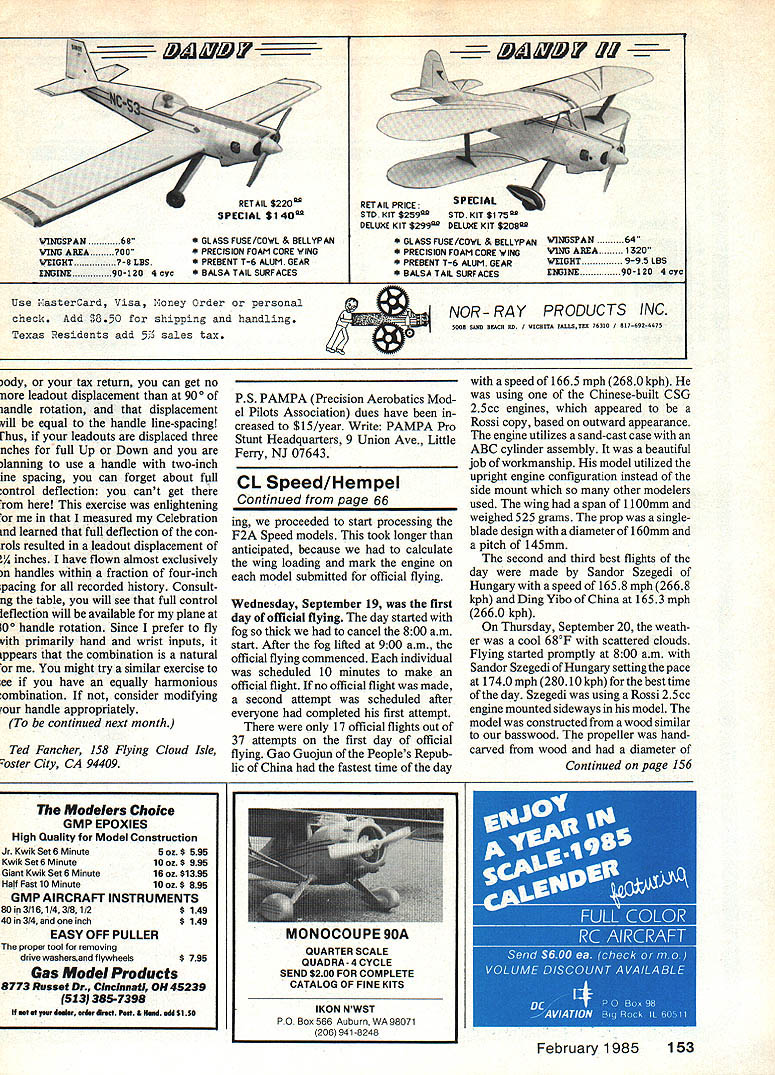
On Thursday, September 20, the weather was a cool 68°F with scattered clouds. Flying started promptly at 8:00 a.m. with Sandor Szegedi of Hungary setting the pace at 174.0 mph (280.1 kph) for the best time of the day. Szegedi was using a Rossi 2.5 cc engine mounted sideways in his model. The model was constructed from balsa and wood similar to our basewood. The propeller was hand carved from wood and had a diameter of 155 mm with a pitch of 6.1 in. The second-best flight was posted by Otello Vitré of Italy at 163.8 mph (263.7 kph) using one of the new OPS 2.5 cc engines. These engines exhibited very good potential for fast FAI Speed. The engines in all of the Italian models were mounted sideways and utilized the single-blade prop design. Gao Guojun had the third-best flight of the day with a speed of 163.7 mph (263.5 kph).
Friday, September 21, was the last official flying day for F2A Speed. The Hungarians really turned it on with the three best flights of the day to capture the World Speed Championship trophy for the second time. The fastest time of the day on Friday was 173.5 mph (279.2 kph). Sandor Szegedi had a time of 173.4 mph (279.0 kph); however, his Thursday flight of 174.0 mph (280.1 kph) was the winning time for the championship. Jozsef Molnar also recorded strong flights, including 172.7 mph (277.9 kph).
All of the Hungarian Speed team members used the Rossi engine and hand-carved, single-blade props. Their models utilized the longest wings—which were made of venetian-blind slats. This really worked quite well. They would mark the pattern desired on the aluminum slat and shear off the excess. Then the upper and lower halves were glued together with a hardwood spar through the center for support and rigidity. The wingspan on these models ranged from 48 to 55 in. The carrying cases for these models were constructed meticulously—just like the models themselves.
Saturday, September 22, was the day everyone was waiting for. This was a momentous event where all the winning competitors accepted their plaques, their national anthems were played, and their country's flag was raised. It was a very emotional event.
The awards banquet was held Saturday evening at the Quality Inn Ballroom with an excellent band playing background music while dinner was served. After dinner, the team trophies were presented, with the Hungarians taking first place, the People's Republic of China placing second, and Italy third. This social event allowed me to talk with different modelers from around the world, discuss different ideas, sign autographs, and swap souvenirs. I loved it. To summarize, the World Championships are rather difficult. I made so many new friends and renewed old acquaintances. I feel this was an opportunity of a lifetime in which to participate.
For the Speed modelers who missed the World Championships, you certainly missed one of the great modeling events of the year.
Gene Hempel 301 N. Yale Dr., Garland, TX 75042
P.S. The table giving all the CLWC Speed results was published on page 124 of the January 1985 issue of MA.
Transcribed from original scans by AI. Minor OCR errors may remain.

