
Control Line: Speed
Gene Hempel
BAN all Control Line Speed events! Well, now that I have your attention, this is no joke. After reading over the new (1986–1987) rules proposals, which should have received their Initial Vote by the time you read this column, I was very disappointed at the number of people who submitted rule proposals (which would affect CL Speed and Racing) that do not fly Speed or other Control Line Racing events. Some do not even seem to understand how a two-cycle engine functions. I'm disgusted!
One example of this is the muffler rule. As written, this would kill Speed events, just so they can be categorized with RC. I say to this: "Moose hockey!" How can Control Line models be categorized with RC models?
I normally do not like to use the Speed column for political rhetoric, but the logic of what is happening is completely beyond my comprehension. The individuals who try so hard to destroy some events must have a very selfish motive. I fear they do not consider the ramifications and future effects of their proposals.
From the letters I have received from modelers, they all share one common philosophy: "If you don't fly the event, you are not qualified to write a rule proposal!" I am tired of hearing the story "Back in '55, I used to fly these events." Well, folks, this is 1985.
Also, this crap about new technology. Who is going to pay for all of this new technology? It certainly isn't the person who made the proposal! He wants someone else to pay for the developmental cost and will then gripe about the cost of the product when it is in the marketplace.
My proposal is: Put your money where your mouth is. It takes dollars to design and build equipment—and not hot air!
Well, now that I have climbed off the soapbox, I feel better.
Visit to the Stanzel Company
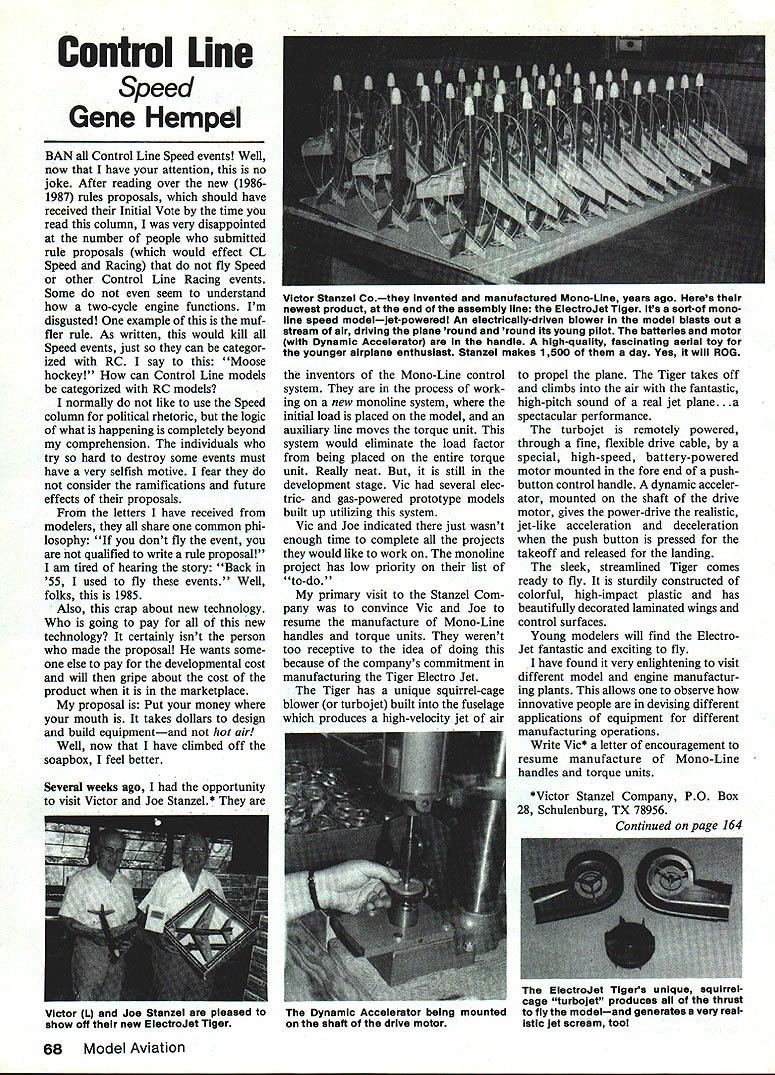
Several weeks ago, I had the opportunity to visit Victor and Joe Stanzel. They are the inventors of the Mono-Line control system and are working on a new monoline system, where the initial load is placed on the model, and an auxiliary line moves the torque unit. This system would eliminate the load factor being placed on the entire torque unit. Really neat. But it is still in the development stage. Vic had several electric- and gas-powered prototype models built up utilizing this system.
Vic and Joe indicated there just wasn't enough time to complete all the projects they would like to work on. The monoline project has low priority on their list of "to-do."
My primary visit to the Stanzel Company was to convince Vic and Joe to resume the manufacture of Mono-Line handles and torque units. They weren't too receptive to the idea of doing this because of the company's commitment in manufacturing the Tiger Electro Jet.
The Tiger has a unique squirrel-cage blower (or turbojet) built into the fuselage which produces a high-velocity jet of air to propel the plane. The Tiger takes off and climbs into the air with the fantastic, high-pitch sound of a real jet plane—a spectacular performance.
The turbojet is remotely powered, through a fine, flexible drive cable, by a special high-speed, battery-powered motor mounted in the fore end of a push-button control handle. A dynamic accelerator—mounted on the shaft of the drive motor—gives the power-drive the realistic, jet-like acceleration and deceleration, when the push button is pressed for takeoff and released for the landing.
The sleek, streamlined Tiger comes ready to fly. It is sturdily constructed of colorful, high-impact plastic and has beautifully decorated laminated wings and control surfaces.
Young modelers will find the Electro-Jet fantastic and exciting to fly.
I have found it very enlightening to visit different model and engine manufacturing plants. This allows one to observe how innovative people are in devising different applications of equipment for different manufacturing operations.
Write Vic a letter of encouragement to resume manufacture of Mono-Line handles and torque units.
Victor Stanzel Company, P.O. Box 28, Schulenburg, TX 78956
Control Line: Speed
Flaps, P‑factor, and Line Tension
allows us to fly a heavier airplane at high G‑loads without exceeding the lift capability of the wing. Note that it is entirely possible to generate more lift than is required, if the flaps are larger than necessary or deflected more than needed. In this case, you suffer all the consequences of lots of negative pitching moment while gaining nothing of value.
Therefore, if our purpose is to make tighter cornering possible, the ideal flap should be no larger than necessary to provide the lift required by the radius of the corner desired. You have, thereby, kept the adverse pitching moment to a minimum. This, in turn, will reduce the force required from the tail to produce the desired rapid change in pitch. Got it?
New subject. At the very root of my difference of opinion with Al and some others about P‑factor, gyroscopic precession, and so forth, is the conviction on their part that Stunters have less tension in outsides than insides. Not so, I say, and submit P‑factor as evidence of the reverse. I will admit that, at times, in a Stunt pattern the ship seems to be on outsides but I still maintain my position with respect to the controversy. How come?
Let's examine the three areas I feel distort our perception of line tension:
- Body (human) asymmetry
- Stunt-pattern asymmetry
- Maneuver placement relative to the wind
We maneuver our Stunters primarily through the manipulation of the flying hand, wrist, elbow, shoulder, and fingers. Of these five components, four are essentially uniform in their ability to input Up and Down control. Only the elbow is unidirectional, aiding only the inside maneuvers. Watch most good Stunt fliers, and you will see the following. The hand, wrist, and fingers will provide the lion's share of control inputs. The shoulder joint will change only a little. The elbow will provide control input exclusively on insides. In addition, the movement of the elbow effectively pulls the model toward us, thus increasing perceived line tension. Neither of these forms of aid—in control or tension—is available in outsides. Experiment doing Inside and Outside Loops, Squares, etc., using wrist action only, and see if you don't agree.
Stunt-pattern asymmetry is a more subtle problem. Due to the rules, we don't accomplish similar—but reversed—maneuvers in the same manner or from the same starting point. Only the Outside Loops are a mirror-image of the Insides, and I think you will agree that outside tension is generally greater. Inside Square Loops start from level flight with a turn up and away from this already good tension entry. Outside Square Loops are entered from a position of poor tension, 45° flight elevation, and start with a dive, wherein gravity is further reducing line tension. We don't do Outside Triangles at all—give them a try, and I think you'll be amazed at the improved line tension in comparison to the insides. The Vertical Eight is obviously discriminatory, as the outsides are done above 45° and the insides below. Worst of all is the Hourglass, wherein the toughest corners of the whole pattern are outsides done at the least advantageous of all positions, directly overhead! Finally, consider what is the most flow-out-of-maneuver of the pattern, bar none. That's right, the first loop of the Four Leaf Clover—the only time in the entire pattern that the ship is allowed to do an inside maneuver above 45° (except the overheads). Where's precision when you really need it? (Now, stop that, Fancher.)
Finally, for most fliers, maneuver placement relative to the wind has a serious effect on outside portions of the Figure Eights and the Four Leaf Clover. The rule book requires that the inside portion of all Figure Eights and the first inside of the Clover be performed first. The flier's natural inclination is to ensure safe entry to the maneuvers, and as a result, most will bias the entry to the left or right. This ensures completion of the outsides (sometimes essential when the Four Leaf is being flown) but puts successful completion of the outside portions at jeopardy, as they will be performed entirely to the left of downwind, if the intersections are held. Again, don't take my word for it. Watch some Stunt patterns flown in a breeze without letting your purpose be known and see if it ain't true.
Okay, I've got my armor on. Let me have it!
Don't be silent about the new rules proposals! Read the summaries in the October, November, and December 1984 issues of Model Aviation. Then write to your District Control Line Contest Board member!
Gene Hempel, 301 N. Yale Dr., Garland, TX 75042.
Transcribed from original scans by AI. Minor OCR errors may remain.

