
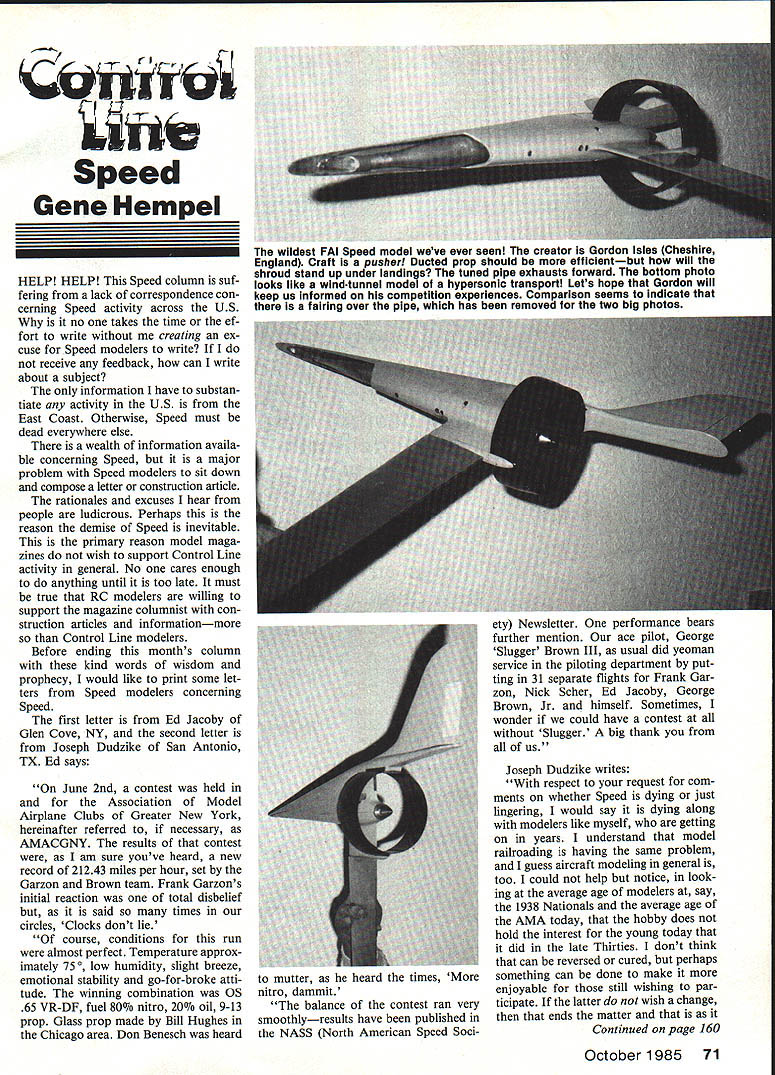
Control Line: Speed
Gene Hempel
HELP! HELP! This Speed column is suffering from a lack of correspondence concerning Speed activity across the U.S. Why is it no one takes the time or the effort to write without my creating an excuse for Speed modelers to write? If I do not receive any feedback, how can I write about a subject?
The only information I have to substantiate any activity in the U.S. is from the East Coast. Otherwise, Speed must be dead everywhere else.
There is a wealth of information available concerning Speed, but it is a major problem with Speed modelers: sit down and compose a letter or construction article. The rationales and excuses I hear from people are ludicrous. Perhaps this is the reason the demise of Speed is inevitable. This is the primary reason model magazines do not wish to support Control Line activity in general. No one cares enough to do anything until it is too late. It must be true that RC modelers are willing to support the magazine columnist with construction articles and information—more so than Control Line modelers.
Before ending this month's column with these kind words of wisdom and prophecy, I would like to print some letters from Speed modelers concerning Speed.
Letter from Ed Jacoby — Glen Cove, NY
"On June 2nd, a contest was held in and for the Association of Model Airplane Clubs of Greater New York (AMACGNY). The results of that contest were, as I am sure you've heard, a new record of 212.43 miles per hour, set by the Garzon and Brown team. Frank Garzon's initial reaction was one of total disbelief but, as it is said so many times in our circles, 'Clocks don't lie.'
"Of course, conditions for this run were almost perfect. Temperature approximately 75°, low humidity, slight breeze, emotional stability and go-for-broke attitude. The winning combination was OS .65 VR-DF, fuel 80% nitro, 20% oil, 9x13 prop. Glass prop made by Bill Hughes in the Chicago area. Don Benesch was heard to mutter, as he heard the times, 'More nitro, dammit.'
"The balance of the contest ran very smoothly—results have been published in the NASS (North American Speed Society) Newsletter. One performance bears further mention. Our ace pilot, George 'Slugger' Brown III, as usual did yeoman service in the piloting department by putting in 31 separate flights for Frank Garzon, Nick Scher, Ed Jacoby, George Brown, Jr. and himself. Sometimes, I wonder if we could have a contest at all without 'Slugger.' A big thank you from all of us."
Letter from Joseph Dudzike — San Antonio, TX
"With respect to your request for comments on whether Speed is dying or just lingering, I would say it is dying along with modelers like myself, who are getting on in years. I understand that model railroading is having the same problem, and I guess aircraft modeling in general is, too. I could not help but notice, in looking at the average age of modelers, at, say, the 1938 Nationals and the average age of the AMA today, that the hobby does not hold the interest for the young today that it did in the late Thirties. I don't think that can be reversed or cured, but perhaps something can be done to make it more enjoyable for those still wishing to participate. If the latter do not wish a change, then that ends the matter and that is it.
"If they do wish a change, then perhaps a suggestion would be welcome.
"As for myself, I would suggest a change, and I think the elimination of the pipe and monoline would be in the direction of making it more attractive to the old-timers still around who may still have an interest to be rekindled.
"When it came out, I thought that Proto Speed had much to commend it. How about a Proto Speed for class D—but with a difference? In addition to a wing area rule and a cross section rule of a generous size, perhaps add a 3/8-in. landing gear with decent-size wheels to save on the expensive propellers and make it easier on the oldsters to actually fly the models. I do imagine that the reflexes which are required for a 200 mph model make it essentially a young man's game.
"In other words, if you are not attracted to the young, perhaps it might be worthwhile to try to attract some of the oldsters—just to get more people out there. To try it out, you needn't have to go so whole hog as to create a new class, but rather: perhaps a sponsor could be found to donate some suitable prizes to be given at the next Nationals for the fastest plane which conformed to the informal rules. In other words, the prize itself would provide the rules, and the planes could be timed just as any other class D model at the Nationals. Well, that is enough of my thoughts, and I certainly enjoy your column in Model Aviation."
Maybe I'll have a happier outlook after the '85 Nats is over. We'll see. Look for my next Speed column sometime after the annual Nats issue of Model Aviation.
Gene Hempel 301 N. Yale Dr., Garland, TX 75042.
Transcribed from original scans by AI. Minor OCR errors may remain.

