
Control Line: Speed
By Gene Hempel
Special Report
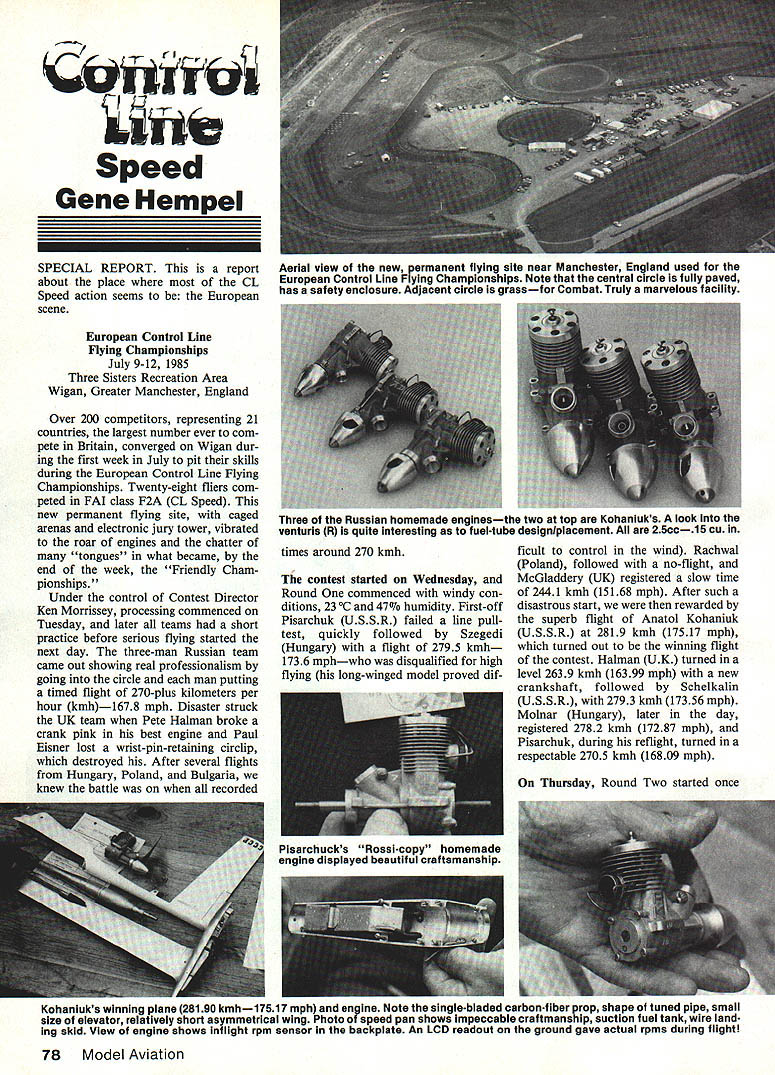
This is a report about the place where most of the CL Speed action seems to be: the European scene.
European Control Line Flying Championships
July 9–12, 1985 Three Sisters Recreation Area, Wigan, Greater Manchester, England
Over 200 competitors, representing 21 countries—the largest number ever to compete in Britain—converged on Wigan during the first week in July to pit their skills during the European Control Line Flying Championships. Twenty-eight fliers competed in FAI class F2A (CL Speed). The new permanent flying site, with caged arenas and an electronic jury tower, vibrated to the roar of engines and the chatter of many tongues in what became, by the end of the week, the "Friendly Championships."
Under the control of Contest Director Ken Morrissey, processing commenced on Tuesday, and later all teams had a short practice before serious flying started the next day. The three-man Russian team came out showing real professionalism by going into the circle and each putting up timed flights of 270-plus kilometers per hour (km/h)—about 167.8 mph. Disaster struck the U.K. team when Pete Halman broke a crank-pin in his best engine and Paul Eisner lost a wrist-pin-retaining circlip, which destroyed his engine. After several flights from Hungary, Poland, and Bulgaria, we knew the battle was on when recorded times clustered around 270 km/h.
The contest started on Wednesday. Round One commenced in windy conditions, 23°C and 47% humidity. First off, Pisarchuk (U.S.S.R.) failed a line-pull test. Szegedi (Hungary) followed with a flight of 279.5 km/h (173.6 mph) but was disqualified for high flying—his long-winged model proved difficult to control in the wind. Rachwal (Poland) recorded a no-flight, and McGladdery (U.K.) registered a slow time of 244.1 km/h (151.68 mph). After such a disastrous start for some, we were rewarded by the superb flight of Anatol Kohaniuk (U.S.S.R.) at 281.9 km/h (175.17 mph), which turned out to be the winning flight of the contest. Halman (U.K.) turned a level 263.9 km/h (163.99 mph) with a new crankshaft, followed by Schelkalin (U.S.S.R.) at 279.3 km/h (173.56 mph). Molnar (Hungary), later in the day, registered 278.2 km/h (172.87 mph), and Pisarchuk, during his reflight, turned a respectable 270.5 km/h (168.09 mph).
On Thursday, Round Two started with increasing wind, 20°C and 57% humidity. First off, Vita (Italy), with a new OPS, registered 256.2 km/h (159.20 mph), followed by Schelkalin repeating his first-round time of 279.3 km/h. Later, Kitipov (Bulgaria) came close on his heels with 271.7 km/h. The contest stopped midday for an FAI jury check; wind speed proved well within the required limit. FAI rules permit interruption when wind speed exceeds 12 meters/sec (26.8 mph).
Round Three commenced Friday with the windy conditions easing slightly, 21°C and 62% humidity. Zanin (Italy) flew first, followed by Chojnacki (Poland), who improved his first-round time to 264.9 km/h (164.61 mph). Szegedi (Hungary) improved to 278.0 km/h (172.75 mph). Kohaniuk slowed to 279.9 km/h (173.19 mph) in that round, which temporarily placed him fifth for the round.
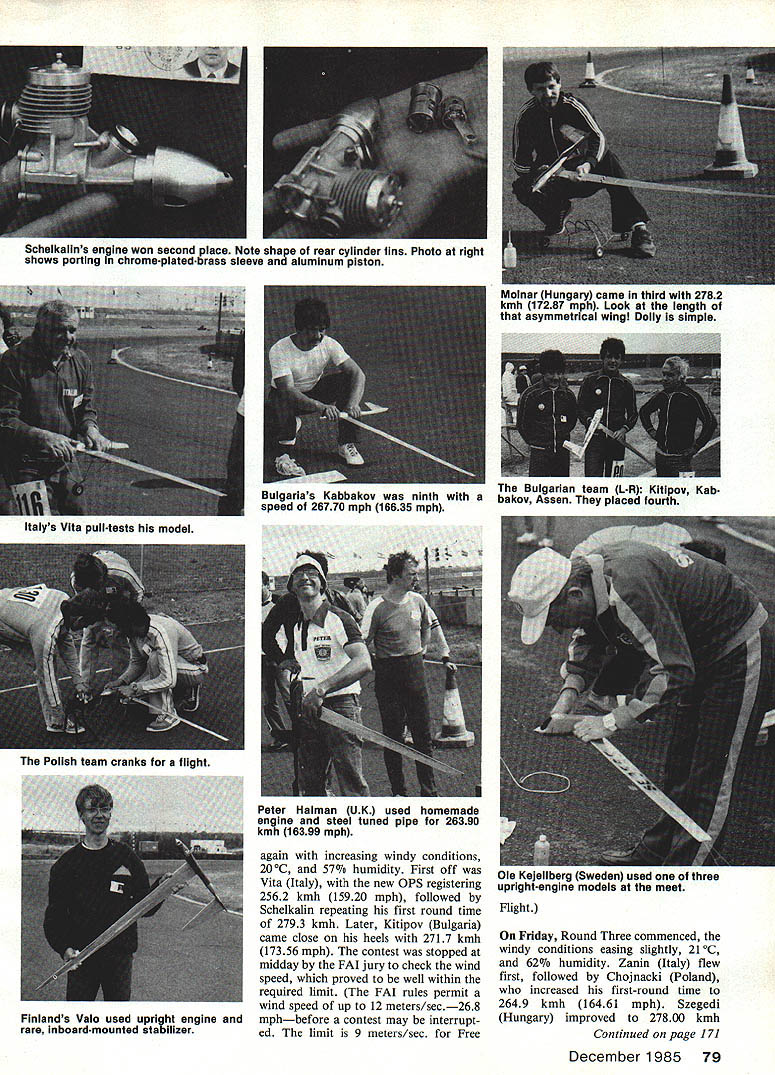
On the technical side of the contest, most competitors used old-style Rossi .15 engines, with the Bulgarians using the latest type; Zanin and Vita (Italy) used ever-improving OPS motors; and Halman (U.K.) ran his own-made motor with a steel pipe. The surprise of the week was the Russians, each with his own-made motors. Kohaniuk had three different prototypes, the latest with an in-flight rpm counter, a five-port aluminum liner, aluminum piston, and a chrome-plated liner built to perfection. Second-place Schelkalin had a four-port masterpiece, and Pisarchuk an excellent Rossi copy.
Most competitors used exhaust timing between 188°–194° and transfers of 128°–135°, with 36,000 rpm the target. All entries used single-blade propellers (the Hungarians and Bulgarians used wood, while the Russians preferred carbon-fiber/epoxy). Sidewinder asymmetric models on suction tanks were flown except for three upright Kingfishers flown by Pisarchuk (U.S.S.R.), Ritenburger (Netherlands), and Schmidt (FRG), all using centrifugal fuel switches and pressure tanks. Pipes were Rossi, OPS, or homemade, with small tailpipe diameters between 4 mm–5 mm and various volumes and lengths to suit each individual engine.
I would like to thank Ken Morrissey for helping me pull all this information together and for the generous hospitality of his friendship on my recent visit to England.
Results: European Control Line Championships
FAI Class F2A — Speed Individual Performance
- A. Kohaniuk U.S.S.R. 281.90 km/h 175.17 mph
- S. Schelkalin U.S.S.R. 279.30 km/h 173.56 mph
- J. Molnar Hungary 279.00 km/h 173.36 mph
- S. Szegedi Hungary 278.00 km/h 172.75 mph
- J. Muli Hungary 271.10 km/h 168.33 mph
- V. Pisarchuk U.S.S.R. 270.50 km/h 168.09 mph
- G. Nowakowski Poland 269.90 km/h 167.54 mph
- G. Kablakov Bulgaria 267.90 km/h 166.35 mph
- T. Chojnacki Poland 266.90 km/h 165.34 mph
- P. Halman U.K. 263.90 km/h 163.99 mph
- A. Zanin Italy 263.50 km/h 163.94 mph
- A. Rachwal Poland 262.80 km/h 163.30 mph
- O. Vita Italy 262.30 km/h 162.97 mph
- J. Horvath Italy 255.50 km/h 158.77 mph
- T. Assen Bulgaria 252.60 km/h 156.87 mph
- R. Rettbergen Netherlands 244.40 km/h 151.84 mph
- R. McGladdery U.K. 241.10 km/h 149.87 mph
- J. Schmidt FRG 240.00 km/h 149.13 mph
- N. Bjork Sweden 233.80 km/h 145.23 mph
- O. Kejelberg Sweden 237.80 km/h 147.72 mph
- M. Forster FRG 226.60 km/h 140.81 mph
- P. Eisner U.K. 221.10 km/h 137.31 mph
- J. Magne France 211.40 km/h 131.31 mph
- F. Marksteiner Austria 0.00 km/h 0.00 mph
- J. Vala Finland 0.00 km/h 0.00 mph
- J. Urban Switzerland 0.00 km/h 0.00 mph
- T. Borner Switzerland 0.00 km/h 0.00 mph
Team Results
- Hungary
- U.S.S.R.
- Bulgaria
- Italy
- United Kingdom
- Sweden
- Federal Republic of Germany (FRG)
- Netherlands
- Austria
- Finland
- Switzerland
- France
Gene Hempel 301 N. Yale Dr., Garland, TX 75042.
Transcribed from original scans by AI. Minor OCR errors may remain.

