
Control Line: Speed
Gene Hempel
.21 Fun Speed
FUN. It's in the form of .21 Fun Speed. Please read on for more information. This month's column covers an entry-level Speed event designed for young folks, middle-aged folks, old folks, and folks who would like to bring the fun back into Speed flying. This will be run as an unofficial Speed event held in conjunction with the 1986 AMA Nationals at Lake Charles, LA. The monies for the trophies will be put up by Gene Hempel and Charlie Davis. The event will be designated ".21 Fun Speed."
In response to numerous letters and phone calls concerning this event, the following rules were suggested. Please read very carefully to make sure you understand each step.
Rules for .21 Fun Speed
- Any .2135 cu. in. displacement engine.
- A mini-pipe or open exhaust system may be utilized. A mini-pipe cannot be any longer than 6 in. measured from the centerline of the cylinder bore to the edge of the pipe. The inside diameter must be constant on the mini-pipe.
- Fuel formula shall consist of 10% nitro, 70% alcohol, and 20% oil. The oil shall consist of a mixture of half castor oil and half synthetic oil to make up the 20% total oil mixture by volume.
- No single-blade props allowed.
- No asymmetrical or sidewinder-type models allowed.
- The engine must be mounted in either an upright or inverted position.
- There can be only a 1 in. differential between the lengths of the left and right wings. This dimension will be measured from the fore-and-aft centerline of the model.
- No profile models allowed.
- The Speed model can be designed with or without a metal speed pan.
- A. The model must be flown on two .016-in. OD solid lines.
B. The length of the two lines must be 60 ft. This distance will be measured from the center point of the grip portion of the control handle to the fore-and-aft centerline of the model.
- The flying lines must be hooked up to the wing leadouts of the model utilizing the large Pylon brand speed clips. No exception to this rule.
- No stranded or braided leadouts allowed on the model.
- The model will be timed for seven laps.
- Fuel will be furnished by contest management.
- Try it—you might like it!
Modelers interested in flying Speed cannot use the excuse of no products available for this event! There are numerous .21-size engines available, and Nick Arpino (East Patchogue, NY) has indicated he has an ample supply of the Darp "A" speed pans. I will attempt to build one of the Darp speed pans. If modelers let me know, I'll report progress. Also, I would like to see some photos of models and ideas to share with others. Let's get the program going. No excuses.
The following is a letter from Glenn Lee (Batavia, IL) concerning the "status quo" of Speed flying.
IS SPEED FLYING DYING?
By Old Gray (used to be Old Blue)
The recent rule proposals to ban tuned pipes finally aroused a few people—even some who don't fly Speed complained bitterly! The proposal was defeated, but there is another round coming up this year.
A few of you may have noticed that I almost quit flying A and B Speed a few years ago. The reason was that I just got tired of making parts! If you get a good run on a pipe, the piston is usually shot, and parts for foreign-made engines are rarely available. I didn't see a single .29 Speed engine for sale at Toledo! I doubt if I'll ever buy another engine with metric screws, and I'm tired of importers who won't import parts. When parts finally arrive, the design has changed so the parts won't fit previous engines.
What I did with my old A and B ships was to put a mini-pipe on both. Lo and behold—it was fun again! I could get flight after flight, just like D Speed and Formula 40. I could use all those bigger props that would never work on a pipe. I didn't have to change anything, either. After all, our D engines work just fine with no pipe, even with pipe timing, and the A and B jobs do, too. I didn't have to put in a $47 bearing, either!
Another thought: none of the people complaining about possible Speed restrictions have ever tried to set a world Speed record. Those rules are wide open; why haven't you tried?
So much for the past; how about the future? What can we do to bring in some young Speed fliers? Can't we come up with a reasonable event that would interest other modelers or potential modelers? A fun event? An event where you have plenty of relatively inexpensive, readily-available engines? An event where models are large enough to be stable but not so large they drag a kid around? An event that doesn't require 80% nitro or all the complications of getting a tuned pipe to work? An event that wouldn't destroy an engine on a good run? An event that is easy enough for novices or old, crippled-up Speed fliers?
I would like to get people interested in an event with possible rules like this:
- 3.5 cc engine — About 15 varieties are available; low-priced; parts are available; and they are good engines.
- FAI fuel or, better yet, 10% nitro — Any hobby shop has 10% fuel; low-priced; easy on engines; runs great.
- Mini-pipe or open pipe — So we can run a metal pressure tank or bladder and get speeds around 150 mph.
- Monoline or two-line — Same lines as A Speed.
- Allow other — Plenty safe, and they fly fine.
Call it Sport Speed or whatever you want to, but it sounds like a fun event. Don't restrict it to Juniors, 'cause I want to fly it!
Afterthoughts: If high-nitro fuels are unsafe in Racing events, aren't they unsafe in Speed, also? What if they pass a safety rule to allow only 10% nitro fuel in Speed events? Could happen!
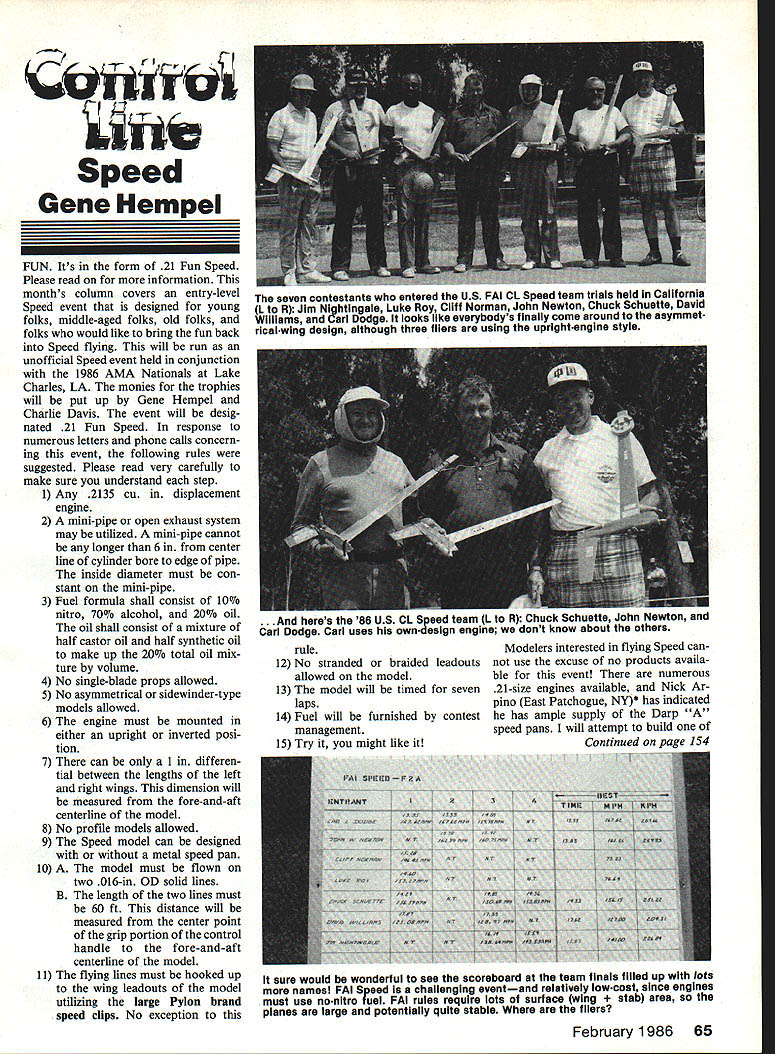
Dale Kirk mailed a few photos of the recent FAI team trials held at Whittier Narrows, CA. Dale indicated he was rather surprised that seven entries showed and everyone got at least one official flight.
Carl Dodge, of Ohio, was consistent with his two 167.62 mph flights on Saturday. The weather was good for both days, and there were quite a few spectators.
The members of the 1986 FAI Control Line Speed team trials consisted of:
- Carl Dodge (Ohio) — 167.62 mph
- John Newton (California) — 161.56 mph
- Chuck Schuette (Washington) — 156.15 mph
Congratulations, gentlemen.
Nick Arpino's address: 301 Wood Acres Rd., East Patchogue, NY 11772.
Gene Hempel: 301 N. Yale Dr., Garland, TX 75042.
Transcribed from original scans by AI. Minor OCR errors may remain.

