
Control Line: Speed
Gene Hempel
Wait—before we succumb to being mesmerized into flying Sport Jet Speed, I wish to thank all of the modelers who took the opportunity to write to me. I was indeed overjoyed by the number of letters (over 100) received to date, and more are still coming in. I hope this is an indication of modelers' interest in having more fun at Speed flying.
I must apologize to Charlie Davis for not mentioning his address in my recent Jet Speed column. If it were not for Charlie's diligence in making Jet Speed flying easy, that article would not have seen print. Please drop Charlie a note expressing your interest in Sport Jet Speed. Mail a self-addressed, stamped envelope (SASE) to Charlie Davis, 6908 Sandybrook Dr., Ft. Worth, TX 76112.
I've had enthusiastic letters about .21 Sport Speed. It's liked because it is an easy event. The major gripe about flying some of the other Speed events was the cost of engines, parts, and the too-frequent, traumatic cases of burning engines down.
We have fooled ourselves into believing that Speed is fun. Wrong! If you want to go fast, you have to pay the price. There are a few willing souls who will put forth such an effort, and money is no obstacle.
The primary intent of .21 Sport Speed was to allow anyone with a low-dollar budget to fly Speed. The .21SS rules forbid anything other than 10%-nitro fuel, and this restriction keeps people from burning down too many engines. However, if you try really hard, it can still be done.
Looking over the number of entries at the Speed contests across the U.S., it appears that this event is quite successful.
New product: I recently received a sample of a new product called "Slip-It." This formulation, developed by Micro Research, Inc., is a truly different idea in lubricants. The active lubricating ingredients are suspended in a medium that penetrates into small crevices and then evaporates rapidly, leaving a lubricating coating with remarkable properties. It has excellent coating and adhering qualities on metals, plastics, and composite materials. It cures rapidly and can be used immediately upon application.
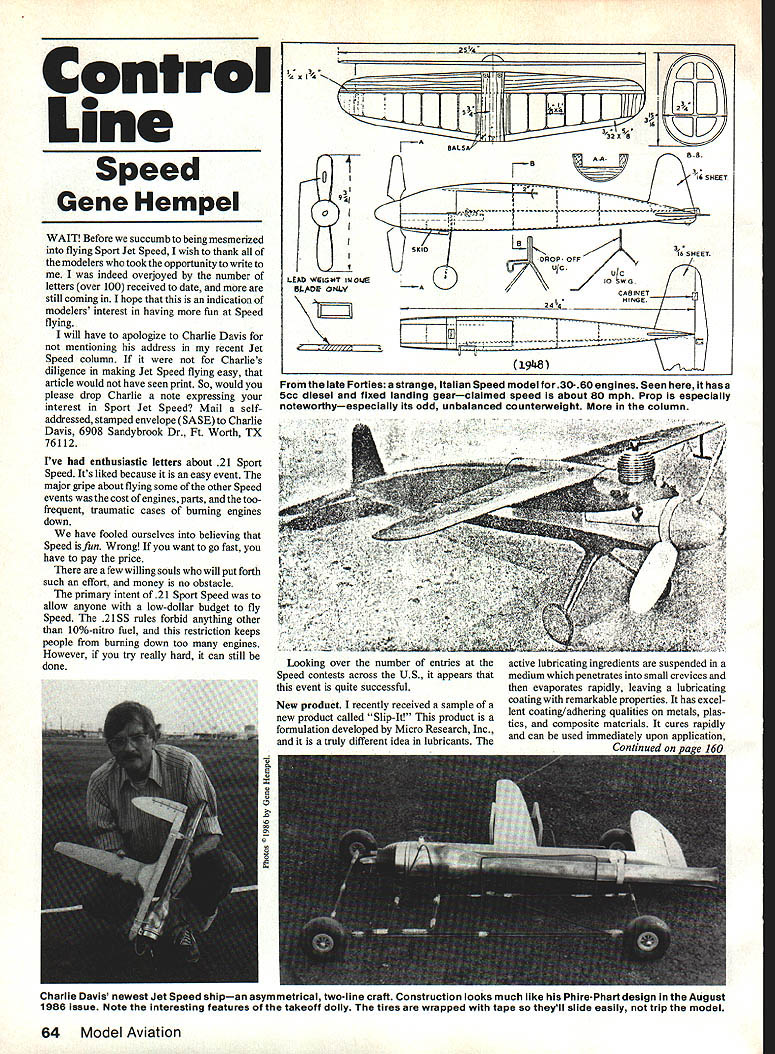
Old news: While cleaning out the desk files, I found an interesting Control Line Speed article from the late 1940s. I thought you might enjoy reading how props were balanced for this particular application.
Description
The Movo M.31, designed by the research department of the well-known Italian Movo diesel engine and model aircraft company—probably the largest in that country—offers a number of points of interest to Speed fliers. The high-shoulder-wing layout departs from the usual low-wing or mid-wing layout for Speed while simplifying construction. The undercarriage is of the drop-off type, using a single-prong fixing centered by a guide over the landing skid. Versions are also flown with fixed, streamlined undercarriage and in this rig have clocked over 80 mph with a 5 cc engine.
Construction is mainly in hardwood—poplar or similar woods being used—with balsa employed only for fairings. An innovation is seen in the fixing of the elevators, where small cabinet hinges are used, screwed into the hardwood in the normal way.
The propeller of walnut may excite comment, both on account of its wide, almost paddle-like blades and its deliberate imbalance, achieved by letting a small block of lead into one blade only. In action, this appears to give the flywheel effect claimed for it, but how the engine stands up to it is not known. Several Italian designs have, however, featured this curious departure.
The M.31 is designed to use engines from 5 cc to 10 cc, either petrol or diesel, while it seems particularly suited to one of the 5 cc glow-plug engines, such as the Sportsman McCoy. The mainplane is designed for removal for access to the control arrangements or for ease of transport. Note also that it is set at a positive incidence of 2°.
Dimensions
- Overall length: 27 in.
- Wingspan: 25¼ in.
- Root chord: 5⅜ in.
- Tailplane span: 11¾ in.
- All-up weight: approximately 2¾ lb.
- Power: .035, petrol or diesel
- Speed: up to 110 mph, according to engine used
Gene Hempel, 301 N. Yale Dr., Garland, TX 75042.
Transcribed from original scans by AI. Minor OCR errors may remain.

